


One of the biggest mistakes I see is people wanting to ad-lib or tweak scripts too early. They hear a framework that works, try it a few times, and then start changing words or jumping to a different script altogether. That’s how you fail.
Multiple touches and conversations before a yes are normal. If you change scripts or use someone else’s before you’ve locked one in 100+ times, you never give it the chance to condition.
Once it’s conditioned over and over again, then you can tweak it. At that point, your natural language starts to take over and fit into the framework.
That’s where the Middleman Framework comes in.
This is a framework gifted to us by BAM board member Sharran Srivatsaa, and it’s designed for agents who are having conversations but still struggling to convert those conversations into appointments.
The idea is this: someone else makes the call for you, positions you as the expert, and sets the appointment.
And when agents actually use it consistently, it moves the needle fast.

The Rule You Can’t Break
Before the scripts, one rule:
Never say, “I have a buyer.” Always say, “We have a client.”
The middleman uses “we” to elevate the agent they’re calling for. Every call is about positioning and setting the appointment, not pitching.
If you have an ISA, great. If not, find someone in your office or even another agent inside BAMx and swap calls. The goal is simple: create more appointment-setting conversations.
The goal of every middleman call is to set the appointment. You’re not trying to sell. You’re opening the conversation, positioning the agent correctly, and letting the framework do the work.
Now, let’s get into two middleman scripts:
- Buyer-side
- Expired listing
Buyer-Side Middleman Scripts
Here’s exactly what that sounds like.
“Tom, Hi. This is Byron calling from the office right here in [city]. Fidel asked me to give you a call because we have a client who has two children. They’re looking for a bigger home, and they need to buy here in the next four months.”
Make it very specific to the client’s needs.
You’re putting this all about the family you’re trying to help, and you’re putting that agent, Fidel, in this case, up on a pedestal.
Then you move into the neighborhood framing.
“We promise our clients that we’ll try and call every single homeowner in the neighborhood just to see if they know anyone who’s thinking of selling or even renting their home.”
This works even if they’re not selling. We’ve framed the call as a promise to our clients.
In Fidel’s case, you can switch this up for any buyer you have in your database.
“Hey, I know you just spoke to Fidel. He’s working with our clients. They’ve got two kids, and he made a promise to them that we’d try to call every homeowner in your neighborhood to see if anyone’s selling this season.”
“Now, I know you and Fidel had a conversation last year about being on the market and ultimately not selling. Would it make sense for you to meet with him and see if these clients are a fit?”
If they’re selling, you set the appointment. If they’re not selling, it doesn’t matter. The framing is about the promise.
Close simply:
“Would it be okay if I emailed or texted you our contact information? That way, if you hear of anything, let us know, because it would really help our client’s family.”
Subtleties matter on the phone. There’s no eye contact. There’s no body language. The language and the tonality are doing all the work.
Expired Listing Middleman Script
Again, the goal here is setting the listing appointment.
The middleman’s job is threefold:
- Position the agent
- Secure the appointment
- Get out of the way
They’re not there to explain everything. Leave that to the agent you’re calling for.
Here’s exactly how the expired listing middleman conversation sounds:
“Hi, is this Tom?”
Seller:
“Yeah. Who’s this?”
Byron:
“Hey, Tom, it’s Byron Lazine from One Team right here in Guilford. Fidel asked me to give you a quick call about your home on 123 Main Street. Is now a terrible time?”
If it’s not a great time, that’s fine. You acknowledge it and stay brief.
“You spoke with Fidel last week about your home, and I know not selling last year probably wasn’t the outcome you wanted when you first put it up for sale.”
“The reason Fidel asked me to reach out is because we’re working with a couple of clients who just came in this last week and are specifically looking in your neighborhood, and they’re in your price range.”
“Your home, like on the MLS, is exactly the type that keeps coming up in those conversations.”
“We know you’re not active right now, but Fidel specializes in helping owners just like you with your home who didn’t sell the first time actually get it moved.”
“So based on that and these buyers we have, your situation is literally what he works on every week.”
“I know you’ve got to go, so I’m going to be brief. We’re offering a quick, no-pressure strategy visit where Fidel comes by for 20 minutes, takes a look at the property, and walks you through exactly what he would do differently this time to get you to your original goal.”
This is where preparation matters. Fidel already had a conversation before lining up the middleman. He should have notes in the CRM. You should know where they were going and what their plan was.
That way you can say:
“This is about giving you a clear plan and options. If it makes sense, great. If not, at least you’ll know.”
Then you move straight to the close.
“Fidel asked me to see if you’d be open to that. We’ve got tomorrow at 5, Wednesday at 6, or Thursday at 6. Which works better for you?”
Seller:
“Thursday could work, but what are you going to do differently? I’ve gotten this call from about 15 different people.”
Byron:
“Fidel specializes in a sell-for-more plan, and we don’t want to take up a bunch of your time because you might not be selling. It’s a 20-minute walkthrough where he builds the plan so you can compare what didn’t work last year versus the decisions you might make this year for you and your family.”
“If Thursday at 6 works, I’m going to go ahead and get you set up with Fidel. I’ll put you on a group text with Fidel right now, and you’ll get a confirmation text.”
Then you lock it in with confidence.
“If anything were to happen between now and Thursday at 6, you’ll let us know, right?”
That language shows you’re confident. You’re not begging for the appointment. You’re operating like a professional with a full schedule.
Once they say yes, you stop talking.
“Fidel’s going to see you Thursday at 6.”
The middleman’s job ends there.
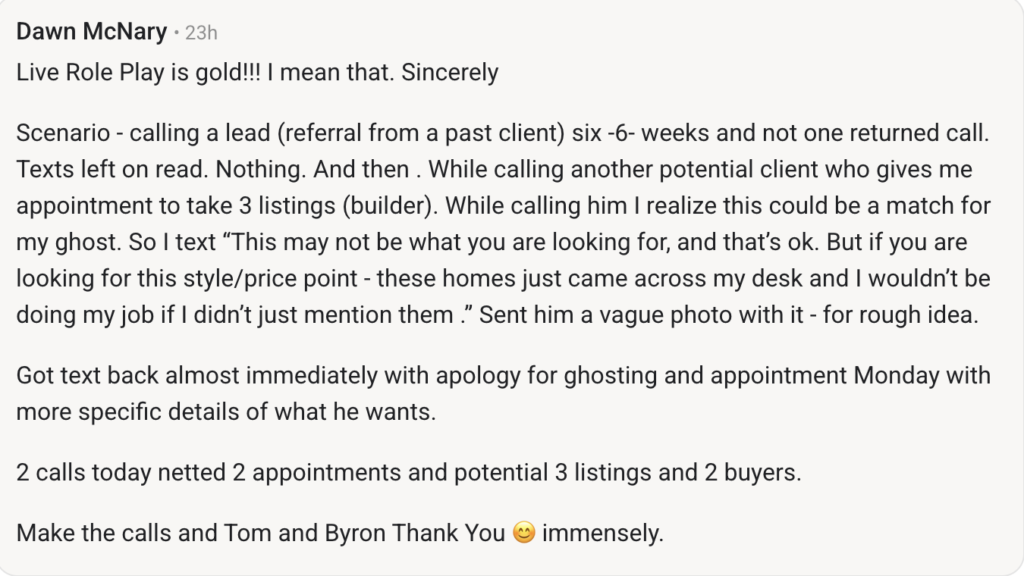
Here’s an example from one of our BAMx members
BAMx member Dawn had a referral from a past client who went completely silent. Six weeks. No callbacks. Texts left on read.
Instead of writing him off, she used a live roleplay and the scripts inside BAMx. She sent one simple, low-pressure text tied to a real opportunity. No chasing. No pitch.
He replied almost instantly. He apologized for ghosting and booked an appointment with clear details on what he wanted.
That same day, two calls turned into two appointments, with the potential for three listings and two buyers.
Great prospecting isn’t about pushing harder. It’s about saying the right thing at the right time.
This is something we practice every week with our BAMx members in live Role Play Masterminds. Members get the scripts, the reps, and real-time feedback so these conversations become second nature.
Not a BAMx member yet? Sign up for a free 7-day trial to get full access.