
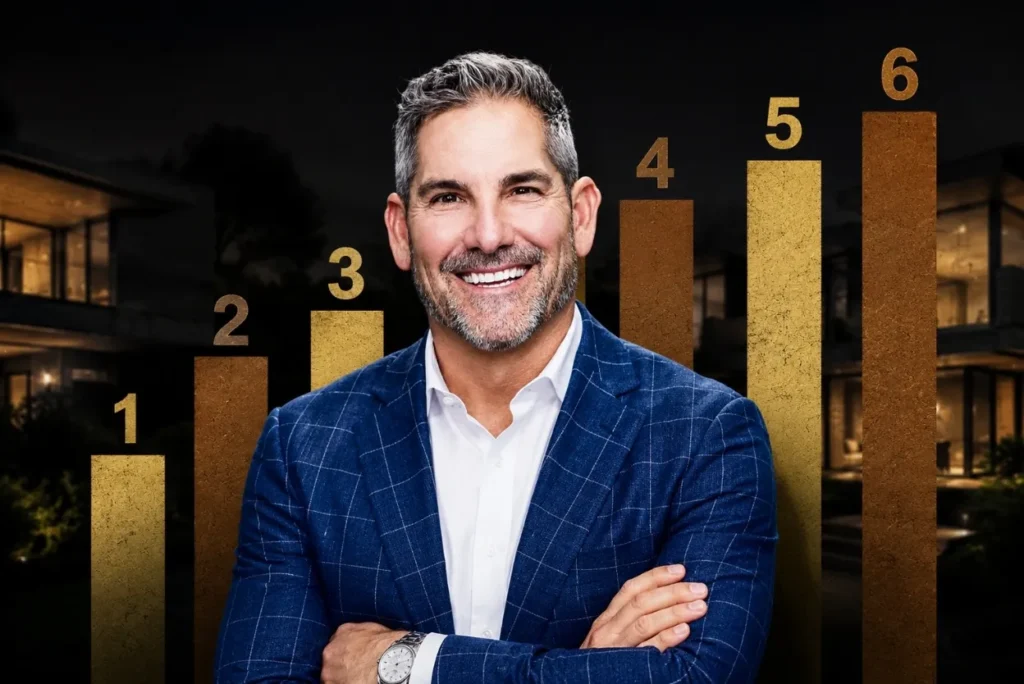


Grant Cardone built one of the most recognized sales training brands in the world before becoming one of the largest private owners of multifamily real estate in North America.
In a recent episode of The Playmakers Podcast, RealScout co-founder and CEO Andrew Flachner sat down with Cardone to discuss everything from sales fundamentals to financial literacy to his take on the housing market
Here are the six sales lessons for real estate professionals that stood out, including the mistake that costs most agents deals.
1. Real estate is a contact sport, not an open house game
Most agents got into real estate because they love helping people buy and sell homes. That’s fine. But Cardone’s point is that loving real estate and being good at selling are two different things, and a lot of agents have never separated the two.
He knows this firsthand. Nobody taught him sales either.
“I was not good at sales. I was not good at meeting people… I didn’t know what I was doing. Nobody taught me sales. I’d spent 17 years in schools. Nobody taught me the sales game.”
After listening to a tape from a professional salesperson, he realized there’s a strategy when it comes to sales. It was then he started treating sales like a technical discipline worth mastering. He spent two hours a day studying it for five years: qualification, decision-making psychology, buying signals, how to identify who’s actually in the room and what they need.
“Most real estate agents do not understand the technical game of sales. It’s not an open house game. It’s a contact sport. It’s qualification. It’s finding out who’s in front of you… And I just think a lot of people in real estate don’t take the time to really learn the sales game.”
2. You should be buying the real estate you’re selling
Every day agents, are in the field, seeing deals before the general public does. You’re being paid to have access to inventory. That’s deal flow most investors would pay to have, and you’re getting it as a byproduct of your job.
“I think more real estate agents should be buying the real estate they’re selling. Own it. Don’t sell it.”
What Cardone is saying is if you’re so focused on the transaction fee that you’re never thinking about the asset itself, you’re collecting a commission on something you could have owned.
3. Follow-up is where deals are lost
This one is personal for Cardone. It’s also the reason most agents are losing business.
Years ago, Cardone says he bought a house while working with an agent named Mimi Starrett. He paid $8 million. He later sold it for $19 million—with a different agent.
Mimi didn’t follow up after the sale, so she didn’t get the listing and she hasn’t gotten a deal from him since. That’s a $40 million Malibu purchase and a $25 million Miami house, among others, all gone because she stopped staying in contact.
“It’s not my job to follow you up. It’s your job to follow me up.”
The data he cites: the average interested lead requires 8 to 12 contacts before a conversation converts. His own team sends 400 million emails a year to 7 million people.
He’s not bashful about the volume.
“What’s too much follow up? Too much follow up is when they say it’s too much follow up.”
“Real estate agents are horrible at follow up. All salespeople are horrible at it, by the way. They’re all horrible at the idea of following people up, emails, text messages, using a CRM, having data.”
Follow-up isn’t just about hustle or persistence. It requires a system: a CRM, a consistent cadence, and the infrastructure to stay in front of people over months and years, not just days.
4. Your job is to make transactions happen, not show houses
Cardone has a problem with the word “agent.”
His argument is that the language you use to describe your role shapes how you think about it, and “agent” lets people off the hook from owning the fact that they’re in sales.
“You are a salesperson. You’re paid to produce something. You’re paid to make sure there’s a deal transacted, not to show a house. Your job is not to show houses. Your job is to make sure there’s a transaction between me and Andrew and you get paid a commission when that happens.”
If you think of yourself as someone who shows homes and helps people find the right fit, you’ll prioritize accordingly.
If you think of yourself as someone who gets paid when deals close, you prioritize very differently.
In Cardone’s view, the second version is the one that builds a real business.
5. Financial illiteracy is the root problem, and it comes before sales training
When Cardone works with agents who are stuck at the same production level year after year, his first move isn’t to look at their prospecting or their scripts.
He asks to see their financial statement.
What he finds almost every time: the house is paid off or close to it, there’s money sitting in a retirement account, savings are stacked up, and almost nothing is invested back into the business. The agent has set up their finances to exit, not to scale.
Which is why he said this:
“The biggest problem real estate agents have is financial illiteracy.”
His argument is that sales training doesn’t fix this. You can give someone every script, every framework, every closing technique, but if they’re not financially motivated, they’re not going to make 15 follow-up calls.
“If you guys don’t fix that, you will not do the sales training. The sales training is not a fix-all…Who’s going to make 15 phone calls if they’re not financially motivated?”
“You believe more in the retirement account and the S&P 500 than you do in your career.”
The fix, in his view, is establishing real financial targets before anything else. Big enough targets that hitting them would actually change your life, or the life of someone you’re responsible for.
6. The one skill worth 10 hours a week
Near the end of the episode, Flachner asks Cardone directly: “One skill, 10 hours a week, no excuses.”
After 70-plus minutes covering everything from follow-up systems to financial motivation to what he’d tell the Trump administration about fixing the housing market, Cardone’s answer is a single word.
“Communication.”
Everything he talked about in this episode, how to follow up, how to stay top of mind, how to close a deal, how to explain what you do and why it’s worth paying for, all of it comes down to how well you communicate with the people in front of you. It’s the whole job.
The full conversation covers a lot more ground: Cardone’s take on where the multifamily market is headed, his prediction that rates need to hit 4% before transaction volume really opens up, and what he’d tell the Trump administration about fixing the housing crisis.
Watch the full episode to catch it all.