

“What would it take?”
It’s a simple question, but it’s the difference between a buyer who gives up and one who’s back at the table.
In our latest BAMx roleplaying session, this one phrase came up again and again as the game-changer that unlocks possibilities when clients are stuck. From budget constraints to school district must-haves, Byron Lazine and Tom Toole demonstrated how this question opens the door to solutions.
Here are four major takeaways from that session that will transform your conversations.
1. The Power of “What Would It Take?”
This question is not a hard close. It’s not a challenge. It’s a collaborative question that invites buyers to imagine what could be possible if one element shifted.
When a client says, “It’s not in the budget,” or “We’re only looking in this one neighborhood,” most agents stop there.
Instead of shutting down at a roadblock, you’re gathering more information.
Use this phrase when:
- The buyer says a neighborhood is too expensive.
- They claim the budget is maxed out.
- They’ve ruled out certain options prematurely.
Sample Scripts to Use:
- “What would it take to consider a different neighborhood in the same school district?”
- “What would it take to find an extra $50K in your budget? Could a gift or loan from a relative be an option?”
- “What would it take to revisit that street you ruled out early on?”
It’s not about being pushy; it’s about being curious.
Also, “What would it take?” implies that it’s possible. “Can do” thinking is contagious.
2. When School Districts Are a Hard Line, Get Specific
One agent shared a common but tricky situation: working with a buyer who needs to be in a particular school district for their kids. Instead of trying to get them to compromise, the advice from the group was crystal clear: don’t fight the boundary, work within it.
Ask the client for five specific neighborhoods or even streets they’d love to live on. Then ask which areas inside the district they’re ruling out and why.
This does two things:
- It creates a focused, manageable farm for prospecting.
- It uncovers assumptions that might be based on outdated info or hearsay (e.g., “I’ve heard that neighborhood has a higher crime rate.”)
Script to Use:
“To keep your options open in the school district, what would it take to consider [insert street or neighborhood]?”
3. Ghosted? Try Negative Framing to Re-Engage
If your buyers have gone quiet after two weeks of listings and check-ins, don’t assume they’re ghosting you.
It’s not that buyers aren’t engaged. They’re just overwhelmed or not ready to respond yet. That’s why tone and framing matter, especially in texts.
Negative framing can spark curiosity and increase responses:
Try This Script:
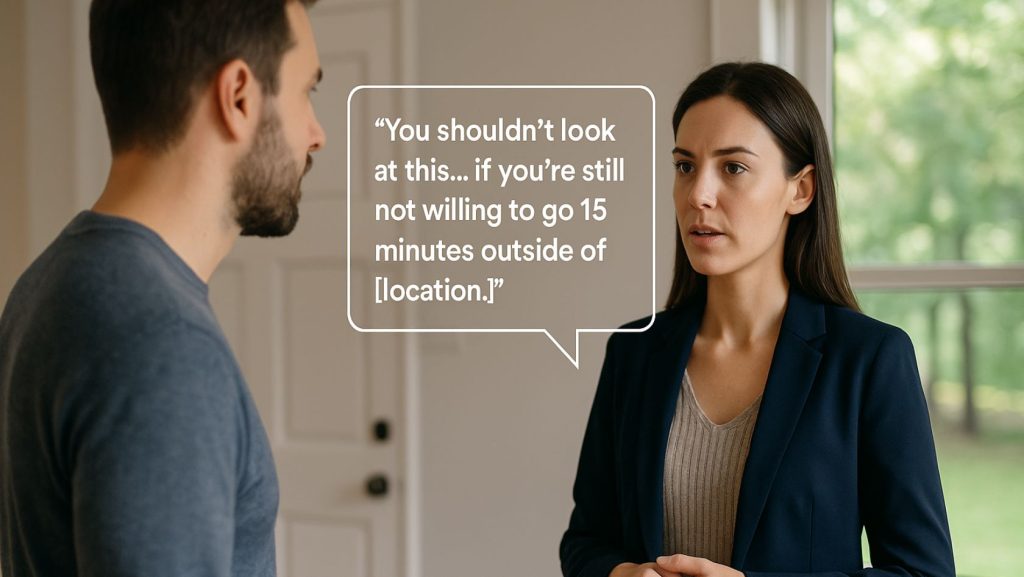
- “You shouldn’t look at this…if you’re still not willing to go 15 minutes outside of [location]. But if you’re flexible on that, **this is the property,** in that location, you should look at the next 24 hours. Here’s why…Here’s two times I can get that set up for you.”
It’s about pattern disruption. A message that sounds different from the last five they’ve ignored is the one that gets read.
4. Turn Buyer Constraints Into Listing Opportunities
Buyers who are laser-focused on a specific neighborhood or school district present a challenge, but also an opportunity. If nothing is available on the MLS, you don’t have to wait.
Use the buyer’s wishlist as your roadmap and start prospecting off-market.
Here’s a strategy you can use:
Off-Market Prospecting Strategy for Buyers
When clients have hyper-specific location needs, here’s how to help them and grow your listing pipeline:
Step One: Ask for Specific Streets or Neighborhoods
“What are the five streets or neighborhoods you’d love to live on within the school district?”
This gives you a focused area to target. It gives you clarity and precision, and sets up the next step.
Step Two: Get in Front of Homeowners
- Once you know the buyer’s dream area, reach out directly to homeowners.
- Send letters or postcards.
- Knock on doors.
- Use social media to target that geo-area.
- Circle dial using tools like PropStream or Vulcan7.
Script for Outreach:
“I’m working with a qualified buyer who wants to move into your neighborhood. If you’ve thought about selling—or know someone who has—would you be open to a quick conversation?”
Step Three: Turn Every Buyer into a Listing Opportunity
Even if no one bites, you’ve started meaningful conversations with homeowners and positioned yourself as the local expert with ready-to-act buyers.
Objections Aren’t the End. They’re the Start of Better Conversations.
Whether it’s a non-negotiable school district, a tight budget, or radio silence from a lead, the agents who win are the ones who ask better questions, use smart scripts, and prospect proactively.
- They don’t wait for objections—they train for them.
- They don’t push—they frame.
- And they don’t lose momentum when a buyer goes silent—they shift gears and keep the conversation alive.
These four strategies from the latest BAMx roleplaying session are more than clever lines; they’re high-leverage tools that move deals forward when others stall out.
Want more of this every week? Join us in BAMx and set a calendar alert for Tuesday morning roleplays at 9 am ET (May and June).
Because the agents who win in 2025 are the ones who practice like it’s game day.