One of the more surprising things we’ve discovered over the last few months is that some of our best-performing content hasn’t been video at all.
Several of our highest-performing posts have been simple headline-style graphics based on local news stories.
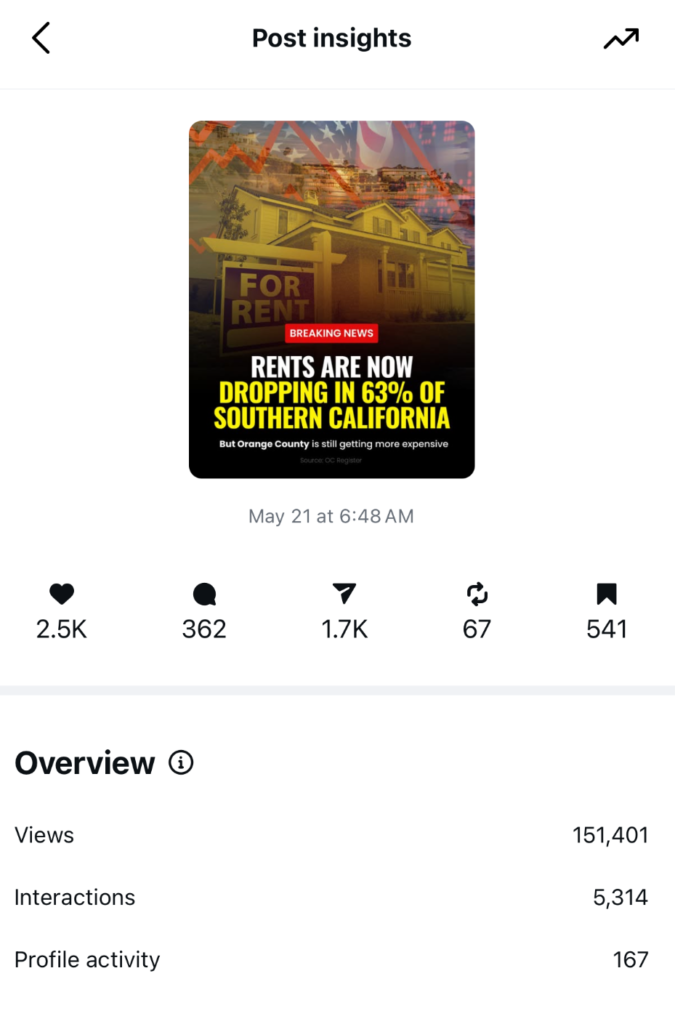
A post we shared about Southern California rent prices generated more than 156,000 views and nearly 2,000 shares.
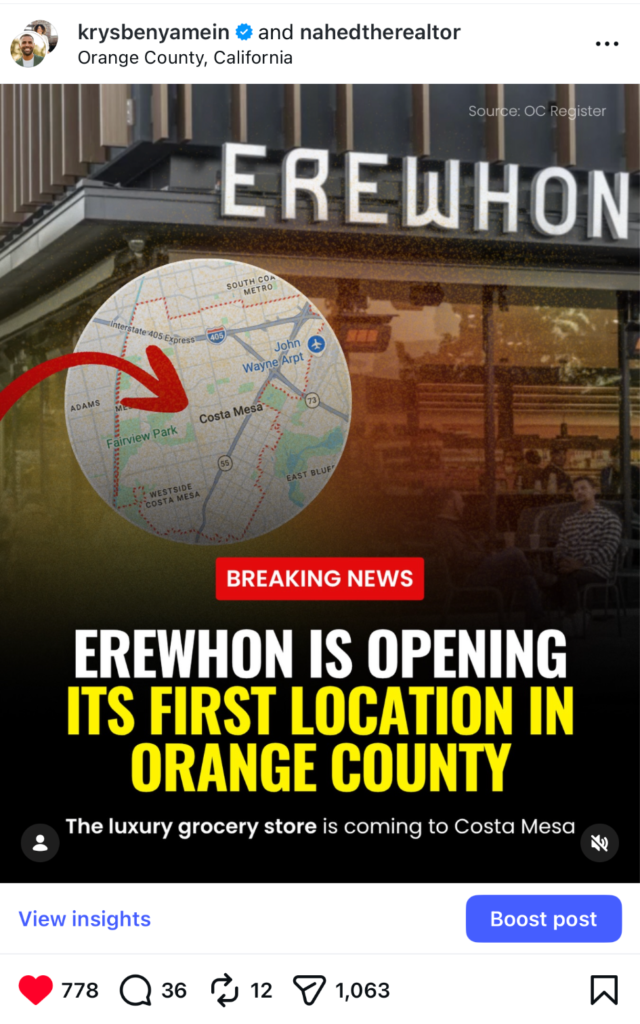
Another about Erewhon opening its first Orange County location was shared more than 1,100 times.
A post about California FAIR Plan insurance increases generated tens of thousands of views and hundreds of shares.
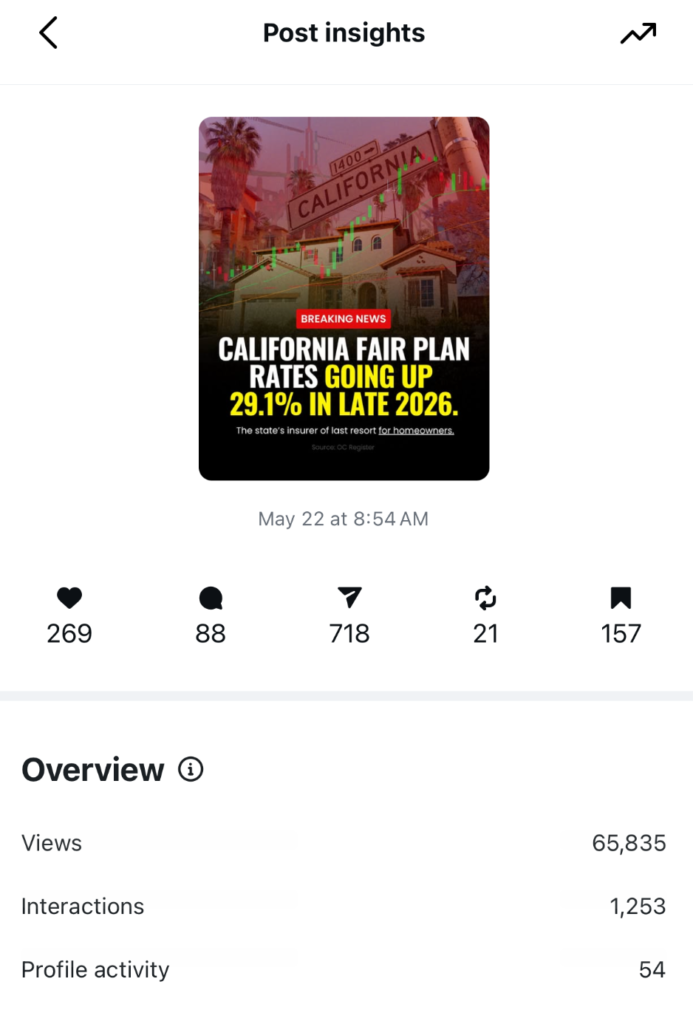
What stood out wasn’t necessarily the reach. It was how often people were sending these posts to friends and reposting them to their Stories.
The more we looked at the analytics, the more we realized these posts were succeeding for a very different reason from most traditional real estate content.
The Easier It Is To Share, The Better It Performs
Most people aren’t scrolling Instagram looking for a real estate agent to promote. They’re looking for information that’s useful, interesting, surprising, or relevant to what’s happening around them.
When they come across something that checks one of those boxes, they share it.
That’s why I think one of the biggest lessons from this entire experiment is that the easier it is for someone to share your content as their own discovery, the more likely it is to spread.
Think about the posts that get forwarded in your own text messages or group chats. Most of them aren’t personal branding pieces. They’re headlines, statistics, local developments, trends, or stories that make you stop and say, “That’s interesting.”
That’s exactly what these posts are designed to do. The reason we’ve intentionally kept these graphics simple is because we don’t want them to feel like advertisements. We want them to feel like news.
People are far more likely to share something that feels like news than something that feels like a brand post.
The Opportunity Isn’t Finding Better Information
Some of the best content opportunities are hiding inside stories that are already getting attention.
- If a major publication is writing about it, people are probably reading it.
- If it’s trending locally, people are probably talking about it.
- If it’s affecting housing, affordability, insurance, development, taxes, or the local economy, chances are someone in your audience already cares about it.
The problem is most articles are written to explain a topic in detail.
A reader might spend five minutes working through an article before arriving at the most important takeaway, but on social media you don’t get five minutes. You get a few seconds.
That’s why we’ve found the most important part of this process is identifying the single sentence someone should remember after reading the article.
Not the entire story but instead the takeaway.
For example, an article might spend several paragraphs explaining rental trends, vacancy rates, and regional market shifts across Southern California.
Most people won’t remember any of that, but what they will remember is:
“Rents Are Now Dropping in 63% of Southern California.”
That’s the headline and the takeaway. That’s the thing someone is most likely to send to a friend.
We’ve found the more immediately understandable a headline is, the more likely people are to stop scrolling, understand it, and pass it along.
Most of the work, then, is taking a story that requires five paragraphs to explain and distilling it into a single sentence anyone can understand.
Once you start looking at articles through that lens, you’ll realize there are content opportunities everywhere.
How We’re Using ChatGPT
This is where I think a lot of agents get AI wrong. Most agents open ChatGPT and ask it to create something from scratch.
Instead, we’ll typically upload the original article, examples of previous posts that have performed well, and examples of the formatting and captions we tend to use.
Instead of asking it to create a viral post, we’re asking it to help us:
- Identify stronger angles
- Simplify complicated language
- Generate headline options that are easier for people to understand at a glance
The quality of the output improves dramatically once ChatGPT understands what you’re trying to create.
To make this easier, I’ve included the exact Canva template we’re using inside BAMx Skool. The template isn’t the strategy, but it does remove the guesswork so you can focus on finding stories and crafting better headlines
It’s similar to hiring a new team member. If you hand them a blank sheet of paper and say, “Go make something great,” the results will probably be inconsistent. If you show them examples of what success looks like, they start recognizing patterns much faster.
The Graphic Gets Attention. The Caption Creates Context.
One thing we’ve noticed is the graphic and caption serve very different purposes.
The graphic‘s job is to communicate the story as clearly and objectively as possible. That’s one of the reasons these posts perform so well. They feel more like news than marketing.
The caption is where we add context. When we posted about Erewhon opening in Orange County, the headline communicated what happened. The caption explored why it might matter and what it could signal about consumer spending, demographics, and the direction Orange County is heading.
The same thing happens with housing stories. The graphic delivers the information. The caption gives us an opportunity to explain why it matters, share our perspective, and include the source so readers can dig deeper themselves.
Another benefit is a strong caption often becomes the foundation for everything else. Many of these posts eventually turn into emails, blog articles, website content, and even videos discussing the topic in more detail.
That’s become increasingly important as search evolves. The more places your insights exist, the more opportunities you have to be discovered by people searching Google, ChatGPT, Perplexity, and other answer engines looking for information on that topic.
Why This Has Become Part Of Our Content Strategy
Another reason we’ve leaned into this format is because of how versatile it becomes once the initial work is done.
By the time we’ve read the article, identified the story, created the graphic, and written the caption, we’ve already created the foundation for multiple pieces of content.
That same story can become an email, a blog article, a green screen video, story content, a market update, or even a conversation starter with clients.
In many cases, we can create several of these graphics in the same amount of time it would take to script, film, edit, and publish a single video.
That doesn’t mean video is going away. Video is still a huge part of our overall content strategy but what it does mean is that these posts have become one of the easiest ways for us to stay relevant, start conversations, and create content around topics people are already interested in.
The Real Lesson
The biggest takeaway from all of this has very little to do with AI. It’s that people share things that help them feel informed.
The agents who will win with this strategy are the ones who get really good at identifying interesting stories, finding the takeaway that matters most, and explaining why people should care.
Inside the BAMx Skool, I’ve included the Canva template we’re using for these graphics so you can start creating your own local news-style posts.
The template will help you create the graphic but understanding why these posts spread is what will make them work.