


Say you’re a buyer looking for a real estate agent. You type a detailed prompt into ChatGPT and ask for recommendations.
Names come back. But Chat doesn’t stop there. You also get a quick bullet-point overview of each agent’s qualifications:
- Years in business.
- Number of deals over the past 12 months.
- Typical price range.
- Impressions from testimonials.
Then it highlights “what matters for your situation” before presenting three top recommendations.
We’re in a new era for consumer research on real estate agents.
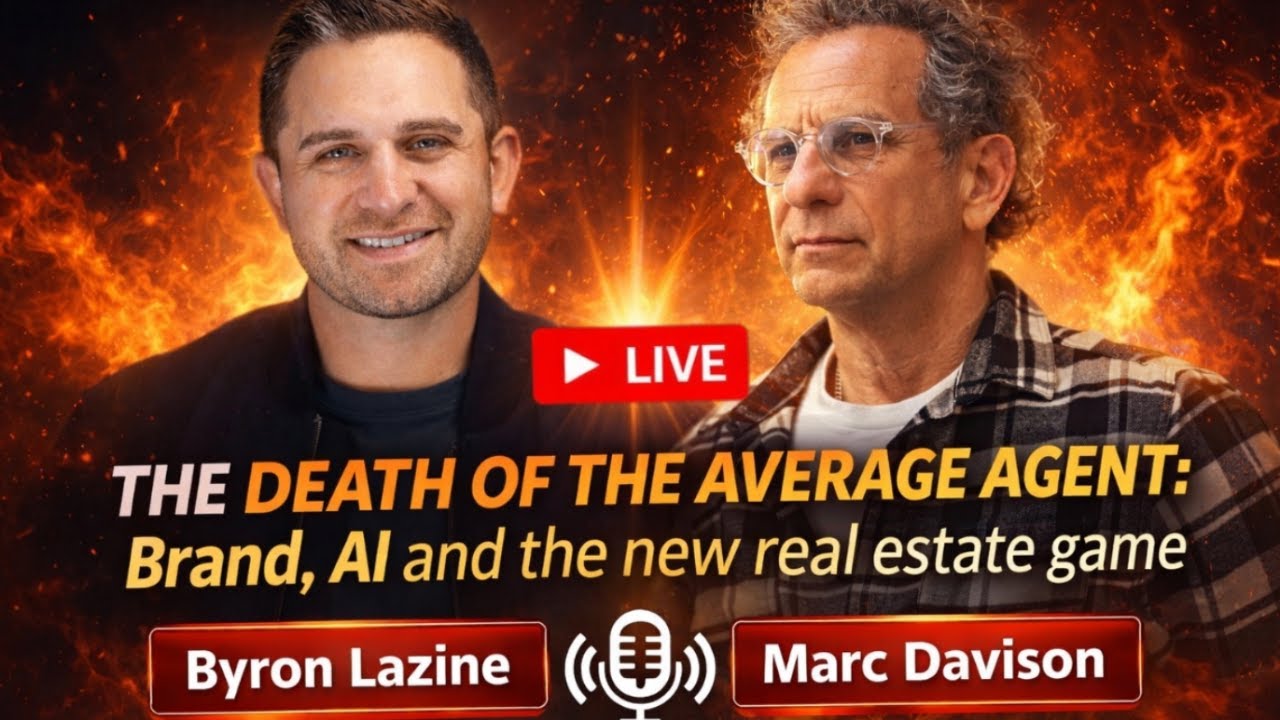
In a recent BAM YouTube Live, 1000watt co-founder Marc Davison walked through how this plays out, while BAM co-founder Byron Lazine pushed on what it means for agents trying to stay visible and competitive.
The conversation stayed grounded in real examples, including how AI influences who gets considered and what clients expect to see when they land on your website.
Things work differently now. Clients are showing up with context, and AI is doing a lot of the early filtering before you ever get involved.
And if you’re not where AI is looking, you won’t even make the list.
AI Is Deciding Who Makes the Shortlist
Clients are going to AI before they ever go to you.
Marc Davison shared a simple example. He gave ChatGPT a detailed prompt about what he wanted, then asked for agent recommendations.
“I ran this experiment. I showed my ChatGPT inquiry. I showed the transcript in the blog, and at the end of my transcript I said, ‘Based on what I just told you I am looking for and I want, can you recommend three agents in my market?’ “It gave me a list of three really good agents.”
This is how the process starts now. A client describes their situation. AI pulls from what it can find online and builds a short list.
If your name shows up, you’re in the running.
If it doesn’t, the opportunity is gone before you even know it existed.
Your Online Presence Is Being Interpreted for You
AI pulls from whatever it can find about you and turns it into a quick summary.
That includes your website, your bio, your reviews, and anything you’ve published. It pieces those signals together and presents a version of you before the client ever hears your voice.
For an example, here’s what ChatGPT gave me for one of the agents it recommended, along with a link to their Zillow profile:
- 13+ years experience, ~72 total sales
- Typical price range includes $200K–$555K, so your budget fits right in
- Known for being attentive and responsive with buyers
- Good fit if you want someone patient who will actually explain the process
Marc Davison showed exactly where this breaks down when the message isn’t clear enough for that interpretation to hold up:
“I clicked on one, and when I clicked on her website, she didn’t have what I felt she should have had in the hero. “So, I created a replacement copy which said, “Hi, I’m Bridget. I specialize in first-time buyers in the Taka Verde section of Tucson,’ because that’s what I’m looking for.”
Quick terminology note: The “hero” is the top section of a website. It’s the first thing you see when you land on someone’s homepage.
It usually includes:
- A headline
- A short description
- Sometimes a photo or background image
- A call to action
In this case, the hero for the agent’s website didn’t match what Marc was looking for.
When Marc says he “created a replacement copy,” he’s not making any alterations to the agent’s website. He’s rewriting it more clearly to show how messaging should read to convert a lead with the same search criteria.
When a client lands on your site, they’re looking for confirmation that you fit what they asked for. They’re scanning for something specific, not trying to figure you out from scratch.
When your positioning is clear, it clicks right away.
If it’s vague, the moment passes and they move on.
If AI Can’t Read Your Expertise, It Can’t Recommend You
AI is pulling from what it can find and turning that into an answer.
Marc Davison spelled out how that works and why most agents miss it. It starts with what exists online about you.
“You need to get AI to recognize…like where does AI get its information from? It’s not making it up. It’s pulling from sources that are reliable. Become the reliable source and make sure that the content that you’re creating showcases your reliability—like the amount of years you’ve been in business, the amount of deals… “Every agent should create a case study.”
If your experience isn’t documented, it doesn’t show up. If your focus isn’t clear, it gets lost in the mix. AI is working with what’s there.
Marc got specific about what agents should actually be doing.
“Write an article…even if it’s a Seth Godin-like two paragraph article. Write content and post content in places that AI looks for content… Write a blog. It’s easily indexable by AI. Use Google Gemini. Create content about the subject matter that you are an expert in.”
This is where visibility comes from now. Case studies carry weight. Specific examples carry weight. Clear statements about who you help and how you work carry weight.
AI can read it and connect it, which is what allows it to surface you in the right context.
BAMx members have Sharran Srivatsaa‘s ready-to-use blueprint for creating content that makes it easier for AI to find and recommend them.
Here’s what one BAMx member shared after using it:
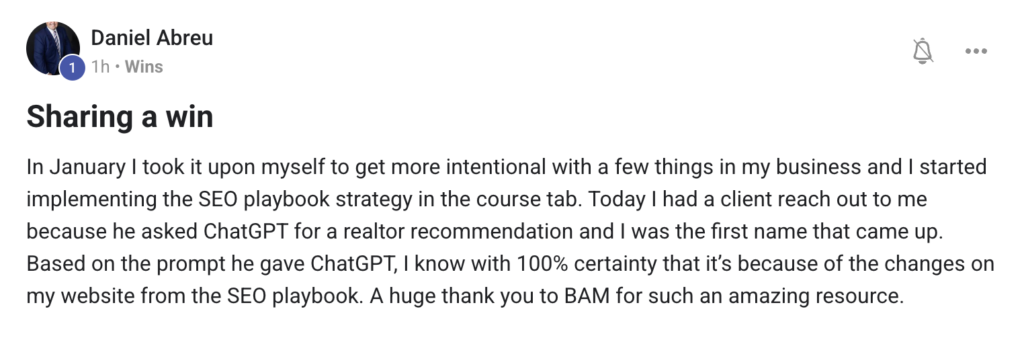
Start your seven-day free trial to BAMx for instant access to Sharran’s full SEO Playbook, complete with a downloadable step-by-step playbook and 30 customizable blogs.
Agents who rely on vague or generic claims blend together. They all look the same. Agents who clearly document what they do stand out in the data AI is pulling from.
So, in a very real way, AI is accelerating the demise of the “average agent.”
Clients Are Showing Up Smarter and More Selective
Clients are walking into conversations with more context than they used to.
The 1000watt data shows a large share of buyers and sellers are using AI to ask questions and check pricing.
Many also use it to validate what they’re hearing from agents before they ever speak to one.
They’re showing up with more specific questions, and they have less patience for fuzzy answers.
Marc Davison pointed to how this plays out on the front end. People are using AI to shape their thinking before they ever reach out, which means they’re already looking for alignment when they land on your site or start a conversation.
Byron Lazine addressed the other side of it, tying in the previous week’s conversation with Zillow COO Jun Choo, where Byron asked if replacing agents was ever part of Zillow’s mission:
“If consumers wanted that, then that would be the path. But consumers do not overwhelmingly want that. And that’s why use of an agent has gone up.”
Clients still want guidance. They’re just more prepared when they ask for it.
You’re stepping into conversations where the client already has a baseline. Your job is to explain why your recommendation makes sense and help them feel sure about the next step.
The Gap Between Average and Chosen Is Getting Wider
AI is sorting through agents before a client ever makes contact.
It pulls from what’s available and compares options. Agents who sound the same get grouped together, while agents with clear positioning stand out.
Marc Davison didn’t soften this point.
“Nobody gets into a business to be average. That is insane to me….There’s no average baseball player. If you’re average, you’re back to the minor leagues. There’s no average doctor. If you’re average, you’re going to get shitty reviews and you’re not going to get patients. There are a lot of average agents…” “I think if you want to be a professional, you need to do what professionals do. If you want to not be average, then you need to fight every urge that feels like ‘If I do this, it’s probably going to make me like everybody else, and that’s going to put me in the average container.’”
This shows up in how agents are described and recommended.
If your messaging sounds like everyone else, you blend into the results. If your expertise is specific and visible, you show up as a match for a particular type of client.
The difference comes down to how clearly you communicate what you do and who you help.
AI Gets You Considered. Positioning Gets You Chosen.
AI is already shaping who shows up in the conversation. Clients are using it to narrow their options before they ever reach out. Your name either appears in that process or it doesn’t.
Getting on the list comes down to visibility. Getting chosen comes down to clarity.
Byron Lazine framed the opportunity clearly.
“This is where agents can win. If you understand how this works, you can position yourself to show up in those answers.”
What’s changed (from the pre-ChatGPT era) is how clients decide who that agent will be.
They’re looking for someone who fits what they already asked for and clearly understands the problem they’re trying to solve, with proof that they’ve handled it before.
AI handles the introduction. Your positioning decides what happens next.