
Newly-appointed Fed Chair Kevin Warsh hosted his first FOMC press conference yesterday, leading with the Fed’s decision to hold the federal funds rate at 3.5% to 3.75% for another month.
June’s FOMC meeting also comes with the latest Summary of Economic Projections.
Of the 18 Committee members who submitted their projections:
- 8 expect no changes to the federal funds rate in 2026
- 1 expect a rate cut
- 9 expect at least one rate hike
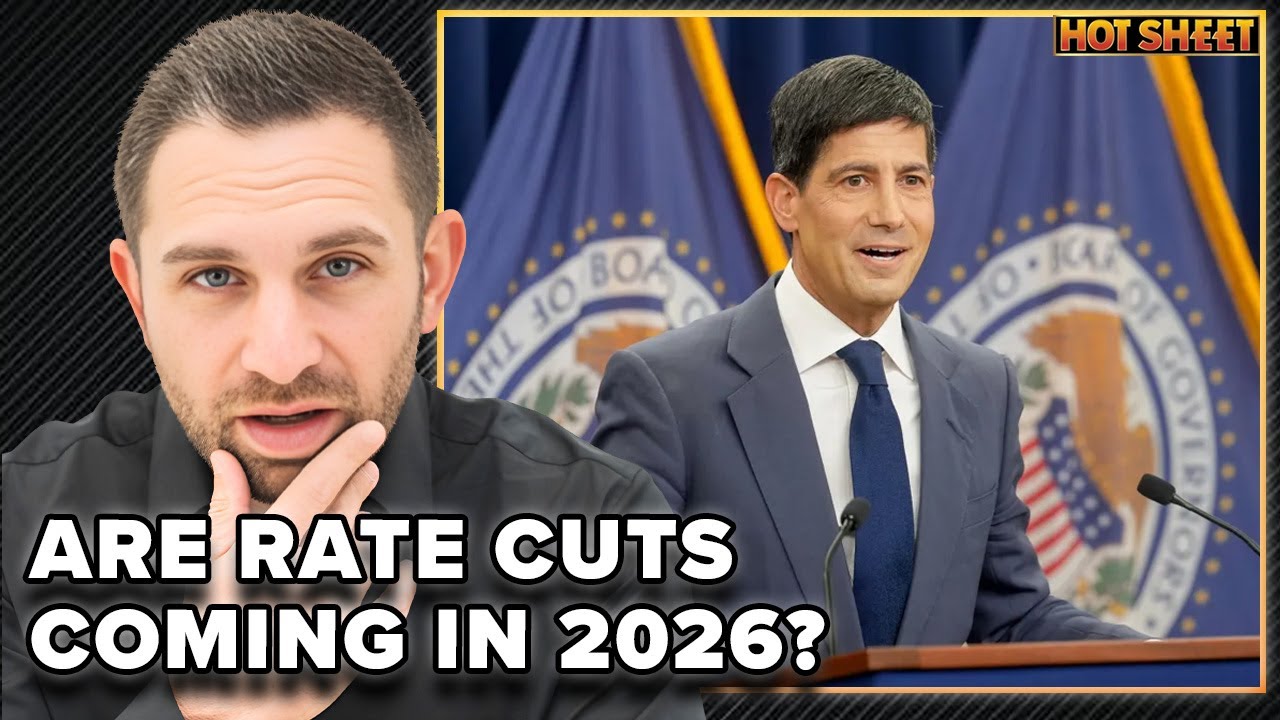
Don’t miss Byron Lazine’s full breakdown on today’s Hot Sheet.
Read on for the highlights from the FOMC press conference.
FOMC Press Conference
Warsh’s opening statement was shorter and made no reference to housing. He did mention housing twice, though, in his responses to reporter questions, though none of the questions mentioned housing specifically.
Reporter questions focused on:
- Fed monetary policy (upcoming rate cuts, rate increases, etc.)
- Inflation and what’s driving it
- New Fed task forces (referenced in Warsh’s opening statement)
- Whether the Fed’s rate policy is restrictive or not
- AI and how it’s impacting demand vs supply
(10:19) — Follow-up question from Howard Schneider, Reuters:
“And just specifically on the inflation framework, you talk about first principles. Does this include a review of the 2% target itself? You’ve mentioned that things to the rate of the decimal point don’t matter. Should this be starting from a premise that 2% as a point estimate is too strict?”
Warsh’s response (10:39):
“Let me break that into two pieces. First, on the inflation framework review, their remit is: what are the drivers of inflation? What’s the Fed’s responsibility for inflation? In part, how do we measure inflation, but that’ll overlap with my data group.
“On the 2% inflation objective, that is the Federal Reserve’s long held objective of 2%. You’ve heard me say before, I tend to focus on the left of the decimal point. Well, the two is the left of the decimal point. For now, zero is to the right. I see no reason until we have reestablished our commitment and ability to deliver on the 2% inflation objective to revisit that. So that’ll be outside the scope of what we’re taking on.”
Byron commented on Warsh’s response:
“So, the good news on what he just said is if we’re focused on the left of the decimal point, getting to the 2….if we’re going to get energy under control, we could get PCE and CPI both with a 2 reading on inflation, we were there before the Iran war. So, that can happen if we’re focused on the left [number] (2.8, 2.9, 2.7). They have lower projections for 2027, so we might be able to get there very quickly. Inflation could turn around. By the end of the summer, could be showing very different numbers.”
NYT reporter Colby Smith then asked about the possibility of rate hikes in response to Fed projections on inflation targets.
(11:26) — Question from Colby Smith, New York Times:
“You in the past said that inflation is a choice, and in the policy statement it includes this pledge to deliver price stability as you’ve reiterated today. But looking at the SEP, the bulk of your colleagues expect core PCE to run around 3.3% by year end and for the 2% inflation target not to be reached until 2028.
“So I’m curious how patient you think the Fed can afford to be at this juncture in terms of waiting for one-time inflation waves to wash through and for underlying inflation to step down after so many years of inflation running above target, and under what circumstances you would support the Fed taking some action and raising rates.”
Warsh’s response (12:09):
“Sure. So quite a bit there. Let me try to break that into pieces. First, we have the capability and commitment to deliver on our price stability objective of 2%. That’s exactly what we’re going to do. In the Fed’s review of its strategy over the last any number of years in January, the Fed, including the strategy that we’re still bound by, the Fed statement says that inflation is primarily determined by monetary policy. You bet it is. I’ve said for years inflation is a choice. You bet it is. And today I’m announcing that this committee unambiguously and unanimously have decided we are going to deliver on that.
“The rest of your questions sounded like encouragement for me to give forward guidance. We’ve dropped forward guidance. Some along the committee, I think dropped it, I suspect from our discussion the last couple of days, because they said at this moment in time, it doesn’t feel as though providing forward guidance is right.
“Others have, I’d say, different views and think as a general proposition, forward guidance isn’t the business we should be in, but that’ll be taken up by the task force on communications and my policymaker colleagues. We’re going to listen hard to what the experts say and make our own decision, but I can’t give you any forward guidance about what we’re going to do next. The good news is we’ll be meeting in six weeks.”
(13:34) — Follow-up question from Smith:
“I guess on the current policy settings then, I am curious how restrictive you think things are at the current moment, given the flow of data that we’ve seen and forecasts that are coming down the pipeline.”
Warsh’s response (13:48):
“I’ve heard characterizations both inside and the Fed about that. I’ll give you my own. It’s uneven.
“If I look at the housing markets as one example, Fed policy isn’t the single determinant of the state of the housing market, but broadly, I would say there, Fed policy appears to be somewhat restrictive. I would have a hard time managing to say those words if I were to see what’s happening in financial markets. So I’d say it’s uneven.
“That’s perhaps a function of different transmission mechanisms of monetary policy, whether monetary policy is coming from our interest rate tool or our balance sheet tool. But the good news, we have a task force on that too, and the balance sheet task force will be looking more at that subject.”
Byron homed in on Warsh’s statement on housing;
“Warsh is saying, ‘Man, we are NOT restrictive on the financial markets’… But unsolicited he says, ‘But if you look at housing, if you look at real estate, very restrictive.’ How do we know this? Well, one of the ways we know this is transactions have been at Great Financial Crisis levels in some markets or 1982 levels in other markets. We’ve had the lowest level of transactions for a 3-4 year period—and you could argue EVER, if you factor in population. So, that’s why it’s been restrictive on housing…
“You print all this money, hard assets aren’t going to move down. But it’s very restrictive in new buyers entering the market—affordability. It’s very restrictive on obviously how many transactions are happening.”
(22:22) — Question from Edward Lawrence, FOX Business:
“So if you don’t give a lot of ongoing forward guidance, won’t the markets have more volatility and shouldn’t Americans have more access into what you’re thinking going forward?”
Warsh’s response (22:33):
“So I think financial markets perform best when they react to incoming data. I think they, the financial markets, work less efficiently when they ask a question, how will the Federal Reserve react to that incoming information? The more that markets are paying attention to what’s happening in the real economy, deciding what’s good data
and what’s less good data, the more financial markets can price what they believe is the most likely and what are the tail risks. Financial market prices are probably the most important source of information to guide central bankers.
“But when all the financial markets are doing is reflecting back what we’ve said, then we’re taking the most important source of information, and we’re being blind to it. I’d like us to create a system where those blinders come off, where markets are following data that they efficiently think is reliable, and they’ll be watching data. We’ll be watching data. They’ll come with better information through market prices to us. We can make more informed decisions. But ultimately, the goal that I said at the outset, deliver on the price stability objective that Congress told us to do and that we’ve got to get in the business of doing.”
(28:24) — Brian Cheung, NBC News:
“So when you say that we’ve dropped forward guidance for the layperson, that might sound like the Fed’s going to say less or offer less insight into where their borrowing costs might go.
“So for the person that maybe you might run into at the grocery store where the price tags are rising at a faster pace than their wages at the moment, how would you explain it to them? I don’t know if a task force might be the answer there, but how would you kind of communicate this era, this chapter of the Fed?”
Warsh’s response (28:52):
“If I told somebody in the milk aisle that I had a task force for that, I think that would be doing a very poor job, so I appreciate it. If I saw somebody in the grocery store, what I would say to them is that we cannot have a very significant effect on particular prices. The price of oil in the markets today or even the price of a dozen eggs, that does not have first-order consequences to what we’re doing. But we do have a really important job there, and it’s to make sure that those changes in oil or beef or eggs or milk don’t broaden in the economy, don’t have second and third order effects. That’s our job, that’s our commitment, that’s our capability, and we’re going to deliver on it.”
(31:08) — Question from Steve Liesman, CNBC:
“You had said before you became chairman that you thought productivity was a reason why the Federal Reserve could lower interest rates. Do you still believe that to be the case?”
Warsh’s Response (31:29):
“So the committee had a discussion of productivity today. AI came up. The way I thought about it before and socialized with the group is that artificial intelligence, the latest generation of general-purpose technology, is perhaps as important a change in the economy and business and households that we’ve had in my adult lifetime. It is filled with both a huge opportunity and with risks. I take both of those very seriously.
“You may have heard me say before that AI is shorthand perhaps for American ingenuity. That doesn’t mean that it’s going to be easy. That certainly doesn’t mean it’s not going to be disruptive. But over the long term, my conviction, and I heard quite a bit of support for this around the committee today, is the United States is a winner as we go down this. The United States is ultimately going to be better off than that.
“Now, to bring that back to the conduct of policy, timing, scale, speed, implications for output and employment. It’s one of the things we have a task force to do.”
(32:42) — Follow-up question from Liesman:
“When you look at the strong job growth that’s out there, the elevated inflation, GDP seems to be going pretty good and the stock market seems to be soaring. Do you look around this economy and see the funds rate being restrictive?”
Warsh’s response (32:58):
“So um that’s your second question. I’m going to give the same answer that I gave before. I’d say, as I think about the conduct of policy, what matters is what’s the effect of policy? Not what do we say, but what happens? And the best way I can describe it is it’s uneven.
“I do see some restrictedness in things like housing. It’s hard to use those same words anywhere else. I’ll just make one other point. You talked about one of our dual mandates and the employment side. I don’t believe that we have a cruel choice. I don’t share the view that was expressed a few generations ago that Federal Reserve chairmen show up at a podium like this and say, “You got to choose.” And you’re going to have to decide whether you’re willing to tolerate higher inflation to put more people at work. I don’t believe in that.
“What I believe is, if we do our job, we can make strong growth, low prices and strong employment mutually compatible. And so what you heard from the committee today is we’ve got some work to do on this price stability front.”
(34:38) — Follow-up question from Nick Timiraos, Wall Street Journal:
“If I could ask about AI, the build-out is generating enormous demand right now, CapEx data centers power. The productivity payoff may be further out. So in your judgment today, is AI adding more to demand or to supply?”
Warsh’s response (34:52):
“It’s a good question. At the central bank in an economics profession, what we spend most of our time doing is counting demand. It’s easier. We can see it, we can count it, we can check it, we can revise it. What we do though is we infer supply.
“You’ll notice in the second paragraph of what one of your colleagues described as a very short statement. We have a sentence on the demand side and a sentence about the same length on the supply side. They’re both important. Just because we can count one better than the other doesn’t mean we’re going to favor one more than the other.
“With respect to AI and the growth of data centers and infrastructure around it, we’re counting the demand side and it is no doubt showing up in GDP figures. We can be less certain when we infer the timing and extent of the growth in the supply side.
“It may well be an intuition the supply side is going to expand but it’ll take longer. I just describe it this way. There’s a race between supply and demand. Milton Friedman says that the only thing we know about economics is that there’s a supply line, a demand line they ultimately cross. When they cross and what are the implications for policy? The good news for you is we have a task force for that.”
We’ll close with this quote from Byron’s coverage of the FOMC press conference:
“Again, the Fed isn’t going to come save the housing market and then risk inflation in other sectors. So, similar to Jerome Powell’s Fed, they’re not mandated to make sure the housing market does well. And they’re certainly willing to keep the housing market in a restrictive state to support the other parts of the mandate.”