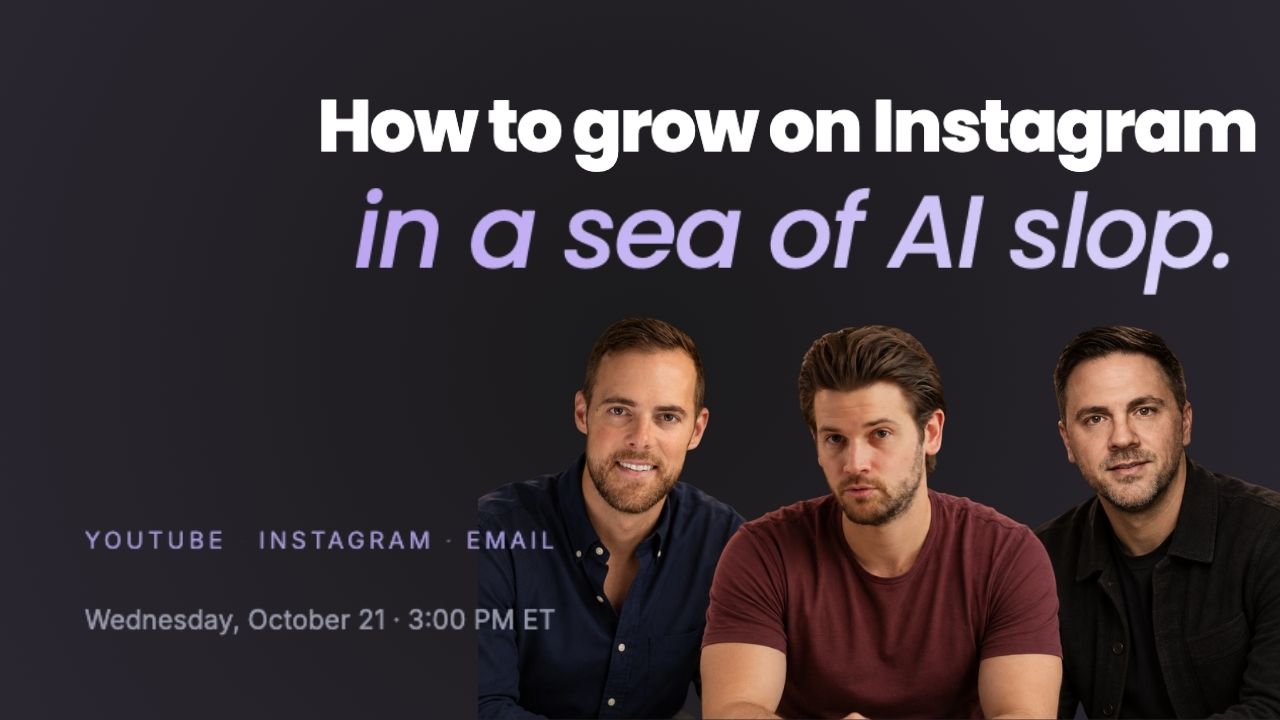
Content that doesn’t connect with your audience…does not convert.
Nothing revolutionary, there, but it’s worth repeating—and worth a closer look. Because, as our BAMMYs keynote, Neel Dhingra, pointed out: “No industry is saturated, because most people suck at what they do.”
That’s actually good news for committed real estate professionals like you.
In his presentation, Dhingra broke down his 3C system to help you as a real estate content creator nail your three-fold marketing goal for 2025: Focus on creating engaging content, building authentic connections, and converting leads.
Skipping any step weakens your results.
We’re sharing Dhingra’s eight proven tips to help you create a dialed-in marketing plan for 2025. And be sure to tune in to his presentation for examples—it is part of the full BAMMYs recording, available on BAMx.
Content: What’s Working for Real Estate Agents
The content that’s working for real estate agents right now stands out from the rest by grabbing the attention of the intended audience and delivering value in a way that makes the creator memorable—and an easy follow.
One of the many takeaways from Dhingra’s presentation is that you no longer need a huge following on Instagram to go viral, thanks to an algorithm that favors smaller creators and puts their content in front of more people.
Another thing to keep in mind when you’re creating content is the importance of having the right objective for it. For Dhingra, everything changed when he switched his focus from “How can I find more clients?” to “How can I make myself more findable for people who need my service?”
If you know your advice matters—that it can improve the lives of your clients—you care more about making it easy for them to find you and to experience as quickly as possible the advantage of working with you.
Use these eight strategies to get in front of the people who need exactly what you can deliver better than anyone else in your market.
1. Show, Don’t Just Tell
Real estate professionals who show what they do for their clients always stand out from the majority of agents who are all talk.
Showing is about proof over promise. And as Dhingra points out, visual storytelling is a powerful way to show potential clients you have what they’re looking for in an agent. Visual storytelling is about showing the steps of the buying/selling process visually—showing the math and bringing clarity to a complicated journey.
One example of this would be a video breaking down mortgage payments or savings. Done well, these are ten times more effective than talking-head videos that only tell the audience something they’ve already heard from dozens of other agents.
Stand out by creating an image in your viewer’s mind, using details that speak directly to their biggest concerns.
2. Transparency Wins
In today’s fast-paced real estate market, where trust is a premium commodity, being transparent with real numbers is one of the most effective ways to connect with buyers.
Modern buyers are more informed and tech-savvy than ever before. With countless online resources at their fingertips, they’re not just browsing listings—they’re crunching numbers, comparing properties, and planning their finances. However, this level of research also breeds skepticism. When agents are upfront about numbers—whether it’s mortgage payments, down payment requirements, or even hidden costs—buyers feel empowered and trust the agent providing that information.
Transparency breaks down barriers. It shifts the perception of an agent from someone trying to “sell” to someone providing valuable guidance. And in an industry where trust is everything, that shift can be game-changing.
Here are some ideas on how to incorporate real numbers into your content:
- Break down monthly payments
- Highlight savings and costs over time
- Compare different scenarios
- Offer localized insights
Neel described three examples of transparency in action:
- The Viral Payment Breakdown: A simple post showing the cost of a $1.15 million home with 5% and 20% down, including property taxes and insurance, recently went viral. Why? It answered questions buyers didn’t even know they had while showcasing the agent’s expertise.
- Educational Short Videos: Short-form content on platforms like Instagram and TikTok is ideal for breaking down numbers. For example, a video explaining how PMI (private mortgage insurance) affects monthly payments can rack up views and build credibility.
- Infographic Posts: Use visually appealing graphics to show what a down payment or monthly payment looks like for homes in different price ranges. Infographics are highly shareable and can attract a broader audience.
Transparency isn’t just about sharing numbers; it’s about being authentic. Just like you, buyers appreciate honesty, even when the numbers aren’t ideal.
For example, if interest rates are high, explain what that means for affordability—but also share strategies to navigate it—like temporary rate buy-downs or focusing on homes in areas with lower taxes.
When you openly address potential concerns and provide solutions, you’re not just building trust—you’re positioning yourself as a problem-solver.
3. Cut to the Chase
We’ve all seen videos that had us thinking, “Get to the point,” about 10 seconds in. On social media, though, we’re not likely to keep watching past the first few seconds if the first words we hear don’t grab our attention.
If we’re not thinking, “Oooh, this is something I need to hear,” in the first five seconds, the pull of the scroll is just too strong. We’re only human.
By now, you probably already know not to start a video with “Hey, it’s [your name] in [your location]. Welcome to my channel…” Before you get to the good stuff, most viewers (if not all) have already moved on.
That said, you don’t want to go hard with a hook that makes a promise you have no intention of delivering. No one likes to be on the receiving end of a bait and switch.
You do need a powerful hook, though.
Say you’re about to film a listing video. Instead of saying, “Welcome to 123 Nobody-Cares Lane,” try jumping directly to the most exciting feature of a property.
If you’re out on a walk in your neighborhood, you could take a page out of Dhingra’s book and start with something like, “This is gonna sound really inappropriate, but…”
4. Personal Content Builds Trust
Your business social media accounts don’t all have to be about real estate. Most folks want to know there’s a relatable human being behind the brand. Because while competence is definitely important, consumers also want to work with someone they like.
Fortunately, anyone can learn to be more competent and more likable.
One way to connect with your audience is to include personal content in your Instagram feed—as well as in your stories.
Some ideas:
- Have an opinion on something—and invite your audience to discuss
- Talk about your hobbies, your interests, your favorite sports team,
- Share how you celebrate the holidays or what you plan to do on your vacation
- Talk about what you (personally) love about your neighborhood
- Share a favorite recipe (could be seasonal or related to a holiday)
- Reveal something about yourself most people would never guess
- Share the top 5 things on your bucket list—or a single life-changing experience
If it helps, keep these five Fs in mind if you’re wondering what to share about yourself on social media:
- Food
- Faith
- Family
- Fitness
- Fashion
5. Overcome Fear and Post Imperfect Content
Perfectionism and fear of looking dumb hold back so many content creators, including those in the real estate space. Dhingra quoted Jesse Itzler when he said, “The greatest gift you can give yourself is to get over the fear of being embarrassed.”

If you can do this correctly—the connection piece—you’ll get more clients. You might know this in theory, but this has been the biggest piece for me is reaching more people by sharing more of the personal things.
People want to work with people who understand them and who care about the same (or similar) things. Sharing personal stories, insights, discoveries, and opinions makes you relatable—at least to some. And keeping personal details, experiences and opinions out of your content is a great way to ensure no one can relate to you.
Think of it as the packaging for the skills and expertise you offer. Your advice matters, and good packaging will make it impactful.
Another favorite Dhingra quote: “Fear doesn’t go away; it gets diluted.”
It’s worth acknowledging here that the fear of being embarrassed—of being criticized, belittled, written-off or ridiculed—doesn’t ever go away. Most of us struggle with some degree of imposter syndrome. It doesn’t disappear once you decide to push through it and “post it anyway.”
But fear does get diluted. And the more you put out value-driven content that scares you a little (or a lot), the more diluted it gets.
6. Quality Matters (But Doesn’t Need Perfection)
Here’s another quote I love from Dhingra’s presentation: “Perfectionism is procrastination masquerading as quality control.”
That belongs on a poster right next to the clock above my desk. It speaks to me. Quality definitely matters (we would never tell you otherwise), but perfectionism isn’t where quality lives.
It’s still important to point out the obvious: there are things you can do to improve the quality of your content without spending hours of extra time on it:
- Clean your camera lens
- Use good lighting
- Consider a wireless mic for better quality audio
That said, content that’s “good enough” (like a 6 or 7 out of 10) often outperforms over-produced videos. You’ve probably run across rants from creators who spent an obscene amount of time on one single video that resulted in crickets.
What’s even sadder is the way too many of these creators interpret those results, blaming the low standards of the very audience they’re trying to attract. Not the move.
7. Don’t Be Well-Known—Be Known Well
Building a smaller, highly engaged audience is more valuable than chasing vanity metrics like followers.
As Dhingra puts it, “I don’t want to be well-known; I want to be known well.”
Well-known creators are a dime a dozen. It’s not enough to have a stratospheric social media following. And it’s not actually necessary to have one, either.
What are you doing to help your audience know you better—to build connections that drive engagement and make you stand out as not only highly competent but also highly approachable (i.e., likeable) and trustworthy?
If your audience feels no connection to your content (and, by extension, the person behind it), they’re far less likely to call you their agent. For most, if not all, of the people you’re trying to attract, it’s not enough to be knowledgeable—just as it’s also not enough to be approachable.
If you’re putting out content that gives your audience a real sense of who you are, what you have in common with them, and what they can expect from the experience of working with you, you’re already well ahead of agents who are more interested in getting their name out there than in attaching any meaning to it.
8. Repurpose and Automate
Another Dhingra quote to keep visible: “The best business models are the ones that grow while you’re asleep.”
With the technology we have available today, including time-saving tools like ManyChat and email drip campaigns, it’s easier than ever to stay top of mind—if you’re using them in a way that delivers value rather than simply cluttering up people’s inboxes and DMs.
The tech is the delivery system; it’s not the differentiator.
By now plenty of agents out there know how to use this technology to get their names out in front of the people they want to attract. But plenty of them are also using them in a way that practically guarantees those same people will scroll right past them or delete their emails.
The whole point is to automate what actually works. Because automating only makes sense when the system you have in place and the content you’re using are both effective.
Take ManyChat keywords, for instance. When it comes to setting up ManyChats for lead magnets, you want to make it as easy as possible for people to type it in and get the value you’re offering them.
Keep your CTA clear and inviting, with a keyword that is short, simple, and relevant.
As Dhingra puts it, “Tell them what you are offering and specifically what to do to get access.” Be super clear with this. ‘Comment the word [keyword] and I’ll send it to you.’” …Make sure the word they’re commenting is simple—one to two syllables. Make it easy!’
Post this somewhere visible in the place where you create content:
“When you confuse, you lose.”
For one example, a map of eligible homes for low-interest-rate programs generated thousands of leads through simple CTAs like “Comment ‘home’ for the link.”
Set it up right, and you can nurture leads while you’re sleeping, spending time with family, or working on other aspects of your business. Your content will be working for you even when you’re offline.
Build Trust, Not Noise: Your 2025 Marketing Blueprint
As you plan your 2025 marketing strategy, remember: it’s not about being the loudest voice in the room but the most trusted.
Whether you’re using transparency, personal storytelling, or automation (ideally all three), the goal remains the same—show your audience why you’re the agent who truly understands their needs and delivers solutions they can’t find anywhere else.
With these strategies, you’re not just creating content—you’re building a brand that connects, converts, and grows.