

When Zillow and Redfin came out swinging with public statements on Clear Cooperation, the industry noticed. Homes.com likewise made its stance clear and widely known.
But one major portal stayed relatively quiet: Realtor.com.
Why didn’t it jump into the headlines with its own statement? And why, unlike Zillow, didn’t it follow up by blocking non-compliant listings?
In last Friday’s episode of the Knowledge Brokers Podcast, Realtor.com CEO Damian Eales addressed both questions head-on. His answer not only clarified the company’s position on CCP but also exposed a structural difference that sets Realtor.com apart from every other major portal.

Read on for the highlights and big reveals. Then carve out some time to enjoy the full conversation, with other surprising insights about the future of Realtor.com and how what makes it different from other portals is a strategic advantage.
Why Realtor.com Chose Not to Issue a CCP Statement
While Realtor.com didn’t publish a press release or marketing push around Clear Cooperation, that doesn’t mean they’re neutral. Damian Eales made it clear: the company supports the policy.
“We have been very clear on this point: we fully support the concept of Clear Cooperation. We were comfortable with the changes that NAR made, but we are fully supportive of the concept.”
So why not a public statement like the others?
Eales explained that Realtor.com’s long-standing ties to the MLS community, and its foundational role in building an open marketplace, mean they’re already aligned with the spirit of cooperation. There’s no need to posture when cooperation is already baked into how the platform operates.
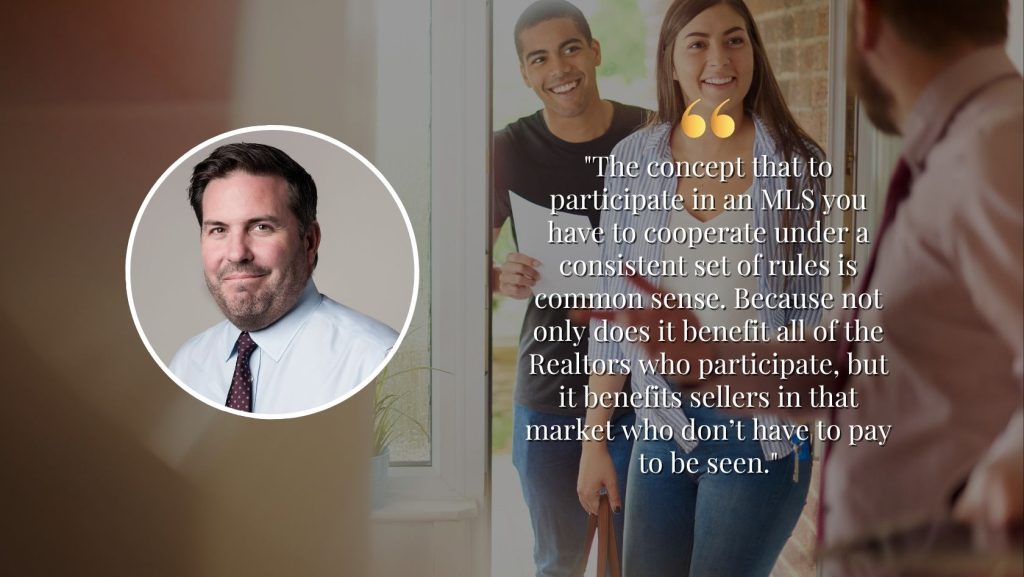
“The concept that to participate in an MLS you have to cooperate under a consistent set of rules is common sense. Because not only does it benefit all of the Realtors who participate, but it benefits sellers in that market who don’t have to pay to be seen.”
This context is important given how much attention the CCP debate has received. As Byron Lazine put it during the episode:
“If you look at CCP, the rule that they made up in 2019, they’ve taken all the meat off the bone. There’s nothing left to it. It’s an irrelevant rule that basically the way they’ve restructured it doesn’t have teeth.”
The Structural Reason Realtor.com Can’t Block Listings
Unlike Zillow and Redfin, Realtor.com is not an IDX broker. That means they don’t operate under the same set of rules that allow brokerages to selectively block listings that don’t comply with Clear Cooperation.
Eales explained:
“I have a one-to-one agreement with every MLS in the country. Because of that agreement, I’m obliged to show those listings. It’s as simple as that.”
He added that if an MLS asks Realtor.com to remove a listing, they’ll comply. But until then, they are contractually required to display everything provided to them.
Co-host Lisa Chinatti responded with surprise:
“I didn’t know that about your relationship with the MLS. That’s new information for me.”
This fundamental difference is why Zillow, Redfin, and others have more flexibility in how they handle listings, and why Realtor.com isn’t playing the same game.
Open Marketplace vs. Selective Gatekeeping
Eales made it clear that Realtor.com sees its role as an open, consumer-first platform that benefits the entire industry.
He pointed to the dangers of turning listing portals into exclusive ecosystems.
“We are on the cusp of a period of time where a lot of sellers are going to work out—after the fact, unfortunately—that had they gotten more eyeballs, more buyers, more offers, they would’ve gotten a higher price.”
He warned against the closed-market models used by competitors, noting that in countries like Australia, sellers have to pay to be seen.
“The concept that you want to be private because it’s ‘boutique’? Come on… for 0.0000% of the population, okay, maybe you have a point. But for everybody else—if you’re selling something, you want it to be seen.”
What This Means for Agents and Sellers in 2025
As the market cools and listing competition heats up, visibility matters more than ever. Realtor.com’s approach may lack the PR splash of its competitors, but it offers something agents can rely on:
- A commitment to showing all MLS listings
- Transparent, one-to-one relationships with MLSs
- No bait-and-switch business models that favor in-house agents or mortgage partners
A brief exchange near the end of the podcast makes it clearer why the latter sees its position as a portal as a strategic advantage not only for them but for the consumer:
Damian:
“If I’m the intermediary—if I have the direct relationship with the consumer and, if I know what their mortgage is, if I can keep an eye on what the market is much better than an individual consumer can—then perhaps I can be that trusted intermediary that is constantly looking to see if they’re on the right deal at the right time. And that’s what choice allows me to do, but that will not be open to my competitors in a closed marketplace.”
Byron:
“So, Realtor.com is maybe a digital consultant on the mortgage side to put them in position for the things that they want most. I don’t want to put words in your mouth, but this is what I’m hearing from you: put them in the right lane for speed or rate because you’re looking at the overall market and matching their needs up with what’s available in the market.”
Damian:
“I mean exactly, and we’re talking about mortgage, but we could be talking about so many other things. If I know who the consumer is, if I know the home that they own, if I know the mortgage that they have—if I’m an open marketplace I have a very unique opportunity to serve that consumer better by ensuring that they’re put in touch with the right connections in a whole variety of different needs…”
Watch the full episode of the Knowledge Brokers Podcast to hear more from Damian Eales on Realtor.com’s evolving strategy, the future of real estate portals, and what it means for agents navigating today’s market.