
Key Details:
- Redfin’s latest report shows how housing affordability influenced early 2024 voter choices, with 38% citing it as a factor in the presidential race—particularly among Kamala Harris voters.
- Key issues for early voters also included the economy, inflation, and democracy, while local races saw housing affordability prioritized alongside crime and safety.
- Voters also expressed varied expectations on mortgage rates based on the election outcome, with many predicting changes depending on the candidate elected.
It’s Election Day 2024! And judging by the early votes that have already been counted, housing affordability is a major influence on voters’ choice of president.
According to a new Redfin-commissioned survey (conducted by Ipsos), nearly four in 10 U.S. residents who have voted as of November 1st (38%) cited this issue as an influence in their presidential pick, along with other leading voter priorities.
That’s 38% of the 442 survey respondents who indicated they had already voted in the presidential election.
Of those 442 respondents:
- 225 voted for Kamala Harris
- 175 voted for Donald Trump
That 38% trails behind the share of early voters influenced by other top concerns, including the economy, inflation, and protecting democracy.
Read on for the report highlights. And watch today’s Hot Sheet for Byron Lazine’s full breakdown of the report.

Housing Affordability a Key Factor in Early Presidential Votes
Among the 442 total early voters surveyed, 38% said housing affordability impacted their choice of presidential candidate. Broken down by vote, 43% of Harris voters prioritized housing affordability as a factor in their vote, compared to 29% of Trump voters indicating the same.
Sitting in 12th place on the list of 14 top issues for early presidential picks, housing affordability ranked below 11 other priorities for the share of early voters saying it impacted their choice of either Trump or Harris.
The largest share of Trump voters (68%) ranked the U.S. economy as their top concern, while the largest share of Harris voters (68%) ranked protecting democracy as the number one factor influencing their vote, followed by 67% prioritizing access to abortion.
Top 14 Issues Impacting Early Presidential Votes:
- U.S. Economy — 63% of total early voters surveyed cited this as an influence in their presidential pick (68% of Trump voters vs 60% of Harris voters)
- Inflation — 59% of total (65% Trump vs 53% Harris)
- Protecting Democracy — 56% of total (44% Trump vs 68% Harris)
- Immigration — 55% of total (72% Trump vs 43% Harris)
- Healthcare — 52% of total (37% Trump vs 65% Harris)
- Crime and Safety — 47% of total (56% Trump vs 41% Harris)
- Access to Abortion — 45% of total (18% Trump vs 67% Harris)
- U.S. Involvement in Foreign Wars — 41% of total (50% Trump vs 34% Harris)
- Freedom of Speech — 41% of total (41% Trump vs 42% Harris)
- Gun Violence — 40% of total (20% Trump vs 56% Harris)
- U.S. Standing in the World — 38% of total (44% Trump vs 36% Harris)
- Housing Affordability — 38% of total (29% Trump vs 43% Harris)
- Climate Change — 36% of total (9% Trump vs 57% Harris)
- Access to Gender-Affirming Care — 19% of total (6% Trump vs 28% Harris)
Top Priorities for Early Voters in Local Races
Housing affordability ranked higher on the list of top concerns impacting early votes in local races. Forty percent of the early voters surveyed prioritized this when voting for local elected officials, placing it fourth on the list of the top 14 voter issues.
Crime and safety ranked at number one, with fully half (50%) of early voters saying it influenced their decision when voting for local political candidates.
Economy came next, influencing 46% of total early voters, followed by inflation at 41%.
The largest share of Trump voters (59%) also ranked crime and safety as the number one issue impacting their vote for local elected officials, while for the largest share of Harris voters (49%), housing affordability and healthcare were tied as the top voting priorities in local races.
Top 14 Issues Impacting Early Votes in Local Races:
- Crime and Safety — 50% of total early voters say this influenced their vote for local elected officials (59% of Trump voters vs 42% of Harris voters)
- U.S. Economy — 46% of total (49% Trump vs 46% Harris)
- Inflation — 41% of total (45% Trump vs 38% Harris)
- Housing Affordability — 40% of total (29% Trump vs 49% Harris)
- Healthcare — 37% of total (26% Trump vs 49% Harris)
- Protecting Democracy — 36% of total (27% Trump vs 45% Harris)
- Immigration — 34% of total (51% Trump vs 21% Harris)
- Gun Violence — 31% of total (19% Trump vs 41% Harris)
- Access to Abortion — 29% of total (13% Trump vs 42% Harris)
- Freedom of Speech — 24% of total (28% Trump vs 23% Harris)
- Climate Change — 22% of total (7% Trump vs 34% Harris)
- US Standing in the World — 15% of total (17% Trump vs 14% Harris)
- US Involvement in Foreign Wars — 14% of total (18% Trump vs 11% Harris)
- Access to Gender-Affirming Care — 12% of total (4% Trump vs 16% Harris)
As for local ballot measures, 37% of early voters say housing affordability impacted their vote. The U.S. economy was the most impactful voter issue with local ballot measures, influencing 47% of early voters, followed by crime and safety (44%) and inflation (42%).
With more than one-third of early voters influenced by housing affordability concerns, this is definitely something agents should be prepared to talk about with consumers, regardless of how either side is voting:

Housing affordability is such an important issue for voters. And as a real estate professional, it’s an issue you’re privileged to be working on….
So once we get past today, I encourage everyone to get involved locally around the housing affordability issue. The data is clear that it’s at the top of everyone’s mind. You need to be leading that conversation and sending out the data so people in your community know you are addressing the issue of housing affordability.
Mortgage Rate Expectations Based on Election Outcomes
Survey respondents also weighed in on what they expect mortgage rates to do after the election, depending on who becomes the next U.S. president.
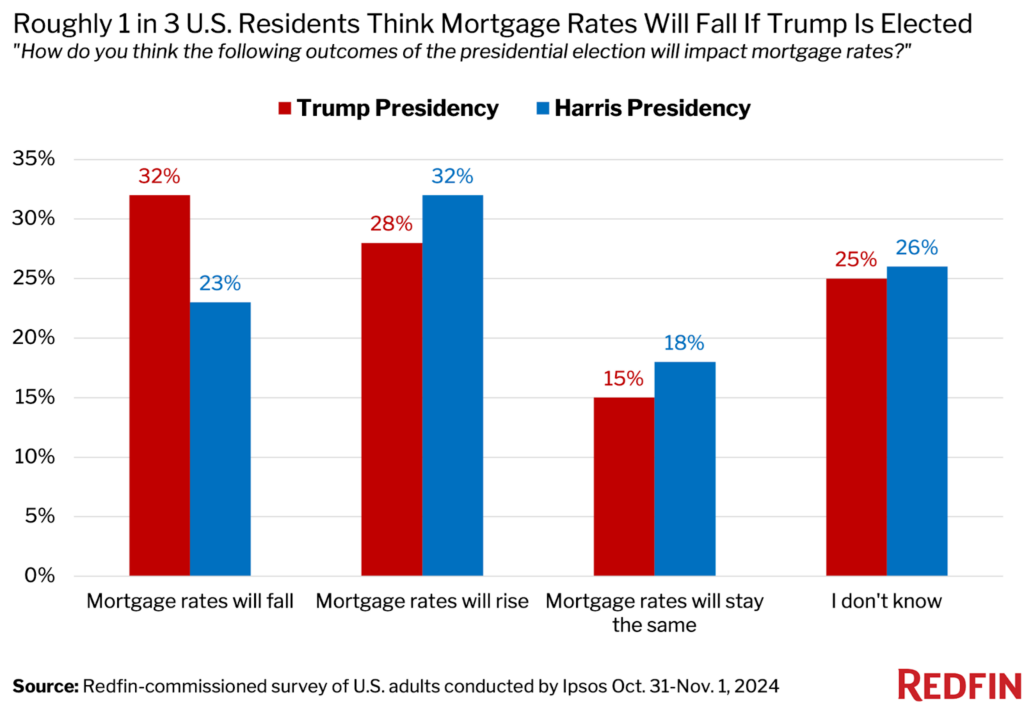
Nearly one-third (32%) believe mortgage rates will drop if former president Donald Trump wins the election, while only 23% expect the same if Vice President Kamala Harris wins.
On the flip side, 32% of respondents expect an increase in mortgage rates if Harris wins, compared to 28% expecting the same if Trump wins.
One-quarter of respondents were uncertain as to what mortgage rates will do regardless of the outcome of the presidential election, with 25% unsure of what to expect if Trump wins and 26% unsure if Harris wins.
Mortgage rates are influenced primarily by economic conditions and Federal Reserve monetary policy. The Fed is politically independent, though the U.S. president and Congress are still able to influence the long-term direction of the overall economy through policy changes.
Mortgage rates are currently above 7%, causing today’s homebuyers to lose $33,000 in purchasing power in six weeks. The Federal Reserve cut rates by 50 basis points in September and outlined plans for future rate cuts, but mortgage rates continue to climb as investors remain cautious about the risk of increased tariffs and government spending after the election.
Ipsos conducted this survey for Redfin on October 31-November 1, 2024, fielding it to 1,002 U.S. adult residents, with four specific questions:
- “How do you think the following outcomes of the presidential election will impact mortgage rates?”
- “Which of the following impacted how you voted for president?”
- “Which of the following impacted how you voted for local elected officials?”
- “Which of the following impacted how you voted for local ballot measures/proposals/initiatives?”
All 1,002 respondents were asked to weigh in on the first question, while only the 442 who voted early responded to questions 2-4.
Read the full report for more information, including methodology. And stay tuned for BAM’s coverage of the election outcome and this week’s FOMC meeting.