

I’ve written a million blogs about how to “appease” the algorithm. What to post, when to post, hooks, text hooks, visual hooks, packaging, trends, retention, calls to action… all of it. That stuff matters.
But there’s a point where it stops working the way you think it does. Not because the tactics are wrong, but because of how you’re using them.
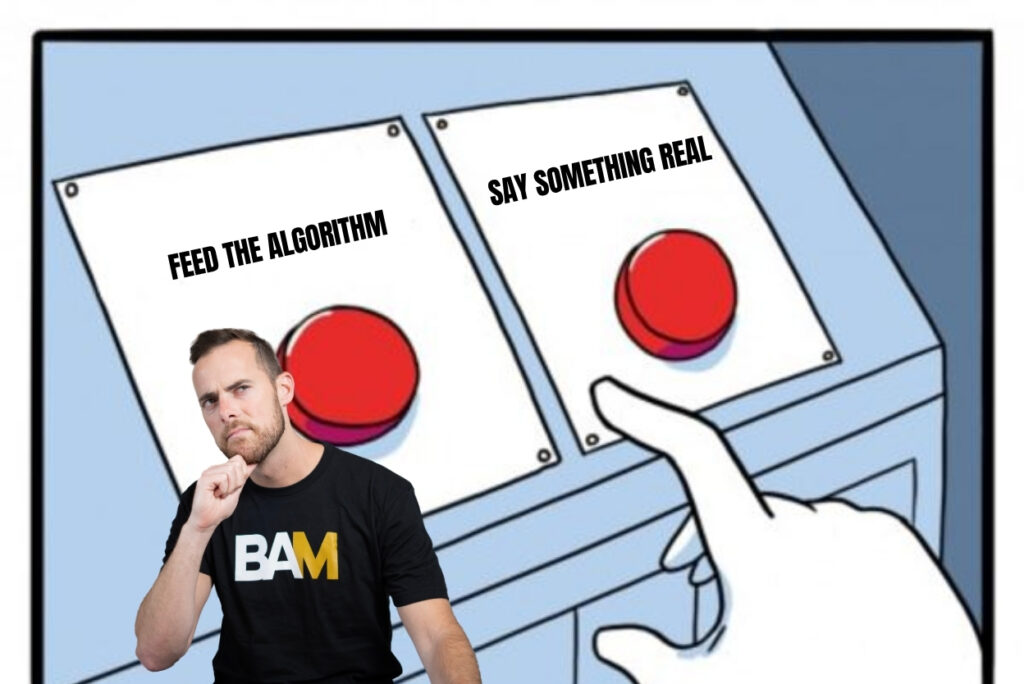
You eventually hit this place where you’re not really creating anymore, you’re just feeding the machine. You’re posting because you feel like you have to. You’re defaulting to formats because they worked before. You’re thinking about how the algorithm will react before you even ask yourself if you actually care about what you’re putting out.
The Content Hamster Wheel Every Creator Falls Into
It doesn’t happen overnight. It just kind of creeps in.
Engagement dips a little. Growth slows down. Nothing falls off a cliff, but everything starts to feel forced. You can still get wins here and there, but deep down, you know what’s happening.
You’ve stopped creating from experience and started creating for the algorithm. “The Jaunt” describes the feeling perfectly:
“Everyone who posts content online arrives at this point…where they now kind of realize what they gotta say to go viral. And maybe they realize that they’re doing this, maybe they don’t, but they start internalizing the algorithm. They start giving the algorithm what it wants. And then they just wake up one day and they’re like, ‘Whoa, I’ve become the cringe clickbait content guy that I didn’t ever want to become.’
“And then you have to go through this sort of like mini death-rebirth cycle and then agree that you’re not gonna focus on views. You’re just gonna focus on getting across messages or content that you feel like even a week or a month or a year later, you’re still gonna feel proud of it. The whole reason so many people get into content creation in the first place is to be truthful, authentic, and to be free, to feel like I can say whatever I want, like, this is not censored… And then you just become a self censor.”
Honestly, I’ve been in that loop for a long time.
For years, The Broke Agent was basically a feedback machine. I could predict what would hit. The meme, the angle, the caption.
- “Dad at inspections”
- “Counting commission before the deal closes”
- Realtor headshots
The bangers. They were pretty much guaranteed to hit, and it kind of took away a lot of my creativity. Why would I change what’s working? I could film a video myself or try to come up with a new angle or a new skit… or I could just post a “seller won’t drop the price” meme and get 10,000 shares.
I’ve talked to other real estate creators who feel the same way. Why put effort or money into a new skit or something highly produced that will get no engagement?
That’s what keeps you on the hamster wheel. You become married to the outcome.
Why Repeating What Works Kills Engagement
It’s dangerous because it feels like you’re doing the right thing. You’re being consistent, showing up, posting. In reality, you’re repeating yourself in slightly different ways and hoping the algorithm will continue to do its thing.
But take it from me, the audience does start to tune out at some point.
So here’s the shift I’m making.
The Return to Authentic Content and 1-0 Storytelling
I’m going back to what Sharran Srivatsaa calls 1–0 content. This is content that only you can make.
Experiences only I have. My opinions, my voice. That doesn’t mean I’m going to stop memes. Of course not. I still enjoy that and can find new angles. But in order to evolve and feel more fulfilled, I want to lean into this more.
I’ve already started by doing more content like this, calling out the most annoying things agents do on social media.
View this post on Instagram
Or addressing my AI anxieties:
View this post on Instagram
Or seeing if anyone wants to go on a real estate spring break:
View this post on Instagram
Engagement is all over the place on these, with my last one being my worst-performing post in years. But I’m more excited about the direction of the page, and it feels like I’m creating content for the fun of it again. Like I’m just getting thoughts out and going on a rant, as opposed to crafting some meme that I hope gets shares to… accomplish what?
How AI Is Changing Social Media Content Strategy
As AI gives every person the ability to mass-produce hundreds of pieces of content a day and copy viral strategies, engagement will continue to drop across all platforms as supply starts to outweigh demand.
You can already see the volume increasing. People who used to post once or twice per week are now uploading five to six pieces of content per day.
The account/people who stand out will likely be the ones who are most authentic and just point the phone and shoot.
In the real estate space, you see it with people like Andrew Undem, who talks about what he’s actually doing in his business through Stories in his car.
He’s not making this for the algorithm. There’s no strategy beyond 1–0 storytelling from his own experiences.
That’s exactly why it works.
Your Audience Knows When You’re Phoning It In
The algorithm is a lot smarter than we give it credit for. And by algorithm, I mean people are a lot smarter than we think. Everyone can pick up on when something is manufactured, when it’s trying too hard, when it’s just another version of something they’ve already seen a hundred times.
It also recognizes when something is different. When it’s raw, specific, and has a real point of view. Again, by “it” I mean you.
That’s the content that gets attention now.
Not because it’s perfectly packaged, but because people actually care about it.
So if you’re wondering when it’s time to switch up your content, it’s probably not when your engagement drops.
It’s when you catch yourself thinking, “I don’t even care about this post… but I’m posting it anyway.”
That’s the signal. That’s when you stop trying to win the algorithm and start saying something worth paying attention to.