

In the latest BAM interview, Andrew Flachner, co-founder and president of RealScout, joins Byron Lazine to review the most impactful—and most surprising—results of The Teams Report.
The report, which is a collaborative effort involving RealScout, Tom Ferry International, and T3 Sixty, reveals trends in real estate team dynamics, economics and growth strategies. The report has four key takeaways, which we cover in more detail below:
- Organizational diversity among teams
- Sphere of Influence (SOI) is Crucial
- Larger Teams Prioritize Spending for Growth
- Optimism for Future Growth
Of the roughly 500 team leaders who responded to the survey, The Teams Report is based on data from 350 of them. Flachner shared many of the biggest takeaways in the interview, with Lazine asking clarifying questions and sharing some of his own insights as the leader of the top real estate team in Connecticut.
Read on for the highlights. Then, for the perfect companion to The Teams Report, make time to enjoy the full conversation:

#1: Organizational Diversity Among Teams
Flachner revealed data on the team leaders who responded to the survey. Based on their input, the median team size in 2024 was six licensed agents, with nine out of ten (91%) teams having at least one non-agent team member, such as marketing, transaction management, or administrative personnel.

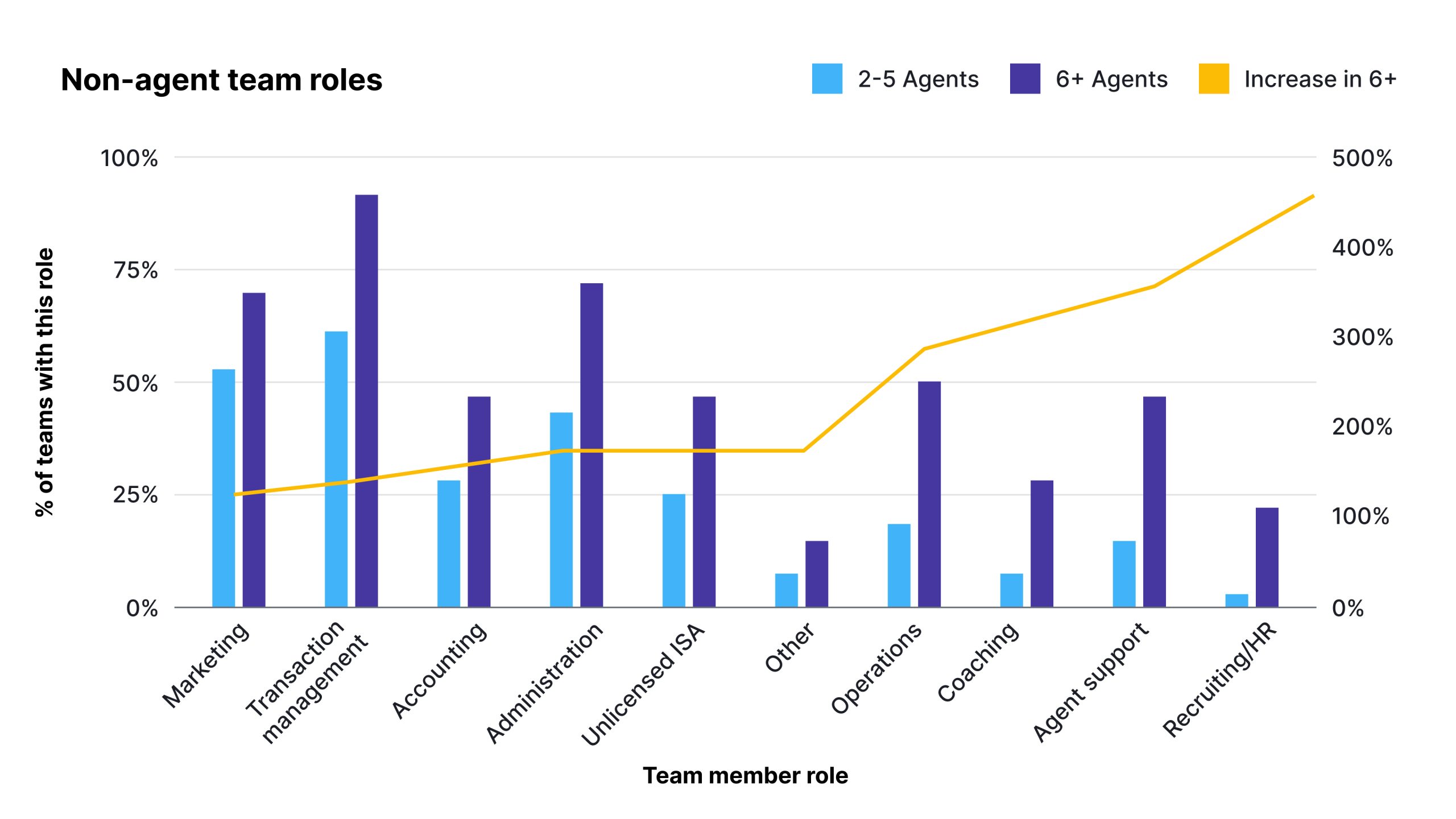
Lazine made the point that hiring marketing personnel ahead of transaction management is backwards, which is something he’s learned from experience.

If you’re growing a team, [if] you’re a team leader, you’re probably still the best marketer in your office or on your team. You probably have the best marketing mind—more likely than not—and transaction management is such an easier role to fill than a great marketing person.
Flachner and Lazine also discussed the three different types of teams:
- Unified — a team of agents working almost as an assembly line, serving a singular customer and using a singular database.
- Cooperative — a team of agents working independently under a team umbrella, each working their database and lead sources, but all of them benefiting from shared resources or shared marketing.
- Hybrid — a combination of unified and cooperative team styles
Regarding the third type, hybrid, Flachner made the point that it’s a popular option, particularly among larger teams.

As teams grow, they may need to acquire other teams or merge with other teams. So, there is that separation but also that unified nature of a team because why would you join a team if not to get the operational efficiencies?
#2: Larger Teams Prioritize Spending for Growth
When it comes to lead spend, the majority of small teams spend less than $1,000 per month, while the median large team spends between $2,500 and $4,999 per month.
Not only that, but larger teams also spend more on a per lead basis, often exceeding $20 per lead. The reason is twofold, as Flachner pointed out:
The majority of small teams are spending less than $1,000 per month on lead gen…And the median large team spends between $2,500 and $5,000 a month on…paid lead gen. This is not surprising in isolation, right? Obviously, bigger teams are more capable of spending more money; they should be spending more money. But are large teams spending big on lead gen because they’re big, or are they big because they spend a lot on lead gen? And that is the question that we wanted to get to the bottom of.
I think if you look one layer deeper on the analysis, what you actually find is that, not only do larger teams spend more on lead gen in aggregate, they actually spend more on a per-lead basis. So, while 50% of small teams said their average cost per lead was below $20, many of the larger teams are spending far more per lead.
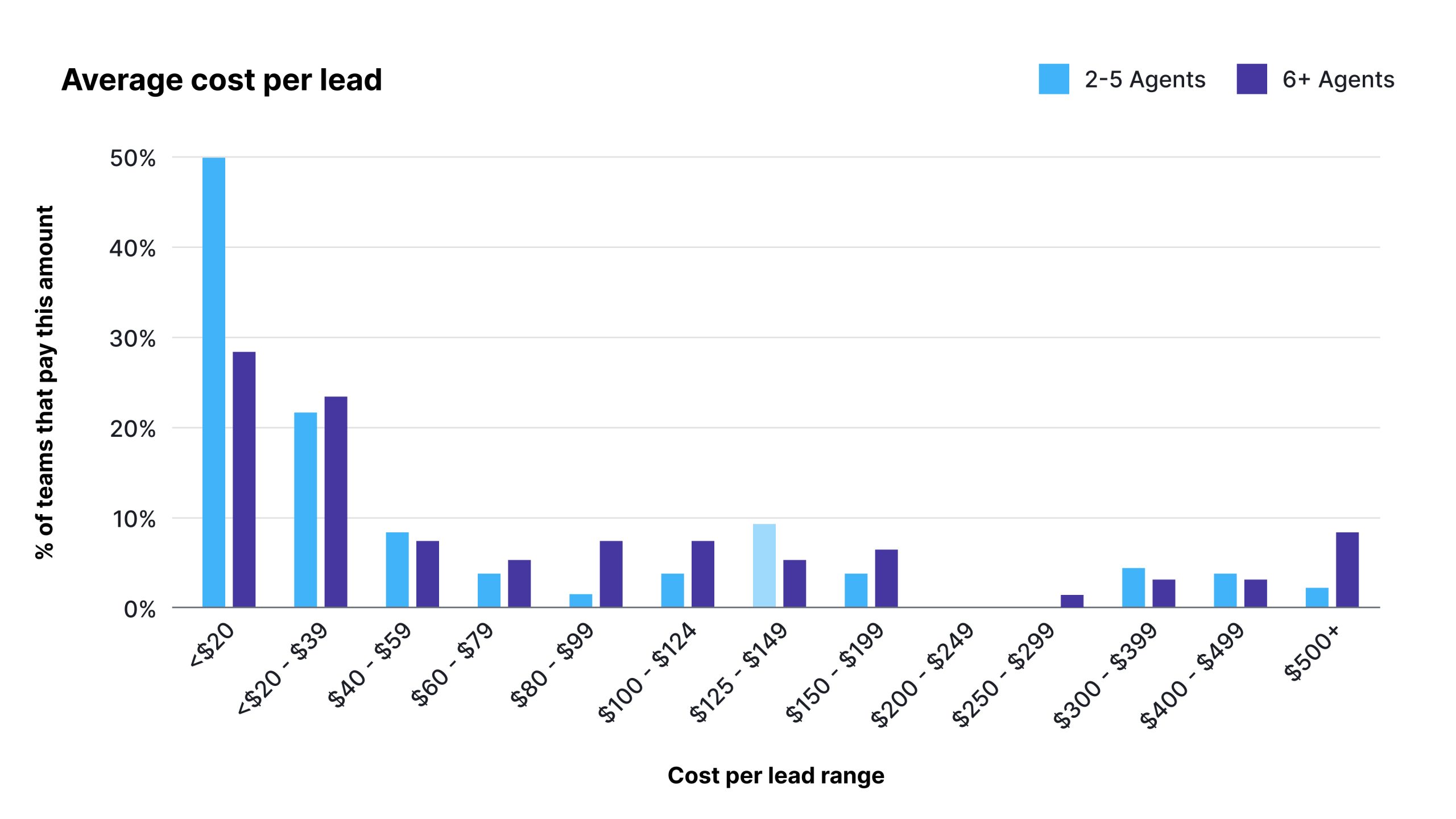
Larger teams spend more on lead generation—and on a per-lead basis—not just because they can but because they would rather sacrifice some of their margins to position themselves for long-term growth.
As Flachner pointed out, larger teams are also willing to pay a higher referral fee, compared to smaller teams. As he puts it, “I think there’s an argument to be made that these larger teams are willing to pay more for higher-quality leads and for channels that are deeper.” For larger teams, the median is 30-34% on a referral fee, while the median for smaller teams is 25-29%.
#3: Sphere of Influence (SOI) is Crucial
Based on survey responses, nearly 80% of both large and small real estate teams generate “most” or “many” of their transactions from their sphere of influence (SOI) or from referrals.
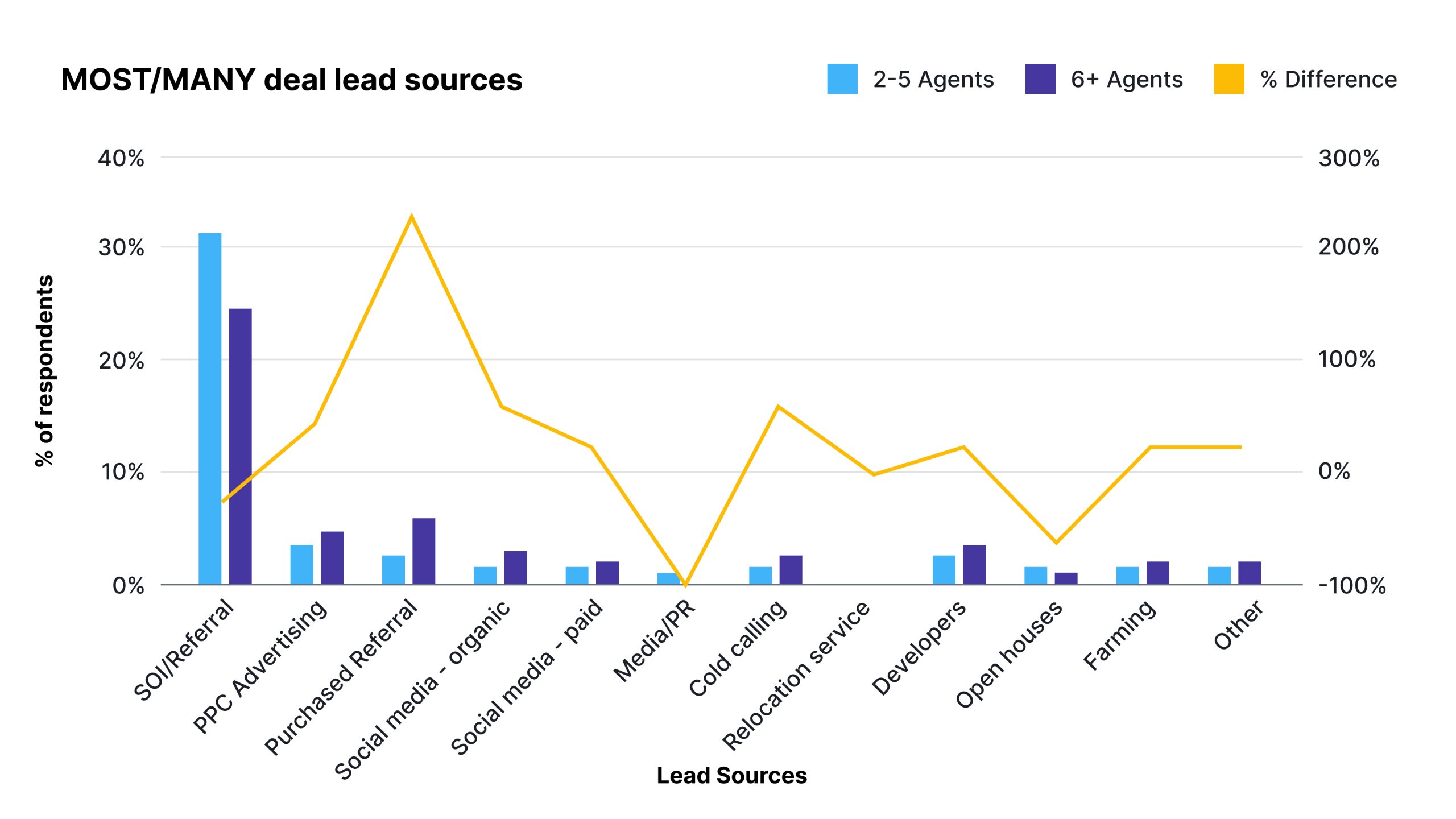
So, this is probably the least surprising thing that I’ve found in the report—that the majority of business is going to come from sphere of influence and referrals—but let’s dig into it because there are some surprising insights that stem from that.
The follow-up takeaway? Four out of ten team leaders (40%) rated their satisfaction with their own lead nurture systems at five or below. Less than one-quarter rated it at a nine or 10.
Together, those numbers reveal widespread dissatisfaction—and an opportunity for improvement.
The general takeaway: While SOI marketing is the most important channel for customer acquisition (i.e., lead generation), many, if not most, teams are underinvesting in it.
As Flachner added, this is largely due to human nature; people, as a whole, tend to invest less of their time and money in things that are working.
We have this fear of loss, so when something is broken or not performing, we want to put all our resources there. Not getting many deals from SEO? I’m going to dump $10,000 into SEO to fix that problem. Whereas the rational thing to do would be like, ‘Okay, if my business is coming through sphere of influence, I want to double-down on that. I want to pour fuel on the fire.
As the chart below shows, 5.4% of team leaders describe their long-term lead nurturing system as “nonexistent,” while more than half (54.4%) described it as “basic.”

As in any aspect of your business, you can’t fix what you can’t see. And you can’t improve your numbers, if you’re not aware of them.
If something is working, do more of it…and if it’s 40% of your business, and if you increase it by 5%, that’s a huge number for anybody… Every year, you should be able to look back and understand, in one spreadsheet, ‘Here’s where the majority of my business comes from, here’s the #2 place it comes from,’ and then be able to address that into your planning for the next year.
#4: Optimism for Future Growth
Nearly three-quarters of the team leaders responding to the survey (74%) expect more than 10% year-over-year growth—with only 2.5% predicting negative growth for their business. For the most part, teams expect to outperform the housing market even as less experienced agents leave the industry—and despite whatever curveballs the market sends their way.
While knowledgeable real estate professionals are miles ahead of their peers when it comes to interpreting market shifts and guiding their clients through the storm, there’s always an element of uncertainty.
Despite that, teams are highly optimistic about growth opportunities and their ability to continue gaining market share, even in a challenging environment.
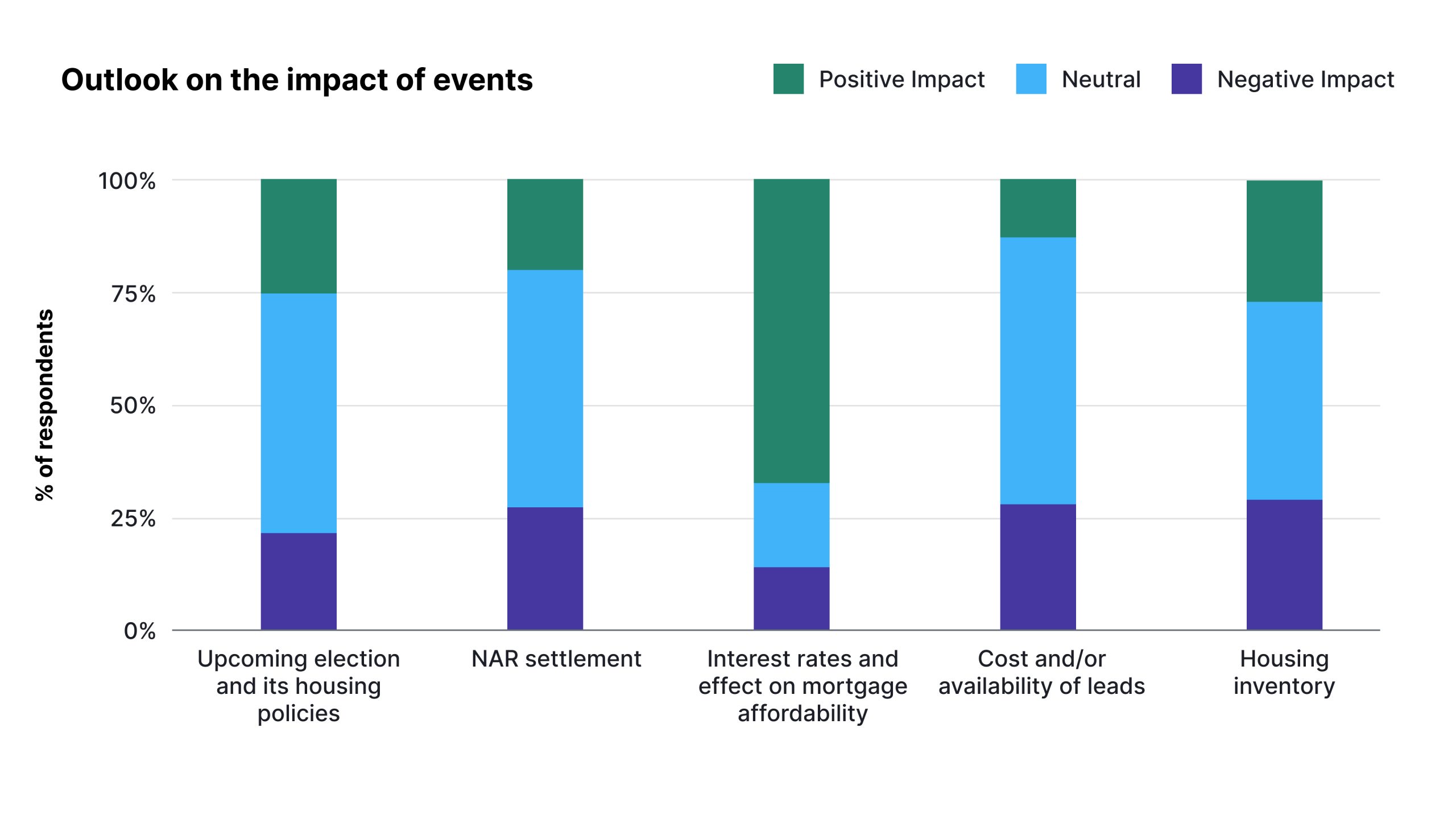
Speaking of which, team leaders also shared their expectations on how specific challenges (both present and imminent) will impact their business this year and into the next. Agents are generally fairly optimistic about their ability to survive and even thrive amid these challenges, with the majority of team leaders expecting a net positive impact from interest rates and their effect on mortgage affordability.
Bookmark and watch the BAM interview to get the full breakdown of the report with Flachner’s and Lazine’s top takeaways. What better way to prepare for business planning this fall?
To access the complete report and join the conversation, click here.