

Key Details:
- Following Tuesday’s markup meeting, the Senate Banking Committee advanced the bipartisan ROAD to Housing Act of 2025, the first housing package in over a decade to earn support from both parties.
- The bill includes proposals from every committee member and incorporates elements from Up for Growth Action’s legislative agenda.
- Key provisions aim to expand housing supply, improve affordability, and increase oversight of federal housing programs.
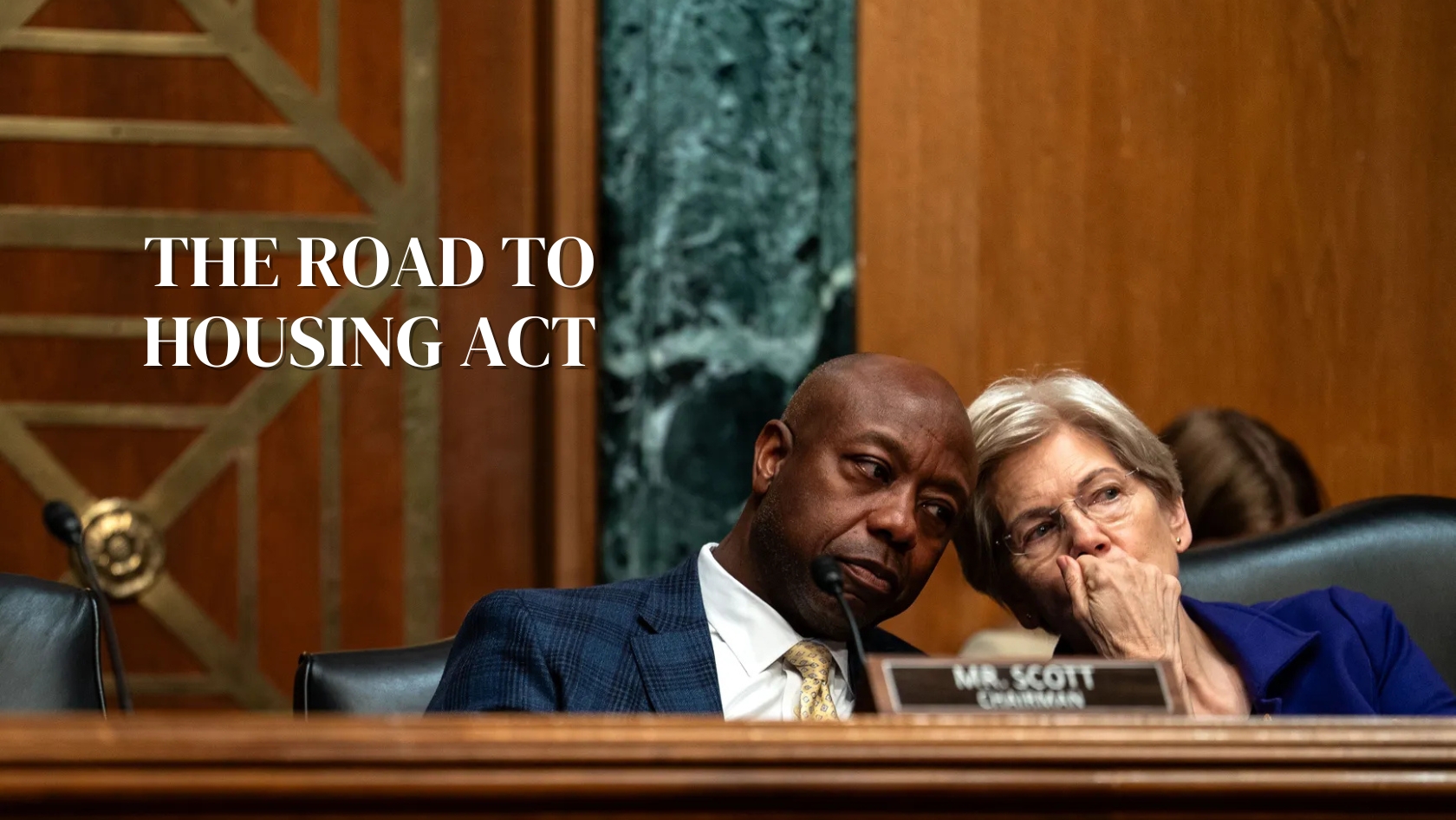
The ROAD to Housing Act of 2025, a 315-page bill unveiled last Friday, was the subject of a markup meeting in the Senate Banking Committee Tuesday morning. Committee members reviewed the legislation—its contents and contributors on both sides of the political aisle—and voted on whether it should proceed to the Senate.
The results of that vote? 24 ayes and zero nays. Senator Scott made it official:
“The ayes have it. The ROAD to Housing Act of 2025 is hereby ordered reported to the full Senate…”
To be clear, the bill still has to clear both the Senate and the House to get to the president’s desk. But one significant hurdle has now been cleared.
So, what, exactly, is in the bill that could change the U.S. housing market for the better?
A Bipartisan Move on Housing
For the first time in more than a decade, bipartisan housing legislation has advanced through the Senate Banking Committee.
The ROAD to Housing Act, led by Senator Elizabeth Warren (D-MA) and Senator Tim Scott (R-SC), aims to lower housing costs by expanding supply, preserving existing options, and rewarding communities that take meaningful action.
Senator Warren, speaking as the committee’s ranking member, described housing as “most families’ largest monthly expense” and called for “more housing options everywhere for everyone.”
She also reiterated her commitment to work with both Republicans and Democrats to deliver cost relief for American families.
What’s Inside the ROAD to Housing Act
The bill includes proposals from every member of the committee, each addressing a different aspect of the housing affordability crisis.
Warren credited the following in her highlight reel of contributors:
- Expanding supply: Proposals from Senators Blunt Rochester, Tillis, Alsobrooks, Rounds, and Reed focus on manufactured and modular housing and on reducing red tape that drives up development costs.
- Preserving affordability: Senators Smith, Rounds, Reed, and Crapo introduced measures to protect housing options for renters, homeowners, veterans, and rural communities.
- Fixing valuations: Senators Warnock, Gallego, and Cramer contributed provisions to improve the reliability of home appraisals and address appraiser workforce shortages.
- Reauthorizing federal programs: Senator Cortez Masto proposed reauthorizing HUD’s HOME program and creating the PRICE Program, designed to preserve long-term affordability in manufactured housing communities.
- Local incentives: Warren and Scott secured support for an Innovation Fund that rewards communities for boosting supply and lowering construction costs. Additional bipartisan proposals include Senator Kennedy’s push for zoning reforms and Senator Banks’ support for modular financing options.
Senator Warren closed her opening remarks by thanking Chairman Scott and his staff for their leadership and collaboration.
The ROAD to Housing Act reflects a rare level of bipartisan cooperation on one of the country’s most urgent issues and sets the stage for broader action on affordability.
Chairman Tim Scott’s statements before the vote included the following:
“Since taking over as Ranking Member in 2022, I pledged to make housing a top priority and put forward commonsense reforms to reverse decades of failed housing policies. Now, as Chairman, I’m proud to lead the committee in considering comprehensive legislation that will increase access to affordable housing for Americans across the country. This is a collaborative effort that includes the work of my colleagues across the committee, and I look forward to advancing these solutions to the full Senate.”
What the ROAD to Housing Act Actually Covers
The ROAD to Housing Act of 2025 is more than a messaging bill. It’s a comprehensive package of reforms designed to expand supply, improve affordability, and tighten oversight across the housing system.
Announced on July 25 by the Senate Committee on Banking, Housing, and Urban Affairs, the legislation reflects months of collaboration between both parties and a wide range of housing stakeholders.
The bill pulls together major pieces of legislation from the Up for Growth Action agenda, including:
- Housing Supply Frameworks Act
- Build More Housing Near Transit Act
- Property Improvement and Manufactured Housing Loan Modernization Act
- Rural Housing Service Reform Act
- Accelerating Home Building Act
- Build Now Act
- Unlocking Housing Supply Through Streamlined and Modernized Reviews Act
- BUILD Housing Act
- Housing Affordability Act
- Housing Supply Expansion Act
The full package is built around three core goals:
-
Expand and preserve housing supply
-
Improve housing affordability and access
-
Advance accountability and oversight
The press release also drew praise from Up for Growth Action CEO Mike Kingsella, who described the legislation as a “landmark” effort that demonstrates “bold, committed, bipartisan leadership at the national level.”
“America’s housing shortage and affordability crisis is a defining challenge of our generation. From coast to coast, the severe shortage of homes affects every individual, household, and community…
“Today’s announcement by Chairman Scott and Ranking Member Warren of the bipartisan ROAD to Housing Act exemplifies the leadership and decisive action we’ve long advocated for. This landmark legislation includes critical, common-sense provisions designed to increase housing supply, boost economic opportunity, and strengthen communities across America. Up for Growth Action is dedicated to driving this legislation forward, collaborating closely with members and partners to ensure its success.”
Now that the bill is on its way to the Senate for a full review and vote, stay tuned for further developments.