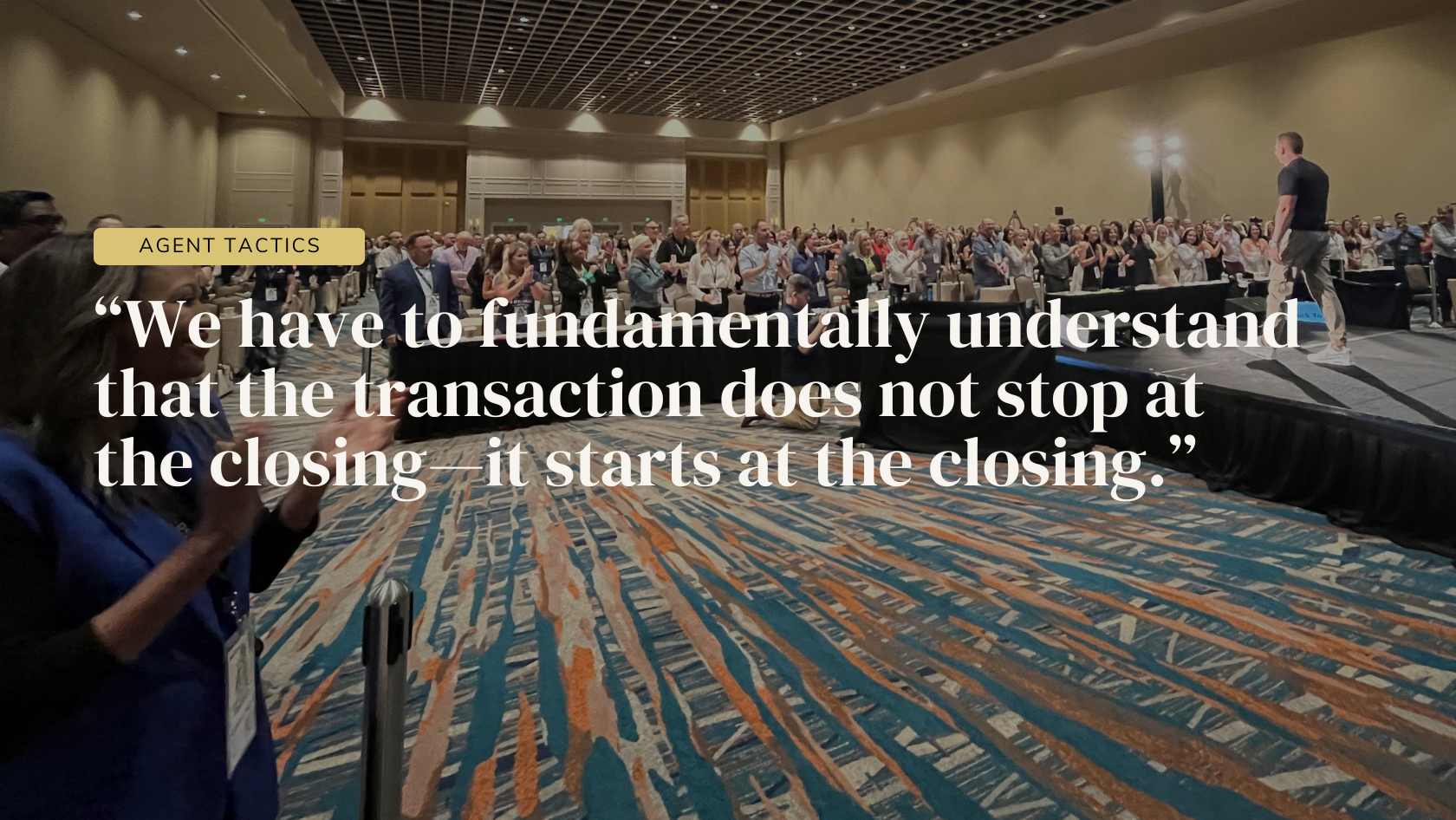

When Jared James stepped onto stage last week in front of over 1,100 industry professionals, his mind wasn’t on what’s new or what’s trendy—it was on the key to long-term success in real estate.
With a nod to the past, James titled his 90-minute opening keynote for the 10th anniversary of the Jared James Advance “Back to the Future.” In preparing for the event, he kept coming back to the same things—things that have always worked.
“We know that when everybody goes in one direction, we have to go up the other direction,” James said. “When everybody’s talking about change, we have to think about what hasn’t changed.”
For anyone who is familiar with him, this seemingly counterintuitive advice is classic Jared James. Instead of simply following industry trends, he digs deeper.
And that’s why, over and over, James encouraged agents to focus on one thing: relationships.
Relationship vs. Transactional Agents
James told the audience that his main message for the two-day conference was a message “for the mature.” It wasn’t about learning something exciting and new, he explained, but a reminder.

“We have to be hungrier to be reminded than we are to be taught.”
What exactly does that mean? “Being taught is sexy,” James said, and “being reminded is boring.” Right now, the entire industry is focused on learning new rules, new guidelines, new forms. And James argued that it’s pushing professionals into becoming transactional agents.
As James explained, transactional agents scramble to relearn the ever-changing rules dictated by associations and attorneys. Relational agents, on the other hand, rely on the strength of their client connections, easing what might otherwise be a stressful process.
“In an industry that’s constantly trying to push you toward being transactional, the only thing that really matters is the relationship with the person in front of you—not just now, but moving forward,” James said.
That new conversation you need to have with buyers about signing an agreement? It’s easy when you’re already in relation with that client. When you’ve worked with someone and stayed in communication, signing one more piece of paper doesn’t take much explaining. He argued that your client’s commitment to you is rooted in the relationship—not the contract. So, naturally, it becomes challenging when agents stop communicating with clients after a transaction has closed.
“At the end of the day, we have to figure out how to keep it relational. We have to make decisions that are about our consumer, not us.”
Of course, James doesn’t deny the important of learning the industry changes. Instead, he challenged the room, pointing out that many of the difficulties agents face today come from ignoring those relationships. “The reason it’s such a stress in your business, and you’re having to relearn everything over and over again, is because you didn’t listen to what we were saying the last 10 years. That’s the truth.”
The True Value of a Client (The $170,000 Secret)
At one point, James asked the audience, “How many times have you heard me talk about the lifetime value of a client?”
While many have probably never done the math, James went on: “It’s not $8,000 or $9,000. The lifetime value of a client now is over $170,000. That’s the number of times they’ll use you if you stay in contact. How would you treat that person if they were worth $170,000?”
The lesson here is simple but career-changing: real estate transactions don’t end when the keys are handed over the the new owners.
“We have to fundamentally understand that the transaction does not stop at the closing—it starts at the closing.”
It’s why James never uses the term past clients. “Active clients, prospective clients—that’s it,” he said. “You’ve got prospective clients that you’re trying to convert, and you’ve got active clients, which is just people who are actively buying and selling from you. And the rest of the people are actively prospecting on your behalf, based on your ability to stay in communication.”
Don’t Get Romantic About the Past—Get Excited About What’s Next
Toward the end of his keynote, James warned about the trap of being too nostaligic. “We are getting way too romantic about what was instead of excited about what is about to be,” he said. Reflecting on his own experience, James shared a story of giving up playing soccer in college to pursue a full-time career. It wasn’t an easy choice, but it’s one that shaped his future.
“Sometimes we have to let go of what was and get way more excited about what’s coming,” James reminded the audience. And right now, that’s what the industry needs most.
“There is no greater time than right now to be a great agent. No greater time—when there’s uncertainty and there’s panic—for you to be great at your job.”