
Housing already comes with enough uncertainty. Now, Polymarket wants to make that uncertainty tradable.
This week, the crypto-based prediction market announced plans to launch real estate prediction markets that let users speculate on future home prices. The news spread quickly on social, amplified by an X post from Watcher.guru that read,
“JUST IN: Polymarket announces plans to launch real estate prediction markets, allowing users to predict future home prices.”
Reactions ranged from skeptical to sarcastic to amused. Not a lot of surprise, but a fair amount of thinly-disguised cynicism. We’re sharing some of our favorites below.
The announcement itself was covered by both CoinDesk and Bitcoin.com, and together they paint a clearer picture of what Polymarket’s actually building, and why it matters.
How the Polymarket–Parcl Markets Actually Work
At the center of the rollout is a partnership between Polymarket and Parcl. The goal is to bring housing into crypto-native prediction markets using daily data, not traditional monthly housing reports.
Under the agreement:
- Parcl supplies independent, publicly verifiable, city-level housing price indices.
- Polymarket lists and operates the prediction markets.
- Each market resolves based on Parcl’s published daily index values, which are designed to reduce ambiguity around outcomes.
CoinDesk emphasized one key distinction. These markets rely on daily housing indices rather than monthly data, which means price signals update far more frequently than most people in the industry are used to seeing.
That frequency’s the entire point. Faster data allows clearer settlement and more precise bets, even if the underlying asset remains slow-moving compared to stocks or crypto.
What Traders Will Be Betting On
These markets aren’t about buying or selling homes. They’re about price direction.
Initial market templates will focus on major, high-liquidity U.S. metro areas, including New York, Los Angeles, and Chicago. Participants can place bets on outcomes such as whether a city’s housing index rises or falls over a defined period of time.
In practical terms, that means:
- No property-level analysis.
- No individual home comparisons.
- No negotiations, inspections, or closings.
Everything settles against a single, city-level index number published by Parcl. In a nutshell, it’s housing reduced to a signal.
Why Housing Is Becoming a Prediction Market Category
Prediction markets have already moved well beyond political elections. CoinDesk noted that platforms like Polymarket are steadily expanding into sports, pop culture, and real-world economic indicators. And if you’re a Hot Sheet regular, you’ve heard Byron Lazine bring up Polymarket’s prediction on the outcome of the upcoming FOMC meeting.
Housing’s a natural next step, even if it feels uncomfortable.
In the announcement, Polymarket spokesperson Matthew Modabber framed the expansion as overdue. He said real estate should be a “first-class category” within prediction markets, emphasizing the importance of clear, verifiable data for transparent settlement.
Parcl CEO Trevor Bacon took a broader view, describing the partnership as part of a paradigm shift in how markets express views and signal truth.
Those comments help explain why daily housing indices matter here. Monthly reports are useful for trend analysis, but they aren’t well suited for markets that need definitive resolution dates.
Prediction markets demand clean answers, even when the real world’s messy.
This Isn’t the First Time Housing’s Been a Bet
While the technology feels new, the idea itself isn’t.
CoinDesk pointed out that housing-related betting markets have appeared before. In 2008, the UK betting exchange Betfair ran markets tied to a potential housing crash.
During the 2020 pandemic, its Australian arm launched similar markets as prices swung amid lockdowns and uncertainty.
Those efforts didn’t redefine housing overnight, but they did reflect a recurring impulse. When housing becomes volatile, people look for ways to express opinions about where prices are headed, even if they’re not buying or selling property themselves.
Case in point: housing doomers on X, etc.
What This Signals for Housing Data and Perception
The most interesting replies under the Watcher.guru post caught our attention for a reason. They tap into a real tension between housing as shelter and housing as a financial instrument.
JUST IN: Polymarket announces plans to launch real estate prediction markets, allowing users to predict future home prices.
— Watcher.Guru (@WatcherGuru) January 5, 2026
Here are a few of the comments that stood out:
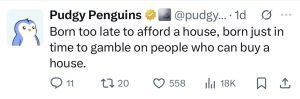
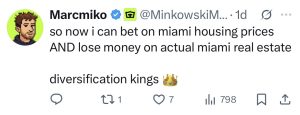
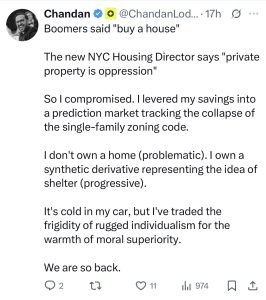


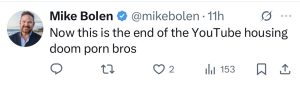
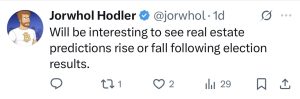

Even so, the more interesting signal here isn’t speculation. It’s data.
Daily housing indices, regardless of whether prediction markets thrive, point toward a future where housing prices are tracked, discussed, and reacted to in near real time. That shift has implications for how narratives form, how sentiment spreads, and how quickly perceptions can change.
You don’t need to believe prediction markets belong anywhere near housing to recognize the trend. Housing data’s becoming faster, more granular, and more intertwined with broader financial ecosystems.
Polymarket’s simply one of the first platforms building a market around that shift.