
There’s a big difference between using AI to crank out content and using it to build something people actually want.
The good news? Once you know what your audience wants from you, the right tools can make it a LOT easier to get in front of them with content they’ll want to save as a resource.
And once they associate you with feeling smarter, they’re more likely to check out your profile to learn more.
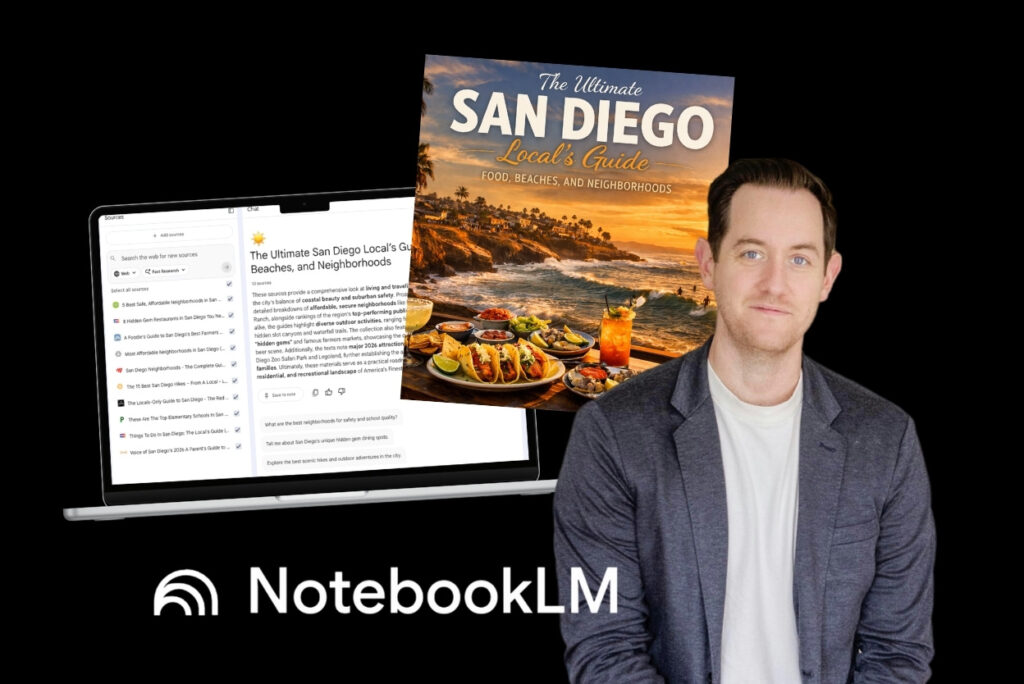
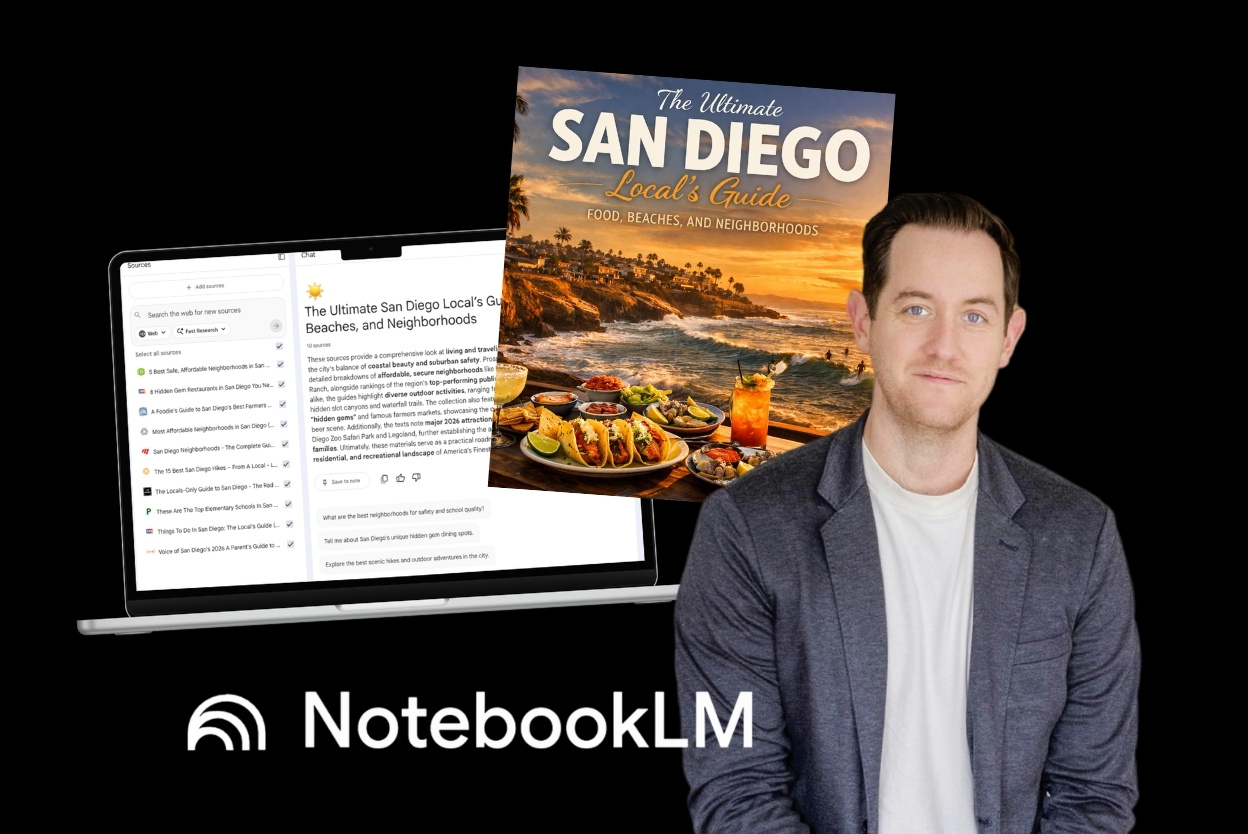
On last week’s episode of The Walk Thru podcast, Jason Cassity sat down with The Broke Agent and walked through how he’s using Google’s NotebookLM to create hyperlocal buyer guides in minutes.
From there, he turns one guide into a full set of content, including lead magnets, visuals, and even a podcast audio file with two virtual co-hosts.
Here we’re breaking down Jason’s workflow step by step, along with a few pointed takes from both hosts on how agents are using AI right now and what’s best left on the cutting floor.
2-Minute Buyer Guide Workflow
Jason keeps the process tight and repeatable, which is why it’s easy to apply in any market.
He opens a new notebook and asks for a guide focused on a specific area. In his example, that’s San Diego, with inputs like local spots, food, school districts, and housing prices.
Here’s the prompt he shared:
“I want to write a guide for San Diego. I want to include, local spots, best food, best school districts, best housing prices…”
Notebook LM will search the web for all of your sources. Then it opens up the chat and it’ll start to ask you more questions. From there, Jason added to the prompt:
“What are some of the best hidden gems? What are the best secret beaches? What are the best local burger spots?”
From there, NotebookLM builds the foundation, and he layers in local knowledge to shape the final output. The workflow looks like this:
- Start with a clear prompt for your market and what you want included
- Let NotebookLM pull in 10–15 sources automatically
- Add local insights like hidden gems, neighborhoods, and go-to spots
- Refine the guide with follow-up prompts for more detail
- Use the finished guide as the base for multiple content pieces
NotebookLM organizes everything into one workspace, so instead of bouncing between tabs, the research and structure are already in place.
Within a couple of minutes, he has a complete buyer guide that pulls from real sources and reflects how a local would actually talk about the market.
And it’s ready to turn into something people will use.
How NotebookLM Turns One Guide Into Multiple Content Assets
This is where things start to get interesting.
NotebookLM doesn’t stop at a written breakdown. It takes the same set of inputs and turns it into different formats you can actually use across your marketing.
Here’s how Jason put it:
“So what Notebook LM does is it takes all the data that you’ve made and then it turns it into things. And I say things because you could actually say, ‘Hey, I just want an infographic of all of these things.’ It’ll take all of your sources, and it’ll make up a little infographic that you can use on social… “And you can see here on the left, it actually broke down the San Diego guide into like a slide deck, which you can now offer as maybe a PDF or a lead magnet.”
Instead of creating content from scratch each time, you’re reshaping one dataset into multiple assets:
- Infographics
- Slide decks
- Flashcards & carousel content
- Audio overviews
Jason drew attention to this last option and explained how it works:
“You can actually break this down into an audio overview. So it’ll have actually a male and a female voice talking back and forth where they’re discussing what it is that’s in your chat.”
Each of these comes from the same original input. You’re building once and then shaping it for different platforms depending on where you want it to show up.
What Agents Should and Shouldn’t Be Doing With AI
Jason and The Broke Agent didn’t spend much time arguing about which tools are better. They focused on how agents are actually using them, and where things are breaking down.
A lot of content online right now feels interchangeable. You can spot it within a few seconds. The same sentence and paragraph structures keep cropping up. The tone feels generic. The cadence feels so familiar it’s almost hypnotic.
The Broke Agent called out content creators posting raw AI content:
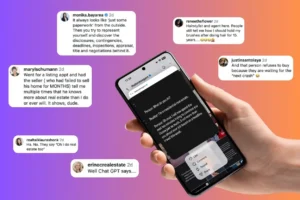
“If you want to use it as ideation, that’s fine, but every post now is someone copy-pasting this long caption directly from ChatGPT. And you can tell.”
They both made the same point in different ways. AI works best when it supports your thinking, not when it replaces it.
- Use AI to organize ideas and speed up your workflow
- Bring your own perspective into anything you publish
- Rewrite outputs so they sound like a real person
- Turn one idea into multiple pieces of content instead of starting from scratch
- Keep your process simple enough that you’ll actually stick with it
They also called out a few habits that are becoming more common.
Posting raw AI output is one of them, and it’s gotten hard not to notice. Long captions with the same pacing, the same formatting, and the same tone show up everywhere. LinkedIn came up as a place where this is especially noticeable. Substack is another one.
Even platforms where users pride themselves on authentic content are not immune.
Another issue is how much attention goes into the tools themselves. Announcing a switch from one platform to another doesn’t change the quality of the content.
In The Broke Agent’s words:
“Everybody’s announcing now what they’re using, almost like it’s that big of a deal, like they’re announcing a brokerage change or something… ‘I switched from ChatGPT to Claude’ or ‘If you’re still using ChatGPT, you’re an idiot. Here’s what I’m doing with Claude.’ … Who cares?”
Turn One Guide Into a Content Engine
Forget the tool for a second and look at how this actually gets used.
Jason starts with a simple idea, builds a guide in a couple of minutes, and then turns it into multiple pieces of content that can live across different platforms. The time savings are obvious, and the bigger win is consistency. You’re not starting from scratch every time you need something to post or send.
The agents who get traction from this are the ones who take what they already know about their market and package it in a way that’s both visually appealing and useful for their audience..
When that happens, the content starts to stack. The guides turn into lead magnets. The visuals turn into videos. The same ideas show up in different places without feeling recycled.
This is a system you can run every week without burning out.
Just remember to keep your editing hat on so every piece of content is clear, accurate, and relevant to your audience.