
Key Details:
- A new Redfin analysis shows the median monthly housing payments in swing states have surged 92% since the 2020 election, reaching $2,161, driven by rising home prices and mortgage rates.
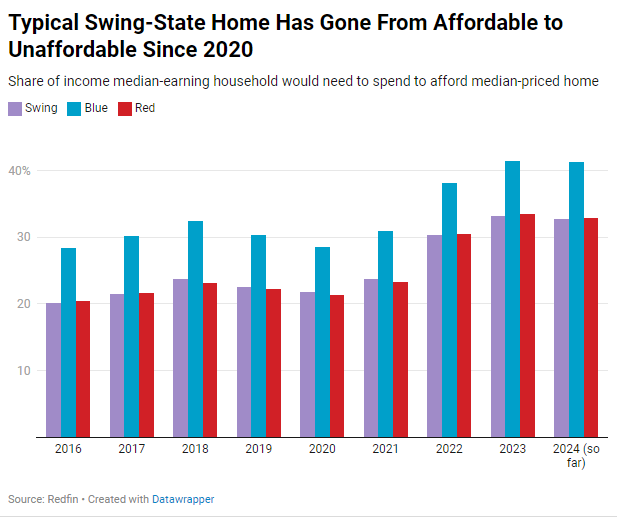
- Housing affordability has significantly worsened, with the median-priced home in swing states now unaffordable for the average family, requiring 32.8% of their income, up from 21.8% in 2020.
- The affordability crisis is a major issue for voters in the 2024 presidential election, with nine out of ten Gen Z voters ranking it as a top priority.
The typical homebuyer’s monthly mortgage payment in swing states has almost doubled since the 2020 presidential election.
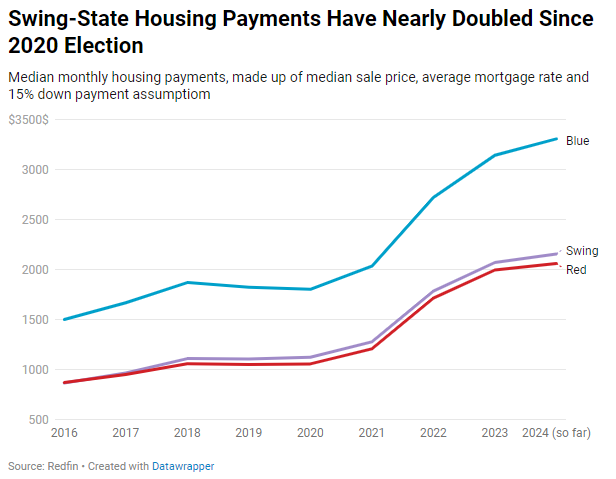
That’s according to a new Redfin analysis, which shows a 92% surge in the median monthly payment for homebuyers in these markets—to an all-time high of $2,161.
The two key factors driving up those monthly payments:
- The median home sale price has climbed nearly 40% to a record high of $316,063 in 2024
- The current average mortgage rate (30-year fixed) is at 6.89%, more than twice the record low of 2.65% at the start of 2021.
In red states, the median monthly house payment has increased by 95% to a record $2,066, while the median payment in blue states has climbed 83% to a record $3,311.
Affordability across the spectrum
A typical swing-state homebuyer earning the median income ($79,155) would spend 32.8% of that on housing—up from 21.8% in 2020. That 11% difference amounts to $8,707 a year or about $726 a month.
To spend no more than 30% of the median household income on a median-priced home, a swing-state homebuyer would need to earn $86,421—which is almost twice the $45,140 required in 2020.
Median-income homebuyers in red states would spend 32.9% of their earnings on housing payments, up from 21.4% in 2020. And in blue states, 41.3% of the median income would go toward housing, up from 28.6% in 2020.
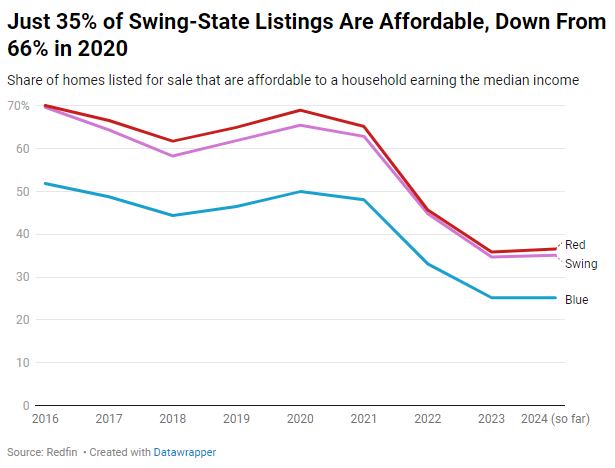
In 2020, 65.5% of the homes listed in swing states were affordable to median-income homebuyers. Today, that percentage is down to 35.1%.
Affordability is slightly better in red states with 36.6% of listings affordable to median-income households—though the 32.4 percentage point drop from 69% in 2020 is steeper than the 30.4 ppt drop for swing states.
Blue states have the smallest percentage of affordable homes at 25.2%, though the decline from 50% in 2020 is the smallest at 24.8 percentage points.
Racial disparities in housing affordability
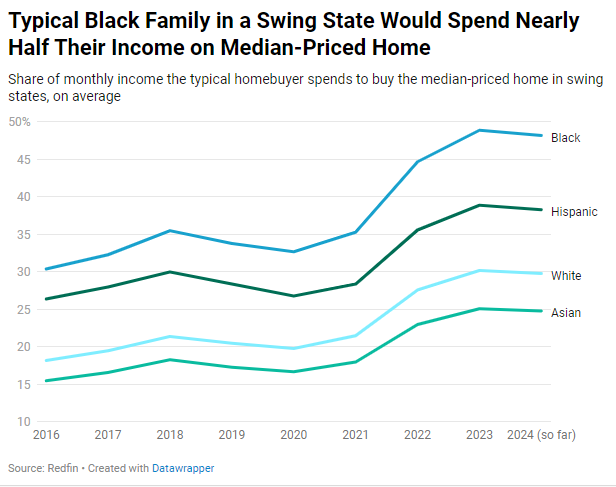
Minority households—particularly Black and Hispanic homebuyers—would have to spend even more of their earnings on a median-priced home:
- A Black household would spend nearly half (48.2%) of their earnings on the median monthly mortgage payment—up from a far more manageable 32.7% in 2020.
- An Hispanic household would spend 38.3% of their earnings on housing—up from 26.8% in 2020.
- A white household would spend 29.8% of their earnings—up from 19.8% in 2020.
- An Asian household would spend 24.8% of their earnings—up from 16.7% in 2020.
Housing affordability as a voter priority in November
More than 90% of Gen Z voters consider housing affordability a top priority for the 2024 presidential election. And at least 80% of Millennial, Gen X, and Boomer voters consider it a key factor in their vote this November.

Voters in swing states care about housing affordability because soaring home prices and mortgage rates, along with a shortage of homes for sale, have made homeownership feel impossible for some Americans. That’s especially true for young people who are earning low incomes and haven’t yet built up their savings, making them feel it would be an uphill battle to reach their parents’ level of financial success. While swing states have historically had lower housing costs than blue states–and most still do–markets in swing states have not been immune to the affordability crunch the country has been facing for the last several years. The inability to afford a home is making a lot of voters feel bad about the economy and their financial prospects.
For historical context, the median home price in swing states went up 40% between 2016 and 2020. In blue states, the median home price rose by 27%, while in red states, it rose by 28% during the same period.
Read the full report for more details, including methodology.