
The markets have already reacted to the news of the election, with surging stock values in multiple sectors, including cryptocurrency, banking, and private prisons.
Of more immediate interest to real estate professionals, mortgage rates could climb higher in response as investors remain concerned about increased government spending—especially if Republicans control Congress as well as the White House.
As Byron Lazine pointed out in Wednesday’s Hot Sheet, any time one party has control of both the executive and legislative branches, government spending tends to go up.
We’ve reviewed Trump’s housing policy, specifically what he intends to do to improve housing affordability during his term. Still, it’s fair to ask, (as consumers, agents and other market watchers on social media are already asking), “How does the housing market move forward?”
Honest question, how does the housing market move forward? It's either incomes up 60%, houses down 30%, or rates down 2-2.5%.
The latter would be the easiest lever, but inflationary policy is at complete odds, right? https://t.co/0Toqb4MgDy
— Beau King 🤖🚛 (@RunningSignal) November 6, 2024
Logan Mohtashami, Lead Analyst for HousingWire, responded to that question with a brief but encouraging history lesson on X, sharing a few charts to illustrate his points.
How does the housing market move forward?
Mohtashami’s first chart shows the difference in affordability between what we’re seeing now in 2024 and what homebuyers experienced in the early 80s, which, hard as it may be to imagine, was actually worse.
The early 1980's had worse affordability https://t.co/jNzKzYWNUk pic.twitter.com/x8Z8ercJKd
— Logan Mohtashami (@LoganMohtashami) November 6, 2024
Mohtashami’s aim was to point out that, while it was worse roughly 40 years ago, what followed was a housing boom. Rates went lower (just as housing economists are currently predicting for 2025), wages increased, and, in time, demand grew.
Rates went lower, wages grew, and household formation happened, and then demand rose in time pic.twitter.com/4R2xUcLUZL
— Logan Mohtashami (@LoganMohtashami) November 6, 2024
On the Hot Sheet, Lazine made the point that “we know we already have pent-up demand.” Now that we’re past the uncertainty surrounding this election, sales are likely to follow historical norms and increase.

You can see it in the stock markets—this economy having a certainty about (who will be in office), that is going to unlock and unleash a lot of movement in the housing market. We’re talking about 3.84 million home sales, the worst since 1995. That number will be dramatically different in 2025.
U.S. Housing Market Relative Invulnerability to Rising Rates
Mohtashami also shared a chart showing how the United States compares to countries with more widespread use of variable mortgage rates, making them more vulnerable to rising rates.
https://t.co/zu8yRJOU4O pic.twitter.com/efNUIwA3rb
— Logan Mohtashami (@LoganMohtashami) November 6, 2024
We don’t have widespread use of these variable mortgage rates, so we’re on the extreme side of being less vulnerable. That being said, you may see rates go up here in the short term.
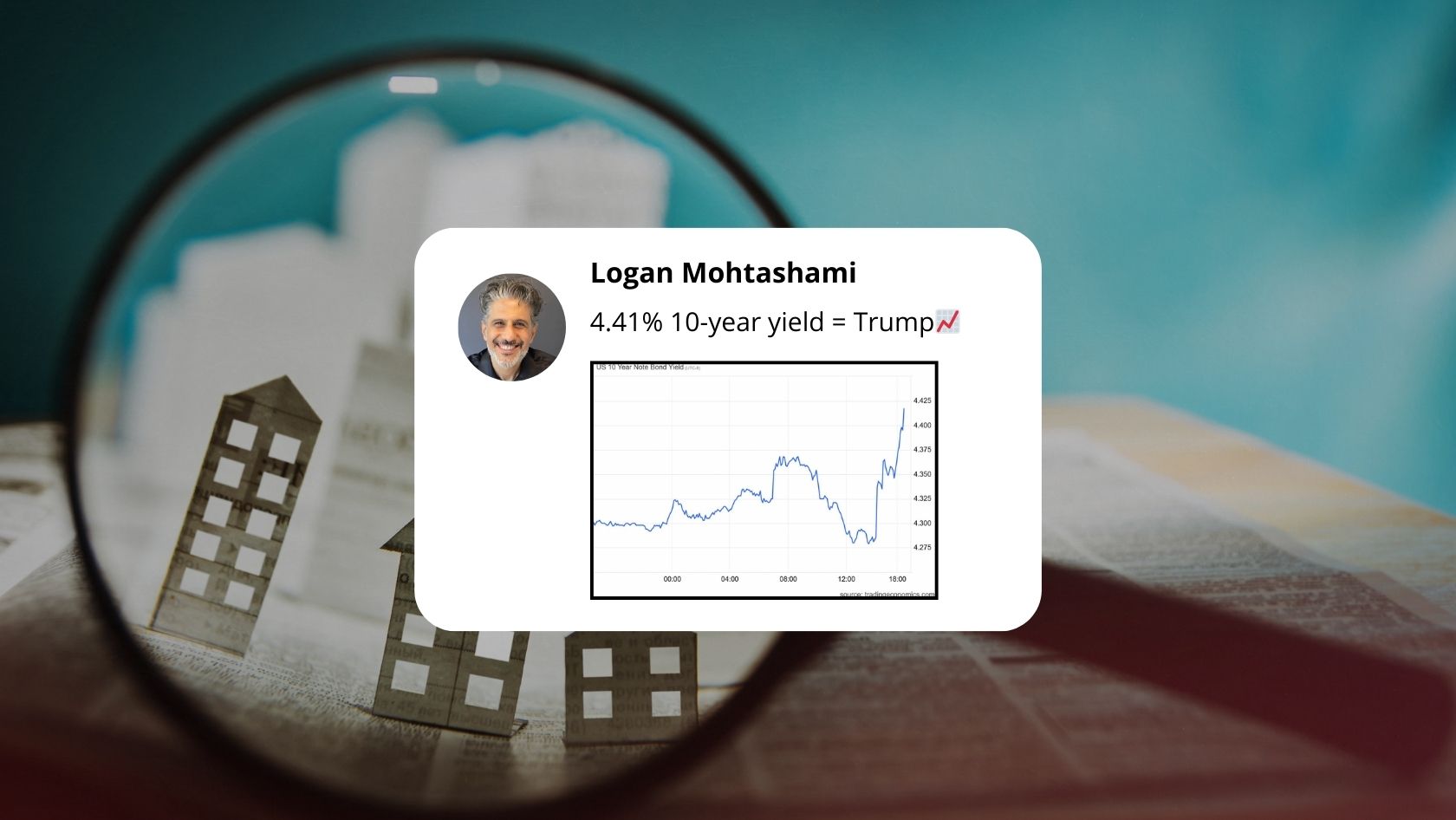
Trump’s second term will be inaugurated on January 20, 2025. But the 10-year Treasury reacted in short order to his win by jumping from 4.3% to 4.43% Wednesday morning, which then caused the 30-year fixed mortgage rate to rise from 7.04% to 7.13%.
Lazine referenced an article on Realtor.com that explained the post-election surge in interest rates. It doesn’t mean rates will stay above 7% for the next four years, but neither can anyone say for certain that a Trump presidency will bring mortgage rates down in the near future.
In the meantime, we’ve got an FOMC meeting coming right on the heels of this election with what will most likely be a 25 basis point cut to the federal funds rate. Stay tuned for BAM’s coverage of the FOMC report and Jerome Powell’s statements at the press conference.