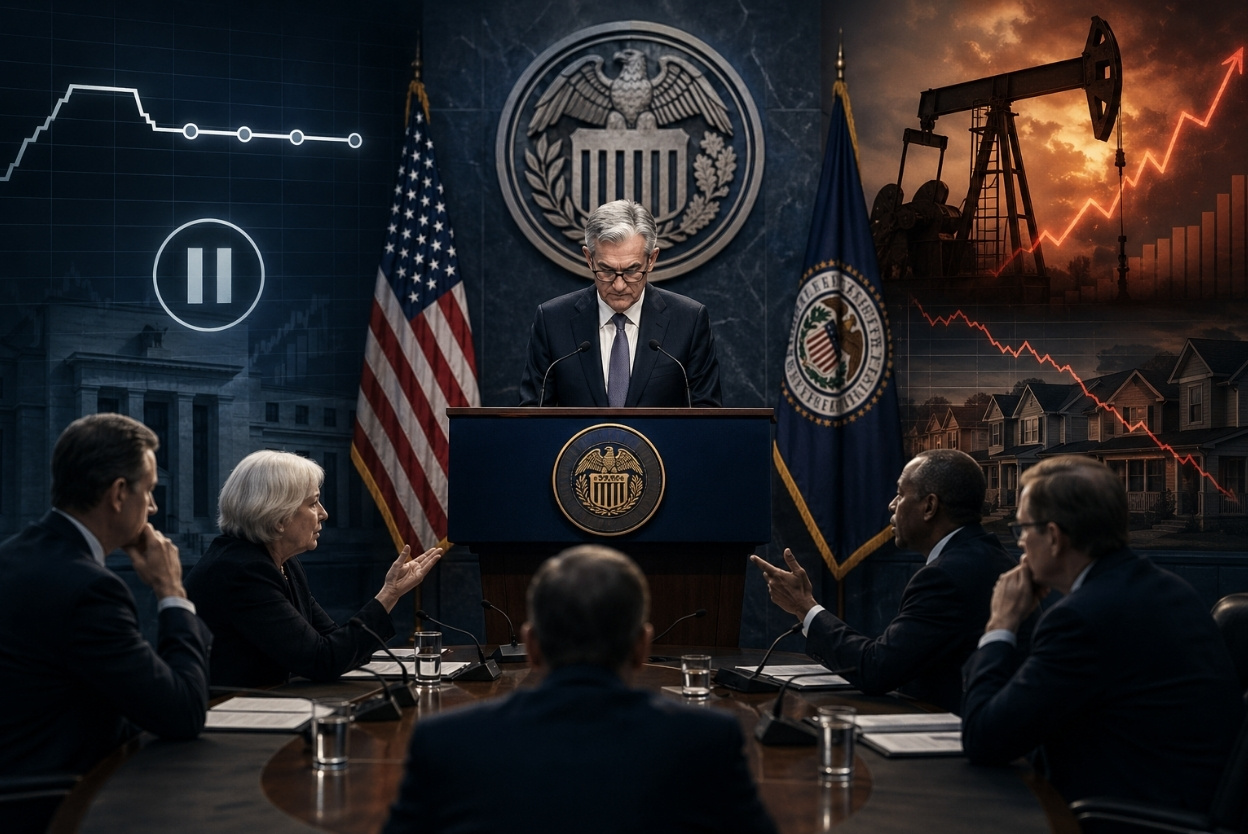

At the April 28-29 FOMC meeting, the Committee voted to keep the federal funds rate steady at 3.5–3.75%, with one dissenting vote from Stephen Miran and three Committee members pushing back on the easing bias language.
Those dissenting votes came up more than once in reporters’ questions at the FOMC press conference, along with questions about Chair Powell’s decision to remain on the board as governor after May 15 “for a period of time to be determined.”
Other questions revolved around inflation, specifically in relation to energy costs and the war in Iran, the DOJ investigation, and threats to the Fed’s independence from political influence.
Don’t miss Byron Lazine’s full breakdown on today’s Hot Sheet:
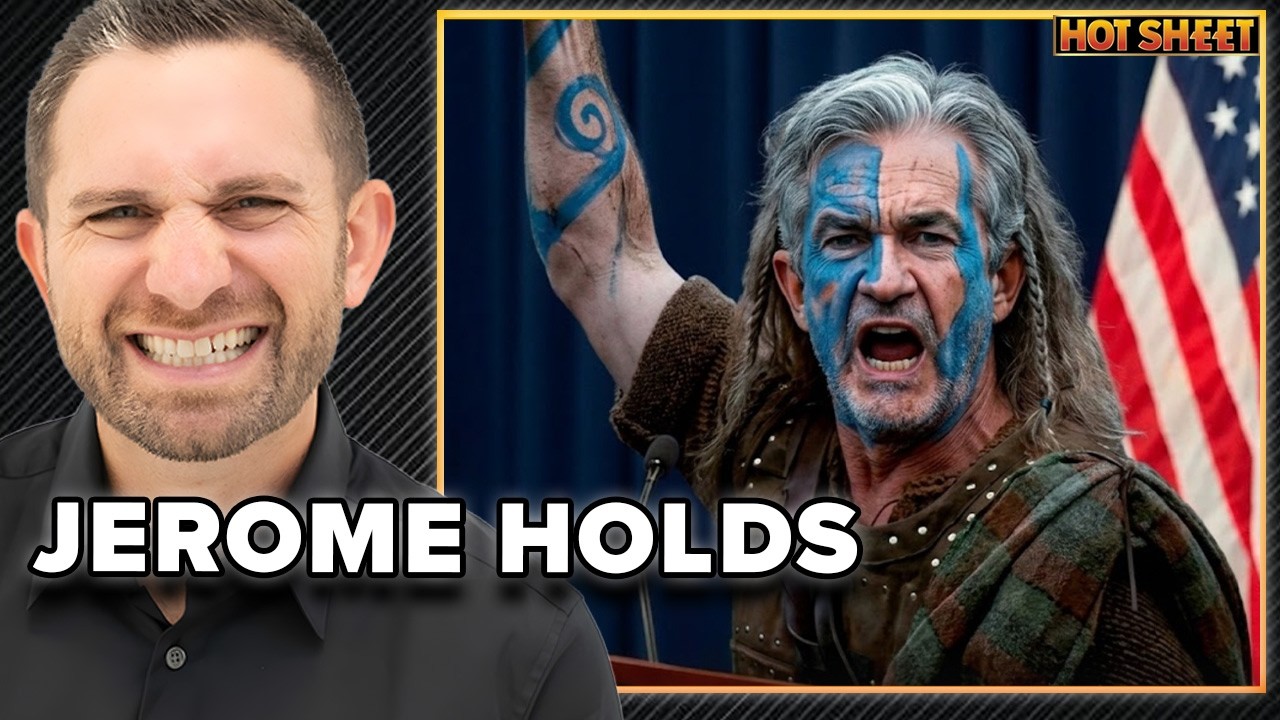
Chair Powell’s Last Press Conference
At Fed Chair Jerome Powell’s final FOMC press conference, not a single reporter mentioned housing.
Questions focused more on monetary policy, Chair Powell’s decision to stay on the board as governor after May 15, and threats to the Fed’s independence from political influence, plus concerns about inflation caused by war in the Middle East.
Chair Powell’s Opening Statement
The only mention of housing came at the start of Powell’s opening statement, and is a line we’ve heard many times before:
(02:03)
“Recent indicators suggest that economic activity has been expanding at a solid pace. Consumer spending has been resilient, and business fixed investment has continued to expand at a brisk pace. In contrast, activity in the housing sector has remained weak.”
Chair Powell also announced the advancement of Kevin Warsh to the Fed Chair seat, making this Powell’s last FOMC press conference:
(04:41)
“This is my last press conference as chair, and I will close with a few thoughts. First, I want to congratulate Kevin Warsh on his advancement out of the Senate Banking Committee this morning. This is an important step forward, and I wish him well as that process continues.”
Chair Powell also mentioned the criminal investigation by the DOJ and announced his intention of continuing to serve as governor on the Federal Reserve Board “for a period of time to be determined” after his term as Chair ends on May 15, 2026:
(06:11)
“I welcomed the announcement last Friday by the US Attorney for the District of Columbia that she had closed the criminal investigation. She also noted, however, that she would not hesitate to restart the investigation. Over the weekend, the Department of Justice provided assurances that they will not reopen the investigation unless there’s a criminal referral from the Fed’s Inspector General. And absent such a referral, if they do appeal the recent court decision, they would not seek as part of that appeal to restart the investigation or send new subpoenas.
“I’ve said that I will not leave the board until this investigation is well and truly over with transparency and finality, and I stand by that. I’m encouraged by recent developments, and I’m watching the remaining steps in this process carefully. My decisions on these matters will continue to be guided entirely by what I believe is in the best interest of the institution and the people we serve. After my term as chair ends on May 15, I will continue to serve as a governor for a period of time to be determined. I plan to keep a low profile as a governor. There’s only ever one chair of the Federal Reserve Board. When Kevin Warsch is confirmed and sworn in, he will be that chair. Once sworn in as board chair, his new colleagues will elect him to chair the FOMC as well. As I regularly point out from this podium, our success in delivering our goals matters for all Americans.
“I’m confident that the Fed will continue to do its work with objectivity, integrity, and a deep commitment to serve the American people. Thank you, and I look forward to your questions.”
From the FOMC Press Conference
Housing was not mentioned during the Q&A segment of the press conference. Reporters asked Chair Powell questions on the following:
- Powell’s decision to remain on the board as governor
- The Federal Reserve’s inflation outlook & impact of the war in Iran
- FOMC member dissent on the easing bias language
- The risk of oil prices bleeding into core inflation
- Attacks on the Federal Reserve and/or Chair Powell
- Fed independence and the DOJ’s criminal investigation
(11:00) — Question from Nick Timiraos, Wall Street Journal:
“Chair Powell, if I could ask about the inflation outlook. In March, you described the standard practice of looking through energy shocks as conditional on inflation expectations staying anchored. Since that meeting, there has been very little progress reopening key energy trade corridors. Can you help us understand how the inflation outlook has changed in the intermediating period, beginning with the prospects for tariff pass-through resolving on the timeline that you had outlined in March, before getting to the energy shock that is now on top?”
Powell’s response (11:34):
“So I would look at it this way. For a long time, we’ve been working on the hypothesis really, that tariffs would lead to a one-time price increase and that that would go away over time. In other words, that there would be no further change, so measured inflation wouldn’t reflect that higher level going up more and more. And it’s time for that to happen. We really do expect that to be happening in the next two quarters. So we’ll be watching very carefully to see that what we’ve thought all along would happen. That’s the kind of critical part of the forecast. We need to really see that. With energy, it’s so hard to say. I mentioned in sort of the textbook, you would look through an oil shock because they tend to be short-lived and they tend to revert, and monetary policy works with long and variable lags, so you wouldn’t necessarily react right away.
“I think that is all the more true given that we’re several years above 2% inflation and that we’re already looking through the tariff shock. So I think we’re going to be very cautious about that. But the question about looking through energy really is not in front of us right now. It hasn’t even peaked yet. And I think we’d want to see the backside of that and progress on tariffs before we even thought about reducing rates.”
(12:54) — Follow-up question from Timiraos:
“The statement today preserves language that has taken on some meaning as it was socialized when the committee was actively lowering rates. Why is that easing bias still ripe given how different the inflation outlook is now versus a meeting or two ago, and what more would have to happen for it to get evicted?”
Powell’s response (13:18):
“So that was, as you’ll recall, we had a discussion about that at the last meeting, and we talked about it in the press conference after the March meeting. We had the same today. We had quite a vigorous discussion about that very issue, and the guidance, and is it still appropriate and that kind of thing. And I would say that the number of people on the committee who either could support that language change, changing to a more neutral stance, so that a hike is as likely as a cut. That number has increased over the intermediate period. And it’s easy to see why. I mean, it’s a good question, right? You see, inflation has moved up over the interim a bit. Core inflation’s 3.2 now, moving, albeit just a little bit, in the wrong direction. And we know that there’s headline inflation coming out of the Gulf, and we don’t know how much that will be. We’re going to need to see.
“So it makes all the sense in the world that people would look at that and we’d have a vigorous discussion about that. You saw that three people dissented over the language. I think all of those people agreed with the rate decision. So the majority of the committee did not want to do that. And I didn’t think we needed to do it at this meeting. It really was just a question of, why do we need to do that now? We have so much to learn. There’s so much uncertainty about the path ahead. There doesn’t need to be any rush to make that decision now because what happens in the next 30, 60 days, even by the next meeting, could really change the picture around that language. So it’s a much closer thing on the committee than it was in March. And that makes all the sense in the world, it seems to me.”
(20:45) — Question from Michael McKee, Bloomberg Television & Radio:
“I’d like to ask you if you could explain a little more or characterize a little more of the discussion about the two-sided view and interest rates, because there were some members of the open market committee who’ve been suggesting that we may need to raise interest rates even absent the war because inflation was not coming down fast enough. Is there any sense that interest rates might have to go up, or was this just a setup to sort of warn people that you’re worried about the war impacts?”
Powell’s response (21:18):
“So the three dissenters and others who could have supported that, and others who were voters and non-voters who preferred it, they all supported the rate decision, right? So people are not saying we need to hike now. It’s more a question of, don’t we kind of feel that we should be neutral, and what are markets doing? People argue that this is consistent with what markets are doing. And again, it’s a very fair question, but these changes, it’s a form of forward guidance, and you want to make them in a way that will be sustained and continue to make sense and not something you need to take back fairly quickly. So I think we just, a group of us, including me, didn’t feel like we needed to be in a hurry on that, that markets are not confused about our reaction function. We don’t have a problem to solve on that.
“But the other side of the argument is a good argument too. As I mentioned, it’s a perfectly good argument to be having. Good discussion to be having. And it came out the way it came out.”
(22:21) — Follow-up question from McKee:
“Well, you’ve got three dissents in favor of two-sided warning. You’ve got yourself staying on the board. You’ve got the criticism that does come from elected officials, and you’ve got a lot of critics who have faulted the Fed for being too slow in 2021 with inflation. Are you worried about Fed credibility under all of this? Is that one reason that you want to stay on?”
Powell’s response (22:50):
“Not driving my thinking now. I mean, monetary policy is going to get made by 19 people. There’s a lot of stability there. I mean, if you think about it, every new Fed chair has the same situation, which is you’ve got 18 colleagues on the FOMC, 11 of them vote during any year, and your job is to create consensus. It’s to talk to them, understand them, be inside their thinking, and be able to pull them together and get consensus and move. And that’s what every Fed chair has to do. And I think Kevin Warsh is actually quite well. He has the capabilities, skills to be very good at that, I would think. So I think I’m not so worried about that process. I think that’ll work itself out.”
(25:31) — Follow-up question from Howard Schneider, Reuters:
“And in your view as a soon to be governor, how do you see the risks of oil prices bleeding into core inflation in coming weeks? Because that was, it seems like the commentary that was coming from, particularly some of the reserve bank presidents, there were elevated concerns about the bleed into core and here we are with three dissents now. What do you see as the prospect of a core inflation level?”
Powell’s response (25:54):
“Those prospects are real. Remember though, and the real thing is we’re going to have to wait and see. We’re going to need to see. And the good news is, we think our policy stance is in a very good place for us to wait and see. We’re right kind of at the high end of neutral or perhaps mildly restrictive. The labor market shows more and more signs of stability, whereas inflation is kind of misbehaving. And so maybe a little bit of restriction or the high end of neutral is just the right place to be. So we can wait here and see how things work out before we act. And we’ll see how much does come through into core. You see it already in airfares, of course, but you may see it in many other places. We just don’t know yet. And it’s so unknowable because how long will the state be closed?
“You can develop any number of scenarios that you want, but we really won’t know until we know. So fortunately, we’re in a good place to wait and let things develop.”
(45:29) — Question from Jennifer Schonberger, Yahoo Finance:
“At the risk of beating the dead horse here, clearly three members objected to keeping that easing bias in the statement. And you said that the majority still didn’t need to move to new language at this point. So does the majority of the committee still have a bias towards cuts at this point, or has the bias on the committee shifted away from cuts towards holding or hikes if that was needed?”
Powell’s response (45:59):
“So I think that the center is moving toward a more neutral place, and that’s sort of what markets are saying too. I just think there’s a lot of signaling going on when you change guidance like that. And so we just, I guess a majority of us didn’t feel like we needed to send a signal on that right now, but maybe it’ll come to that. And the reason is because we’re kind of waiting to see what happens with events in the Middle East and what are the implications of those events for the US economy. So there’s a group who feels like we don’t need to be in a hurry to do that. We get it. And of course, we will move to a hiking bias if we want to hike, and we’ll move to a neutral bias before that. But there was a difference over whether to do it at this meeting, at a meeting at which all but one of us agreed that the rate decision was correct, which was not to move.”
(52:09) — Question from Richard Escobedo, CBS News:
“We talked a lot about gasoline prices, and even you mentioned airline ticket prices, both of which are up dramatically because of the war in Iran. And so I wonder, are you seeing that way down consumer spending in other parts of the economy? And if so, how worried are you that that will be a drag on growth?”
Powell’s response (52:29):
“You don’t see it in spending yet. You really don’t. I mean, as one of your colleagues said, the economy has been resilient. It really has. Not just this time, but it’s been remarkably resilient for some years now. The US economy has just powered through shock after shock, and consumers are still spending. And that’s what the banks will tell you. Credit card companies will tell you, the retail sales numbers that we got most recently, people are still spending. And how long can that go on in a world where if gas prices were to go up a bunch more, that’s taking otherwise spendable money out of people’s pockets. But right now, we don’t actually see much slowdown yet, and certainly none from this, but you think logically you will because people have a certain amount of money to spend that they’re spending 25% more on gas or something like that, then that’s going to come out of other spending. But again, we don’t see it yet.”
(53:21) — Follow-up question from Escobedo:
“One last thing. You mentioned those economies in Southeast Asia that are particularly dependent on petroleum. They make a lot of the stuff that American consumers buy. So was there any discussion today about whether or not those costs getting passed along to consumers is a real concern and whether or not that might push up inflation?”
Powell’s response (53:41):
“So all of those things are in the models that we use to calculate inflation. So they’re just parts … You can ask about anything like that, and the staff has a place where they’re looking at that and pricing in what will happen with higher prices and that kind of thing. So it’s there. The effects are not that big yet. We’re a huge economy. The import sector is only 10% of the economy. So we’re not like a European country where 50% of the GDP is in the external sector. We’re also, as I mentioned, we’re an oil exporter, so we’re not feeling the same kind of pain and we’re not likely to feel the same kind of pain that economies in Western Europe and certainly in Asia are feeling. Anyway, thank you very much, everyone. I won’t see you next time.”
Bottom line: the Fed didn’t move, but overall uncertainty has amped up. Inflation is heading in the wrong direction, energy prices are still climbing, driven by the war in Iran, and there’s more disagreement inside the FOMC than there used to be.
With Powell stepping down but staying on the board and political pressure on the Fed’s independence growing more direct, the uncertainty goes beyond just the next rate decision.
For housing, conditions are largely unchanged from the last meeting as the market feels its way forward, slowed but not stopped by rising rates and tight inventory.