

Most agents start the pricing conversation in the wrong place. They lead with comps, guess at a number, and hope the market cooperates.
In the recent Bulletproof Pricing Strategy Masterclass with Sharran Srivatsaa and Andrew Undem, Sharran showed how to flip that script with a simple, visual Pricing Matrix that repositions you as a strategist, not a price picker.
It shows clients how market dynamics work, how your process reduces risk, and why you set a launch price together to maximize attraction.
Sharran went through each quadrant step by step:


Part 1: Pricing Is About Positioning, Not Picking a Number
Sharran opens with a clear reframe: the list price is not the sales price. It’s an invitation to the market, and your job is to position the property so the market responds in your seller’s favor.
“Mr. and Mrs Client, pricing is about positioning and the list price is just an invitation. Our job is to actually determine and agree upon the list price together so that we can get the maximum attraction possible.”
To drive this home, he draws a simple line on the page and divides it into “10%” and “90%.”
“Here’s the 10% and the 90%… 10% of the agents, the market works for them… 90% of the agents, they work for the market.”
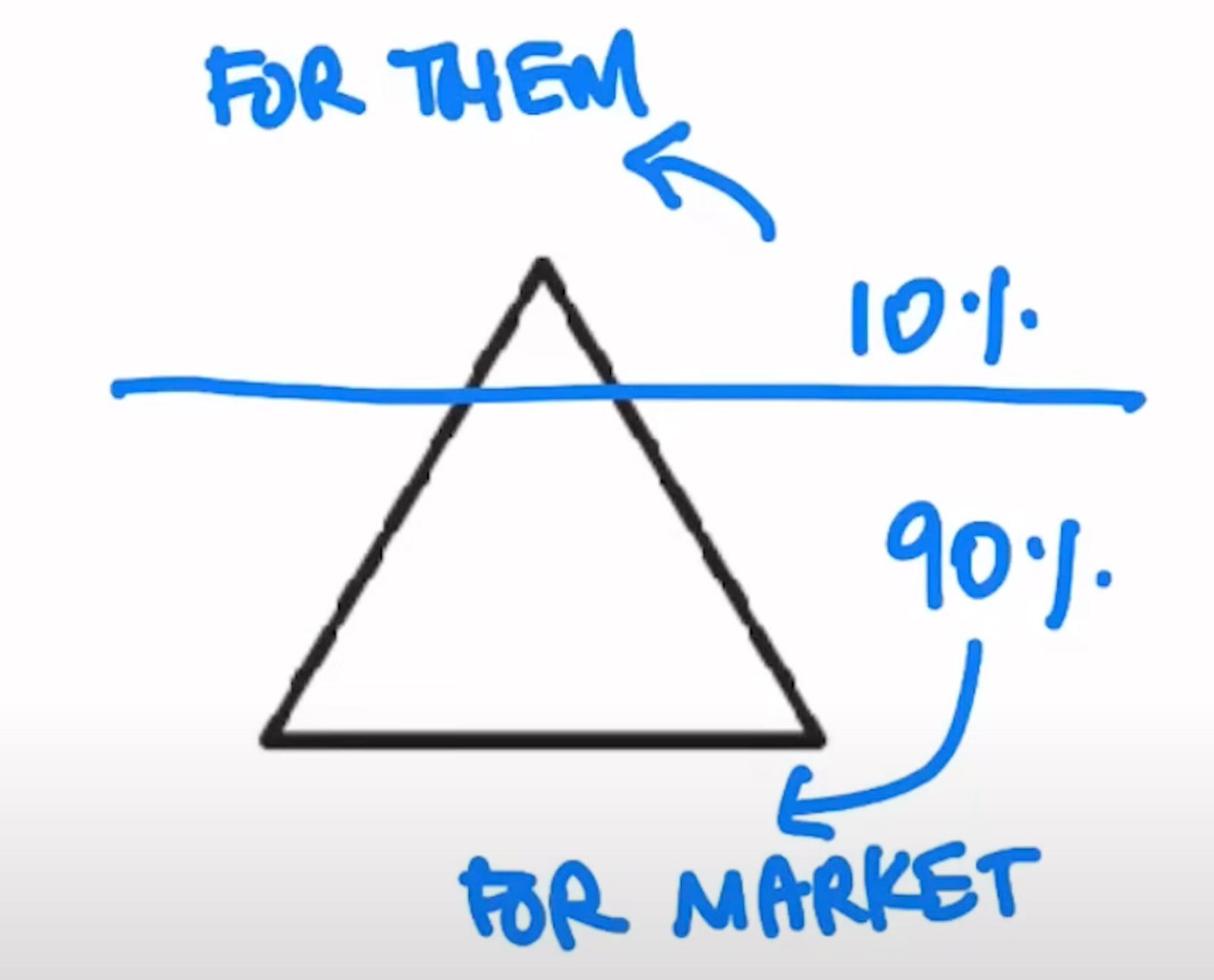
The visual positions you as part of the 10%: the agents who influence the market instead of reacting to it.
How to Use This:
Script:
“The list price is an invitation. It’s how we get people in the door, not a guarantee of the sales price. My job is to position your home to attract the most buyers possible so the market works for us, not the other way around.”
Always draw the 10% vs. 90% visual to show where you operate. And avoid promising a number you can’t control; focus on process and positioning.
Part 2: Visual One, Market Dynamics
Once the seller understands positioning, Sharran moves into market dynamics. He explains that the CMA isn’t just a set of comps; it’s a tool for understanding the relationship between actives, pendings, and solds.
“The key part of explaining the comps is to explain the relationship between actives, pendings and solds.”
Andrew builds on this by showing what he brings to every pricing conversation: not cherry-picked properties, but statistical data for the price range.
“What I always have is a statistical analysis of the market in that general price frame… average days on market… list to sales price ratio…”
This reframes you as a market analyst who uses data to interpret the market, not someone guessing based on a few similar homes.
How to Use This:
Script for high actives, low pendings:
“We have more competition in this price range right now, so buyers have options. This means we’ll need to be more conservative with our launch price.”
Script for low actives, high pendings:
“Homes are moving quickly in this range, so we can be more aggressive.”
Always bring stats, not just comps: days on market, list-to-sale ratio, inventory count, and pending count.
Part 3: Visual Two, The Funnel
Next, Sharran switches to the second visual: the funnel. It’s a step-by-step map of the selling process, starting with the invitation (list price) and moving through selection (showings and offers) to acceptance.
“We are going to pick a list price together… the list price acts as an invitation… This is where we get more people or less people.”
He uses an extreme example—listing at $1 vs. $10 million—to show how price impacts the size of the invitation. Then he points out that most sellers think the process ends at acceptance, but that’s just the midpoint.
“The selection has two parts: showings and offers. At the end of this process, we get to pick an offer to accept.”

Sharran describes this as a “show flow demo.” And the goal is to make it clear that the list price and the sale price are two different things. One is an invitation; the other is a result.
How to Use This:
- Draw the funnel in the appointment: Invitation → Selection (showings/offers) → Acceptance.
- Use the $1 vs. $10M example to explain how pricing changes the size of the invitation.
Script for sellers:
“The launch price controls how many people see your home. Once we’ve got them here, the marketing and showing process drives offers.”
Part 4: De-Risking After Acceptance, The Three Outs
After mapping the funnel, Sharran shows sellers what happens after acceptance, and how you keep accepted offers from falling apart. He calls these the “three outs”: inspection contingency, appraisal contingency, and loan contingency.
“The three ways are: inspection contingency, appraisal contingency, loan contingency. Our job is to mitigate each of those risks.”
He explains exactly how he addresses each one to reduce risk and keep the transaction on track.
How to Use This:
- Inspection contingency: Recommend a pre-inspection and explain how it reduces surprises.
- Appraisal contingency: Attend the appraisal with market data in hand.
- Loan contingency: Call the buyer’s lender to confirm financing readiness
Script:
“Here’s how we keep accepted offers from falling apart: we take away as much risk as possible before we ever get to closing.”
Part 5: Hacking Motivation With Two Questions
Only after showing the visuals and process does Sharran ask about timing and pricing. By this point, he’s earned the right to get clear, honest answers.
“If we were to get the perfect offer tomorrow, what would be the earliest you would be willing to move? What would be the latest you need to move?”
He then asks for the floor and the smile number. The first question gives you a number low enough that the seller wouldn’t even want to be bothered to hear of it. The second question reveals the seller’s dream scenario: “What number would put a smile on your face?”
This gives him both the timing window and price range to guide negotiations.

How to Use This:
Ask timing first, then pricing. This gives you both the happy path for move dates and the seller’s price range.
Script:
“What’s the lowest number you wouldn’t even want to see? And what’s the number that would make you excited to move forward?”
Document both answers. They’ll guide negotiations later.
Part 6: Three Pricing Strategies
With motivation on the table, Sharran presents three pricing strategies. He describes each one and lets the seller recognize the approach that best fits their situation.
#1: Aspirational Pricing. High initial price, multiple reductions. Often for unique or celebrity properties. Sharran uses a celebrity example to signal fit:
“This is generally used for unique homes that are custom-built or homes that have celebrity factors. Like recently, when Rihanna sold her home.”
#2: Perceived Market Value Pricing. Feels “just right” to buyers. Avoid calling it “fair market value.” Sharran rejects the phrase agents often use out of habit.
“Whenever someone says fair market value, you should know that they’re an inept agent because fair market value is not determined by an agent. It’s determined on the day of closing between a buyer and a seller.”
#3: Event-Based Pricing. Price to create an auction-like environment, then let demand push higher. Sharran defines the outcome you are engineering.
“You create an auction-like environment to allow for all the invitation-based pricing to actually drive the value of the pricing up.”

For most typical homes, he narrows to perceived market value or event-based pricing, then asks which resonates.
How to Use This:
Explain all three, then eliminate what doesn’t fit:
Script:
“For your home, we’re choosing between perceived market value and event-based pricing. Which approach feels right to you?”
Part 7: Process Over Price, Manage the Ecosystem
Andrew reinforces the point: you don’t set the sales price, you set a strategic launch price and manage the entire ecosystem to maximize equity.
“We don’t pick a price, we pick a strategic launching price… and you’re going to effectively manage the whole real estate ecosystem on their behalf.”
Sharran echoes the importance of language and artifacts. The way you present the process earns you the right to ask the hard questions and unlock motivation.
“The reason why Andrew and I are stressing on the language and the artifacts so much is because most of the agents have been taught to generate referrals after the closing of the transaction. They say, ‘How well you stay in touch determines how many referrals you get?’ No! How much you blow them away and delight them during the process and how much they’re engaged in the process with you—they co-create the process with you—is how much they’re going to refer you. I don’t ever have to send a referral email.”
How to Use This:
Create a visual or checklist showing all transaction stakeholders.
Script:
“My role is to manage every player in this transaction so we maximize your equity at every turn.”
Position yourself as the seller’s partner against the market, not an adversary on price.
Part 8: The “Critical Dependencies” Question
Andrew opens many pricing talks with one question that surfaces the seller’s true constraints.
“Is there any critical dependencies on pricing for you to get from here to your next move?”
If the seller hesitates, he rephrases. This is where debt payoffs, down payment targets, and timing pressure come out.
Andrew explains why the frame works.
“Oftentimes, that frame, that question, that queue will say, ‘Hey, I owe $300K. I need to get at least $800K so I have 20% down on my $2 million purchase.’”
In other words, you get the information you need to do your job, which is to maximize your client’s equity.
How to Use This:
Lead with Andrew’s question before diving into numbers. If the seller hesitates, reframe:
“Do we need to hit a certain number or timeline for you to get where you want to go next?”
Use this to uncover payoff requirements, down payment targets, or timing pressure.
Part 9: Why This Drives Referrals
Sharran is clear: referrals aren’t earned after closing; they’re earned in the appointment, when you show sellers a process so valuable they repeat it to others.
“They’re going to dinner that night and saying… in one page, he actually broke down for me how everything works and what my price should be. You need to meet with [this agent].”
He’s equally clear about what not to do.
“You don’t need to send them a closing gift or send them a $5 Starbucks gift card… Instead, you just do a delightful job in the appointment. They see such a big delta between you and the average agent that that’s how you win.”
How to Use This:
- Focus on delivering a process sellers can retell.
- Stop relying on token gifts to inspire referrals.
- Make your visuals so simple that a client could recreate them from memory.
When you stop guessing the number and instead show the market, show the process, and earn the right to set the strategy together with your client, you influence outcomes and make yourself unforgettable in the listing appointment.
Watch the full replay for more.