

You don’t need to be a marketing genius to stand out in your geographical farm. You just need to understand what actually moves a seller.
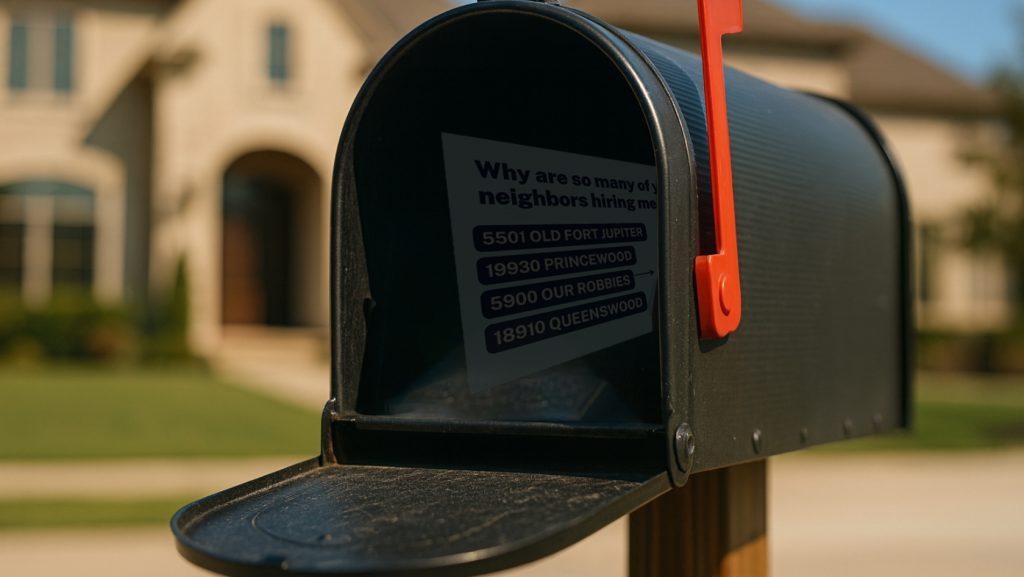
This postcard nails it:


1. Social Proof
(aka “Your neighbors already picked me”)
People don’t want to be sold. They want to be reassured.
And nothing reassures like knowing people just like them have already trusted you. Same street, same price point, same situation, etc.
That’s the bandwagon effect. When a decision feels uncertain, people look to what others are doing. It makes them feel safer, like they’re not going first.
This postcard doesn’t say, “I’m the best.” It says, “Look who already hired me.” That’s way more believable. And way more powerful.
2. Familiarity Bias
(aka “That house looks like mine”)
The listings on the postcard weren’t just within my farm; they were in recognizable neighborhoods where people see the street and instantly connect it to a friend or their own front porch.
That’s familiarity bias. It’s not just about geography. It’s about emotional shorthand. It makes people feel like you already get them and their world.
I didn’t need to say I specialize in the area. Listing six homes in the neighborhood made it obvious.
3. Pattern Recognition
(aka “This isn’t luck—this is a system”)
There’s a difference between a few random sales and a consistent presence.
When people see you show up over and over again, especially in a farm where no single agent dominates the market, it doesn’t feel like chance. It feels like strategy and momentum.
That’s cognitive fluency. The brain is wired to spot patterns and trust what feels consistent.
When you’ve sold this many homes in one area, it doesn’t look like luck. It looks like a process worth hiring.
4. Authority Framing
(aka “I know the buyers, not just the market”)
Every seller wants to know if you “have a buyer.” But what they really need is someone who understands buyer behavior.
Who’s moving here, why are they buying, and how to showcase their home to attract the right audience.
That’s positioning. You’re not just talking about price per square foot; you’re connecting the dots between market knowledge and real results.
Local experience doesn’t just get homes sold. It gets them sold faster, stronger, and with less chaos because you’re not starting from zero.
5. Low-Pressure Curiosity
The call to action on the back says: If the perfect buyer came along—motivated, no contingencies, and willing to pay a premium—would you consider an offer?
It’s not aggressive. It’s not a pitch, it’s a prompt.
Compare that to the typical agent approach: “CALL NOW FOR A FREE HOME VALUATION!” or “Ready to sell? I’m the #1 agent in your area!” Those feel like sales pressure from the first word.
But this question works because it feels safe. It lets the seller consider without committing. It invites the smallest yes. And that’s often where the best conversations start.
The psychology is brilliant: instead of asking them to do something (call you), you’re asking them to imagine something (a perfect buyer scenario). One feels like work, the other feels like possibility.
That’s a different energy, one that sellers respond to, and it works.
Speak to How Sellers Think
Stop trying to be the loudest agent in the mailbox. Be the smartest.
This postcard works because it speaks to how sellers actually think, not how we think they should think. It builds trust instead of demanding it. Shows results instead of promising them.
Your farm doesn’t need another pitch. It needs proof that you understand their world. Give them that, and they’ll give you their attention.