


Key Details:
- Zillow’s April 2023 Housing Market Report shows a market strongly in favor of sellers as rising demand meets low inventory.
- Yet many sellers remain on the sidelines, with many locked into low mortgage rates, some choosing to rent out their properties, and some looking to avoid California’s steep capital gains tax on their home value appreciation.
The U.S. housing market is firmly in sellers’ market territory, thanks to the combined effect of rising demand and scarce inventory driving up home values. That’s the upshot of Zillow’s April 2023 Housing Market Report.
Competition for available homes—especially well-presented homes at lower price points—is heating up as many sellers remain on the sidelines, largely due to the lock-in effect of lower mortgage rates.

Buyers are back on the hunt for houses in what is typically the hottest time of year, thanks to a normal seasonal surge in demand around the end of the school year and some help from slightly lower mortgage rates. Unfortunately, many potential sellers have ghosted the market this spring, concentrating buyer demand on the few listings that do come to market and fueling price growth, especially for more affordable and well-presented houses.

April home values are up
Home values climbed 1% from March to April—the biggest jump since June 2022. That’s fairly normal for this time of year, but a “normal” springtime sellers’ market, with rising buyer demand, stands out in 2023 as a turnaround from the second half of 2022, when buyer demand cooled in response to higher mortgage rates.
Affordability challenges remain, thanks to mortgage rates hovering around 6.5% combined with home price appreciation of 1.5% year over year and 38% compared to April 2020, resulting in an 11% average annual growth rate over the past three years.
Buyers flocking to open houses is pretty typical of this time of year, but the spring market of 2023 is bringing far fewer new listings compared to historical norms.
Metro-level home price trends
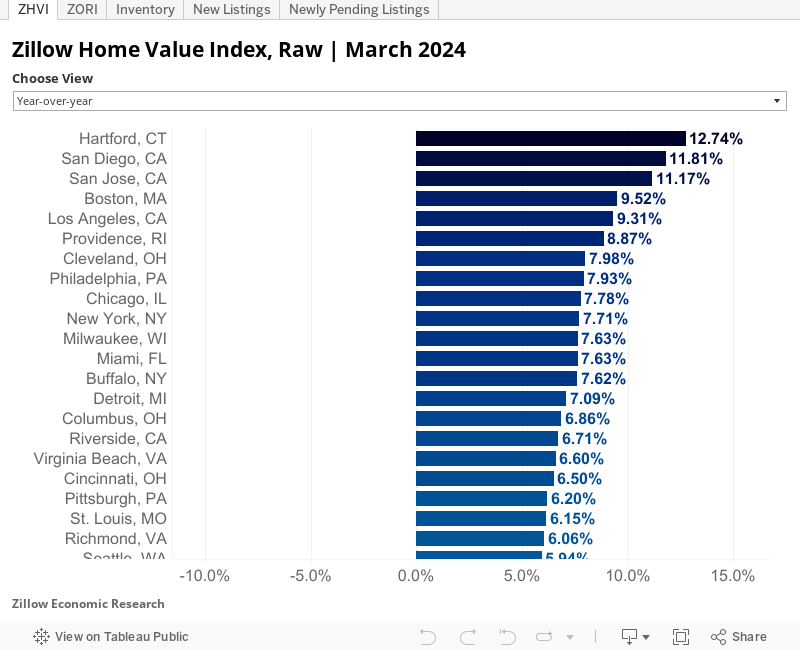
Monthly home price changes at the local level ranged from nearly flat (0.1%) in New Orleans to 1.9% growth in Kansas City—the metro with the fastest monthly growth in home values for the second consecutive month.
Among the 22 markets with year-over-year declines in home values, here are the top five markets with the biggest price drops:
- Austin (-10.0%)
- San Francisco (-9.9%)
- San Jose (-9.5%)
- Seattle (-7.5%)
- Sacramento (-6.8%)
All five of the above markets, however, recorded monthly gains in home values, with the following three outpacing the national average of 1.0%:
- San Francisco (+1.3%)
- San Jose (+1.5%)
- Seattle (1.2%)
These West Coast metros also recorded some of the biggest drops in the flow of new listings, which no doubt explains, at least in part, the upward trend of home values after recent price declines.
Source: Zillow
Pending sales are narrowing the gap
Newly pending listings are gaining on 2022 figures and are now 21% below April 2022, compared to March’s annual decline of 24.1%.
The uptick in pending sales might indicate a return to more normal seasonal trends. April’s lower mortgage rates are likely another factor. Weekly April readings of Freddie Mac’s Primary Mortgage Market Survey averaged 6.34%, down from March’s 6.54% and closer to February’s average of 6.26%, which is the lowest rate since September 2022.
Falling mortgage rates early in the year brought a slight rebound in pending sales—sooner than in new listings. The same could be happening in April, right at the beginning of the best time of the year to sell. And unless we see more sellers entering the market, we’ll likely see the same trend for May.

Inventory shortage is getting worse
April brought a 28% drop in new listings compared to a year ago—worse than the year-over-year decline of 22.2% for March. While spring typically brings more sellers to the market, April had slightly fewer (-0.5%) new listings than March, defying the seasonal norm.
Compared to the first four months of 2019, January through April of 2023 brought roughly half a million fewer new listings for a deficit of 30%.
Many sellers are unwilling to trade in their 3% mortgage rates for rates hovering around 6.5% for a new 30-year loan. A drop to 6% or lower could bring more sellers to the market, especially as more of them learn of the advantages of listing in May or June (now that April has passed).

Other factors impacting the flow of new listings include homeowners choosing to rent out their homes rather than sell them when they decide to move. New digital solutions for rental property managers could entice more of them to choose this option until mortgage rates narrow the gap. They may also choose to keep those properties as rentals regardless of rates.
Another issue arises for long-term owners in pricey markets like those on the West Coast. Interest rates may have nothing to do with their decision to move if they can cash out on their more expensive home to buy one with a lower price or move to a lower-cost market.
Long-term California homeowners also have to contend with a steep capital gains tax on home value appreciation in excess of $500K for couples or $250K for single tax filers.
Finally, remote work could impact whether homeowners taking new jobs need to move, which would likely influence their decision, especially if other factors argue for staying put.
That could explain why active inventory for April was only 2.9% higher than last year—and an eye-watering 45.8% below April 2019 inventory levels. And that slight annual increase for April (2.9%) is a far cry from the 19.5% annual jump in active inventory for January 2023.

The inventory shortage is a major factor behind the upward trend in home values.
Asking rents climbed to a nearly-normal seasonal growth rate
Like home prices, rental costs are now trending upward, with asking rents rising 0.6% compared to the previous month, which is close to normal for this time of year. Rents have also climbed 5.3% year over year. For more information on this, see Zillow’s April 2023 Rental Market Report.

Top takeaways for real estate agents
With home prices trending upward, buyers need to know what’s happening with mortgage rates and inventory to better assess what they can afford and just how ready they need to be to offer more than the asking price. Sellers need a clear idea of their home’s market value, as well as how many buyers are out looking for homes like theirs—and how to maximize their seller profits.
In a market like this one, it’s all the more important for your clients to know what to expect and why, so they can get the best possible results.