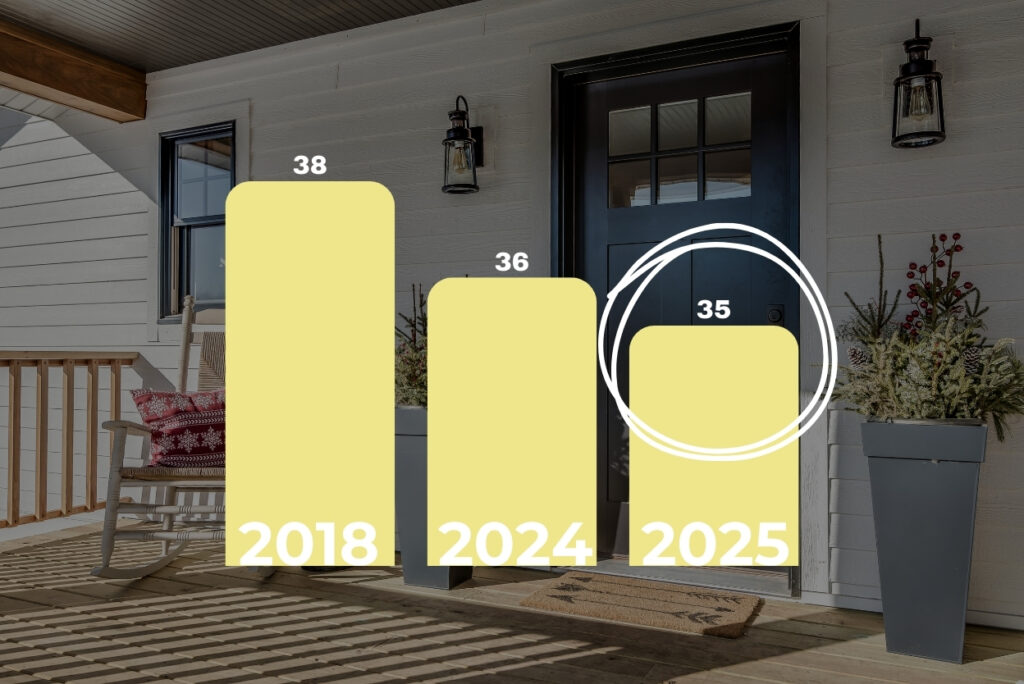
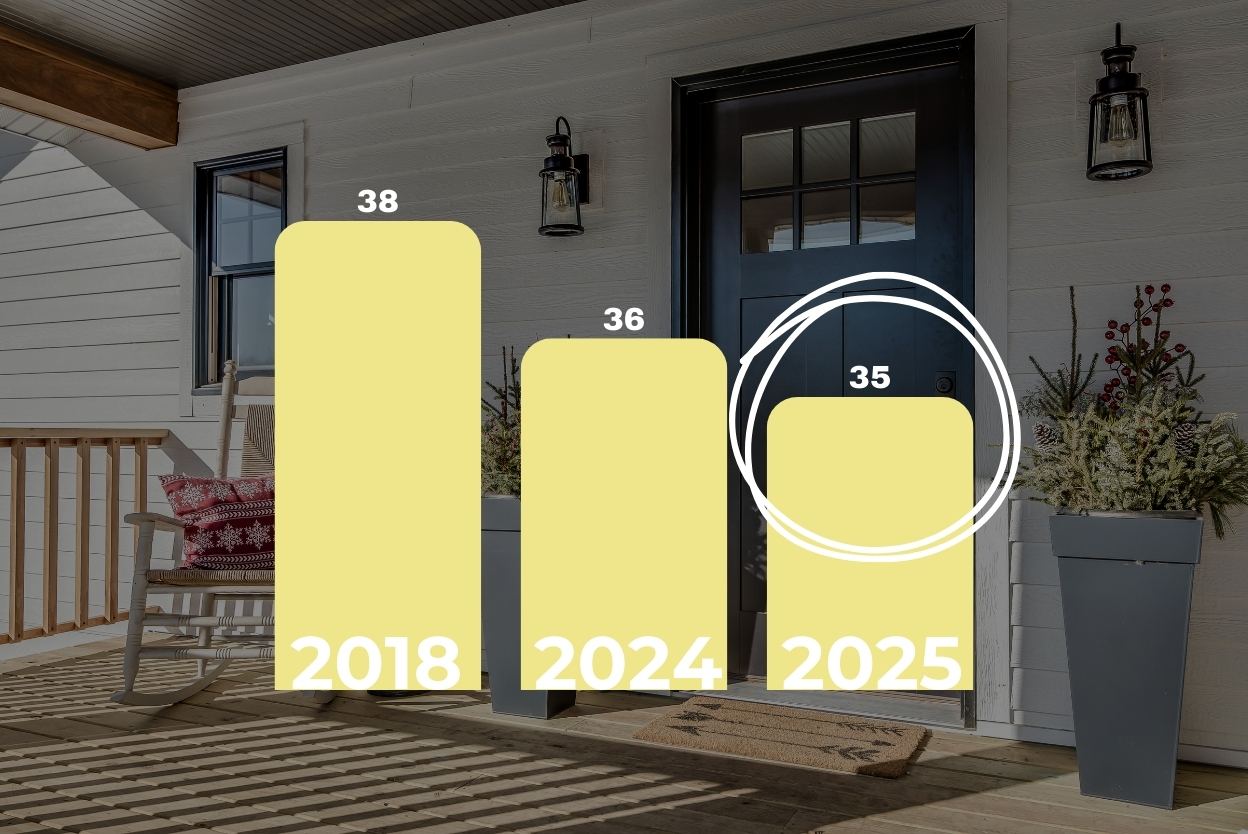

The typical first-time homebuyer in 2025 was 35 years old, according to Redfin’s latest analysis of U.S. Census Bureau data. That’s down slightly from 36 in 2024 and below the recent peak of 38 in 2018.
That stands in contrast to the widely cited figure of 40 years old, which comes from a survey of recent homebuyers by the National Association of Realtors.
The reason for that disparity is that NAR and Redfin aren’t measuring the same way. Redfin relies on Census data designed to be nationally representative, while NAR uses a survey of buyers who recently purchased a home.
At the same time, Redfin found the median age of repeat buyers fell to 47 in 2025, down from 52 the year before, a quarter-century high.
So what does this mean? Americans are still buying homes later in life than they did decades ago, but the reported age depends on the dataset behind the headline.
What Changed in 2025
Redfin’s data shows the median age of first-time buyers ticked down from 36 in 2024 to 35 in 2025, after peaking at 38 in 2018. The median age of repeat buyers also declined, falling from 52 in 2024 to 47 in 2025.
Part of that shift happened alongside modest improvements in affordability.
The average 30-year fixed mortgage rate was 6.6% in 2025, down from 6.72% in 2024. While home-sale prices continued rising, price growth lost steam, and affordability improved in most major U.S. metros.
Daryl Fairweather, Redfin’s chief economist, pointed to changing market dynamics after the sharp rate increases that began in 2022.
“When interest rates went up in 2022, it made buying a home much less affordable than it was during the pandemic. And people who were able to buy homes were people who were wealthier, and older people tend to be wealthier.”
By 2025, conditions had shifted somewhat.
“In 2025, the market started to improve. It became more of a buyer’s market. People who were borrowing money had an easier time getting their offers accepted, even when they were putting down smaller down payments.”
That environment may have helped more younger, financed buyers compete, contributing to the slight decline in the median age.
Chen Zhao, Redfin’s head of economics research, framed the broader affordability picture this way:
“Housing costs have steadily risen over the last few decades, especially in the last five years with the pandemic homebuying frenzy pushing up prices and the subsequent rise in mortgage rates. Wages have increased, too, but not as quickly, making it more difficult to afford a home. But the typical age of first-time homebuyers hasn’t changed much in that span, suggesting that more millennials and Gen Zers are getting help from family to buy a home, or using other sources of income like money that would have gone to their retirement savings.”
Generational Trends and How Buyers Are Making It Work
Redfin’s data shows incremental movement among younger buyers. Gen Z’s homeownership rate rose to 27.1% in 2025, up from 26.1% the year before. Millennial homeownership increased to 55.4%, up from 54.9%.
At the same time, many younger buyers are relying on additional financial support to get across the finish line. According to a November 2025 Redfin survey:
- 19.6% of millennials who recently bought a home received a cash gift from family for their down payment.
- 14.8% of Gen Z buyers received a cash gift.
- Roughly one in five recent buyers from both generations sold stock investments to fund their down payment.
- 13% pulled money out of retirement funds early.
Daryl Fairweather cautioned against reading too much into a one-year shift in age data:
“Just because it got a little bit younger last year doesn’t mean…mission accomplished in terms of making housing accessible and affordable. There’s still a lot of work to do.”
The data also shows that improvement hasn’t been uniform. While Gen Z’s overall homeownership rate increased, the Black homeownership rate among Gen Zers remained flat, highlighting ongoing disparities in access to homeownership.
Why the Numbers Differ
Redfin’s estimate of a 35-year-old first-time buyer doesn’t line up with the National Association of Realtors’ reported median age of 40 because they’re pulling from different datasets and measuring in different ways.
NAR’s numbers come from a survey of recent homebuyers conducted through mail and text. It reflects the experiences of people who purchased during a specific time frame and chose to respond.
In its latest report, NAR found the median age of first-time buyers was 40 and the median age of repeat buyers was 62.
Redfin is using data from the U.S. Census Bureau’s Current Population Survey Annual Social and Economic Supplement, with data spanning 1976 through 2025. The Census survey is designed to represent the broader U.S. population and identifies households that moved within the past year and why they moved.
Because it doesn’t directly ask whether someone is a first-time buyer, Redfin classifies respondents as first-time buyers if they say they moved to own rather than rent or to start their own household. Everyone else is counted as a repeat buyer.
Daryl Fairweather addressed the difference this way:
“The NAR survey is administered through the mail, and the kind of person that opens their mail tends to be older, which is why that data skews upward in terms of age…
“The census gives us a much more accurate read on what’s happening nationally because more people respond to it. It just covers a lot more of the population.”
Both approaches are trying to measure buyer age, but they’re asking different groups of people in different ways. That helps explain why the headline number can change depending on the source.
The Bigger Picture
Even with the median age of first-time buyers coming in at 35 in 2025, the broader trend hasn’t reversed. Americans are still buying homes later in life than they did a decade or two ago.
Redfin and NAR may report different numbers, but both datasets point to that same long-term trend.
The slight dip from 36 to 35 reflects a year in which mortgage rates eased slightly, competition cooled compared to the peak frenzy years, and financed buyers had a bit more room to compete.
At the same time, affordability pressures remain. Younger buyers are still more likely to rely on savings, family support, or alternative funding sources.
And while overall Gen Z homeownership ticked up, not every demographic group saw gains.
For agents and industry professionals, the key is understanding the nuance. The typical first-time buyer isn’t universally 40, and it isn’t universally 35 either.
The reported age depends on how it’s measured.
What’s consistent across the data is that access to homeownership remains closely tied to affordability, wealth, and market conditions.