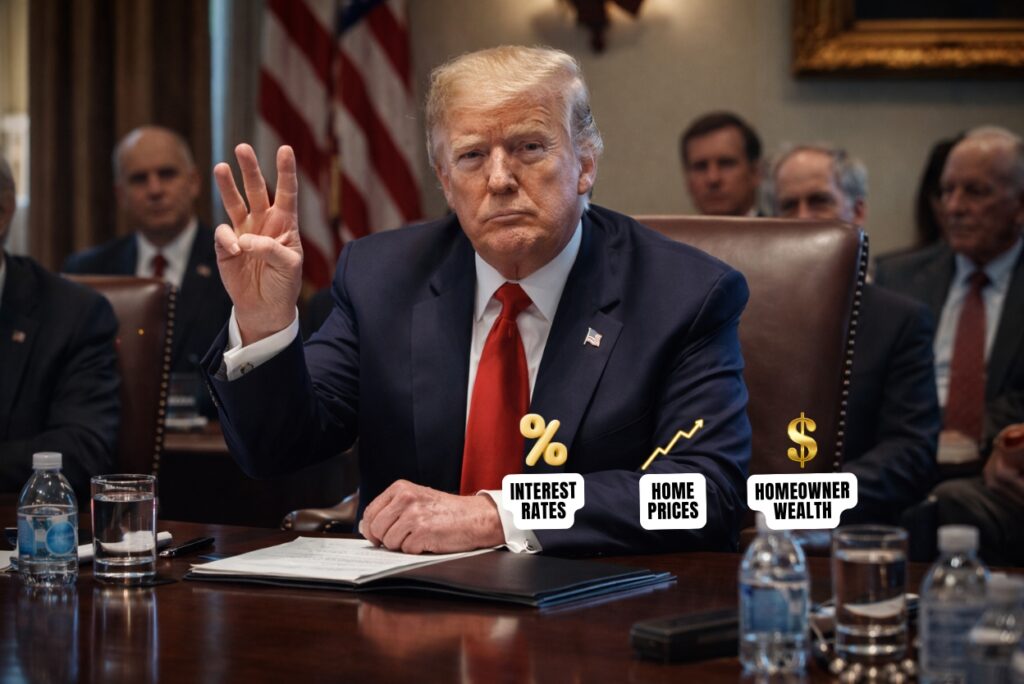


President Trump used last week’s cabinet meeting to lay out a simple housing message in three points:
- Get interest rates lower
- Keep home prices up, and
- Do not undermine existing homeowners’ wealth.
Before handing the topic to HUD Secretary Scott Turner, he framed the conversation in his own terms.
Trump described interest rates as the biggest factor in housing (with some verbal side-eye toward the Federal Reserve), and he kept circling back to the same tradeoff: Make buying “too easy and too cheap” and home values fall.
Read on for the highlights from the president’s housing-related comments.
Interest rates were the centerpiece
Trump started by putting borrowing costs front and center before speaking to homeowner wealth
“…we’ve got to get interest rates down even lower. They are now pretty low, but we’ve got to get them lower.
“To me, the biggest factor is interest rates for housing; only in that…you have a lot of people that have become wealthy in the last year because their house value has gone up. And you know, when you make it too easy and too cheap to buy houses, those values come down.”
He also brought the Federal Reserve into it, framing the Fed chair as part of the path to lower rates.
“The best thing that can happen for both groups of people is lower interest rates, and those interest rates are coming down. And with a proper intelligent person at the Fed, that person will be able to work with us to get interest rates down.
“That covers all of the sins. It covers everything. Lower interest rates keep the values up for the people that have housing and lets other people buy housing.”
Home values were the boundary he kept defending
Trump described falling prices as a risk, and he repeated that he wants to avoid that.
When he explained what he’s trying to protect, he used a specific example of what rising values look like for homeowners.
“I don’t want those values to come down. We have millions of people that own houses and, for the first time in their life, they’re wealthy because the house is worth $500,000 or $600,000 or more or less, but more money than it’s ever been worth before. I don’t want to do anything to knock that down.”
The president also argued that housing activity could be increased quickly, but he kept returning to the same warning about making buying “too easy.”
“I can turn on housing immediately, but you make it too easy, and you’re going to knock the value down of people that own houses. For those people, those millions of people that own houses, we’re going to drive those values up. But we’re also going to try making it easier for people to buy.”
Near the end of the exchange, he repeated the same promise in plain language, including the direct rejection of a prices-down goal.
“We’re going to make it easier to buy, we’re going to get interest rates down, but I want to protect the people that for the first time in their lives feel good about themselves. They feel like they’ve — you know that they’re wealthy people. And I want them to understand that, you know, there’s so much talk about, oh, we’re going to drive housing prices down. I don’t want to drive housing prices down. I want to drive housing prices up for people that own their homes, and they can be assured that’s what’s going to happen.”
Turner backed it with market claims and federal levers
After that setup, Scott Turner moved into market conditions and a set of policy tools he framed as affordability and access support.
To ground his optimism, he pointed to sales, mortgage rates, and payments.
“But because of your policies, sir, home sales in December, they rose sharply to their strongest pace in three years.”
He followed by pointing to mortgage rates and payments:
“The 30-year fixed mortgage rate dipped to multi-year lows, driving monthly payments down for two years at the lowest levels.”
Turner also cited program volume through federal housing channels.
“At HUD last year we helped to support over 1 million people through FHA and Ginnie Mae to be able to buy a home. 500,000 of those were first-time homebuyers and hundreds of thousands of our veterans we supported.”
Then he moved into policy actions and initiatives. It helps to separate what he described by what each lever is trying to move.
Here are the specific tools he called out, using his numbers and phrasing:
- A move “to ban institutional investors from buying single family homes,” which he framed as keeping those homes “for the American people.”
- Work with FHFA Director Bill Pulte “to buy $200 billion worth of mortgage-backed securities,” which he said would drive down “even more the cost to get a home.”
- The “One Big, Beautiful Bill” raising the low income tax credit, which he said helps “produce more projects and more homes in America.”
Opportunity Zones came up as a housing and wealth claim
Turner also highlighted Opportunity Zones, saying the same bill made them permanent and claiming large outcomes tied to housing and household finances.
He described the impact in this run of numbers:
“Over 1 million people lifted out of poverty, sir, in Opportunity Zones, 300,000 new units of housing in Opportunity Zones and a 3.4 increase in the value of houses.”
Trump then jumped in to credit Senator Tim Scott for the program’s origin during the first term and to characterize it as a major success that does not get enough attention.
“Senator is a great guy. Tim Scott came to see me, first administration, first term and he had this idea for Opportunity Zones. And he gave me the idea, we did it, we implemented it. It’s one of the most successful programs in the history of our country and nobody talks about it. The press doesn’t talk about it, but I want to just tell you, Tim Scott, Senator, South Carolina, did a great job.”
Trump’s cabinet meeting comments were consistent on priorities: lower interest rates, and protect the value of existing homes.
Turner’s numbers and policy list add a few concrete markers to watch, including the $200 billion mortgage-backed securities reference and the push to limit institutional buyers in single-family housing.
Expect the housing conversation to keep circling around those two levers.