
This week, a chart has been circulating across real estate social media.
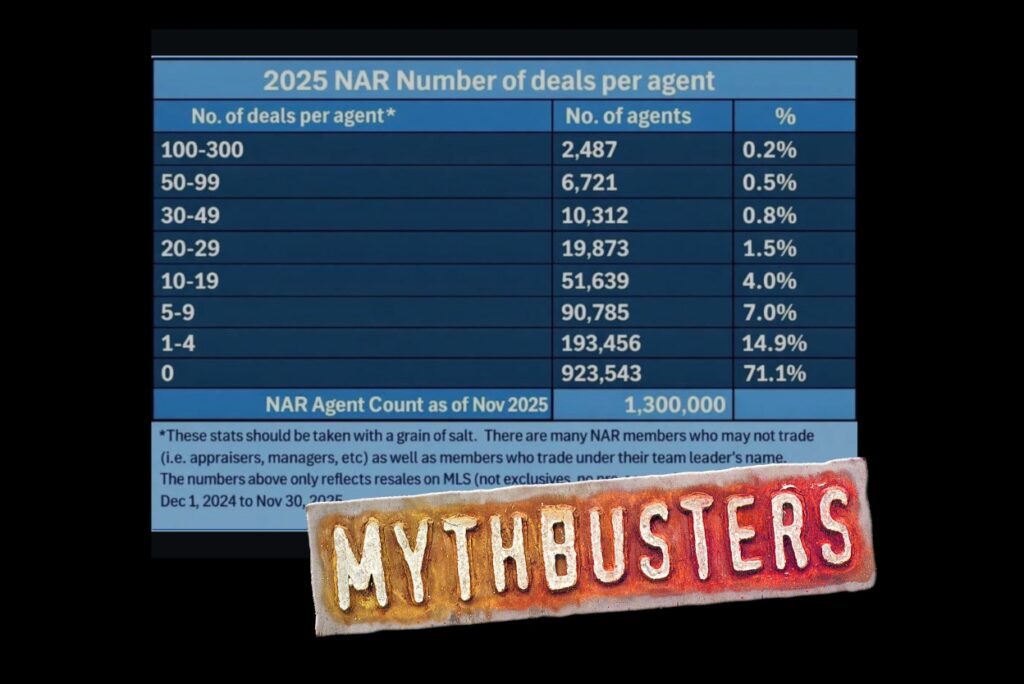
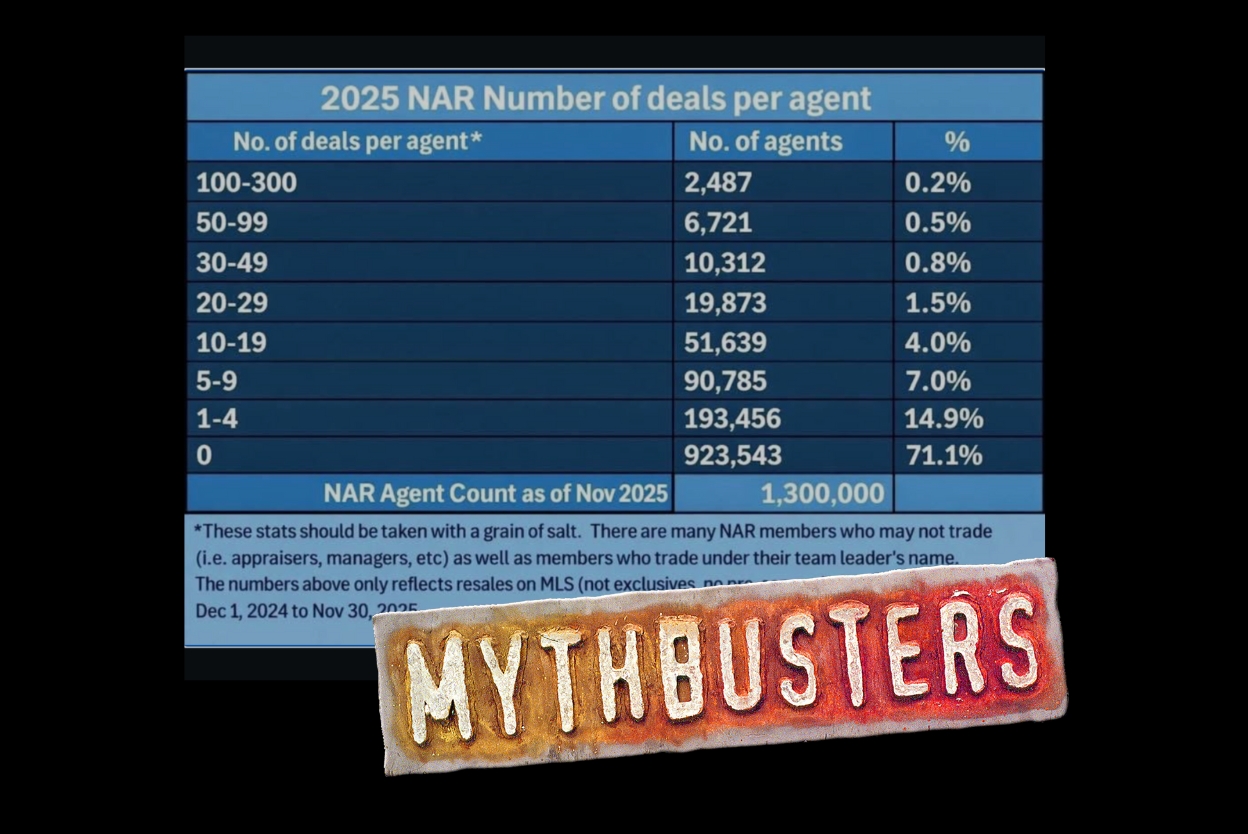
It claims that 71.1% of real estate agents closed zero transactions in 2025, with another 14.9% closing just one to four deals. You may have seen it:
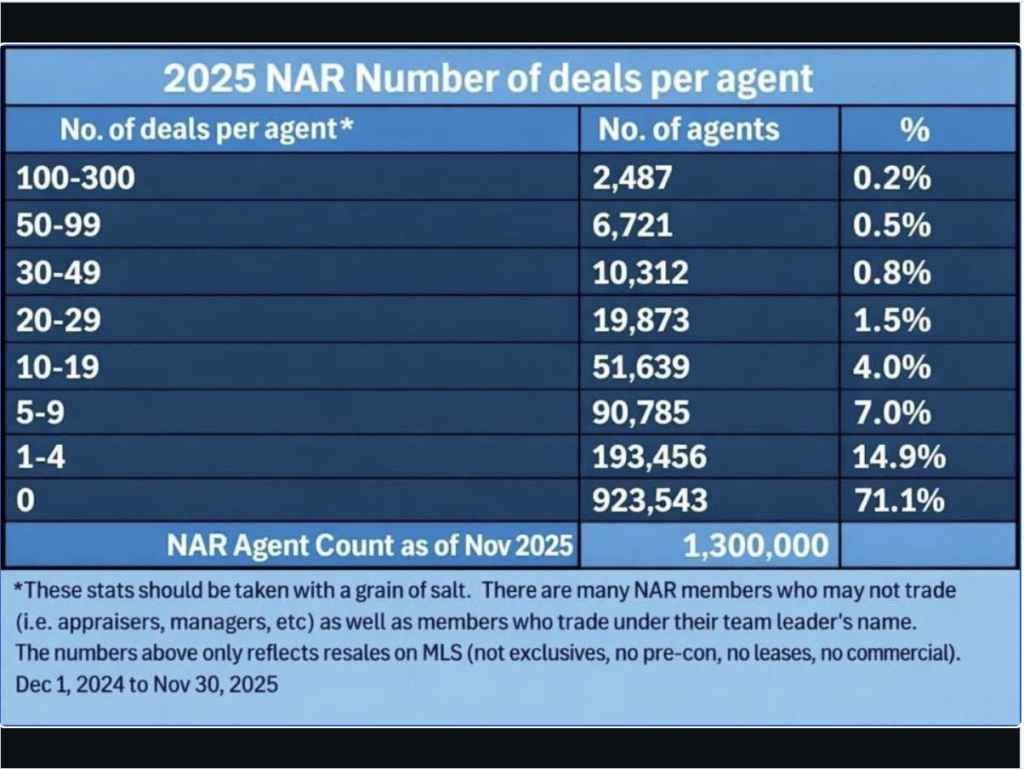
The graphic is showing up in green-screen videos, screenshots, and posts framed as proof that most agents aren’t actually doing business.
And while the chart states the data is from the National Association of Realtors® (NAR), that attribution is wrong. Here’s where the viral stat came from, and what NAR data actually shows.
Where the Stat Came From
When something is going viral in the industry, BAM takes notice. So to verify the claim, we reached out directly to NAR, which confirmed that the 71.1% stat did not come from its research.
Instead, the number appears to trace back to a January 2025 onstage mention of a Redfin survey.
When BAM followed up with Redfin, the company clarified that the statistic was never formally published. It was mentioned in a talk track by Joe Rath, Redfin’s head of industry relations, during a session at Inman Connect last year.
According to Inman, Rath stated, “Thirty percent of agents do all the business. Seventy-one percent of agents did not close a transaction last year.”
He went on to say “that number can be a little bit misleading,” because not all agents are closing transactions. This is because there are agents who are part-time license holders, people who got licensed but never entered the business, and even agents on a team where all deals are closed under the team leader.
In other words, the stat was spoken, not published, by Redfin. And later circulated as if it were official NAR data.
What NAR’s Actual Data Shows
The 2025 NAR Member Profile paints a different picture.
Among REALTORS® specializing in residential sales:
- Only 5% reported zero transaction sides in 2024
- The typical Realtor completed 10 transaction sides
- Realtors with two years or less experience reported a median of 3 transactions
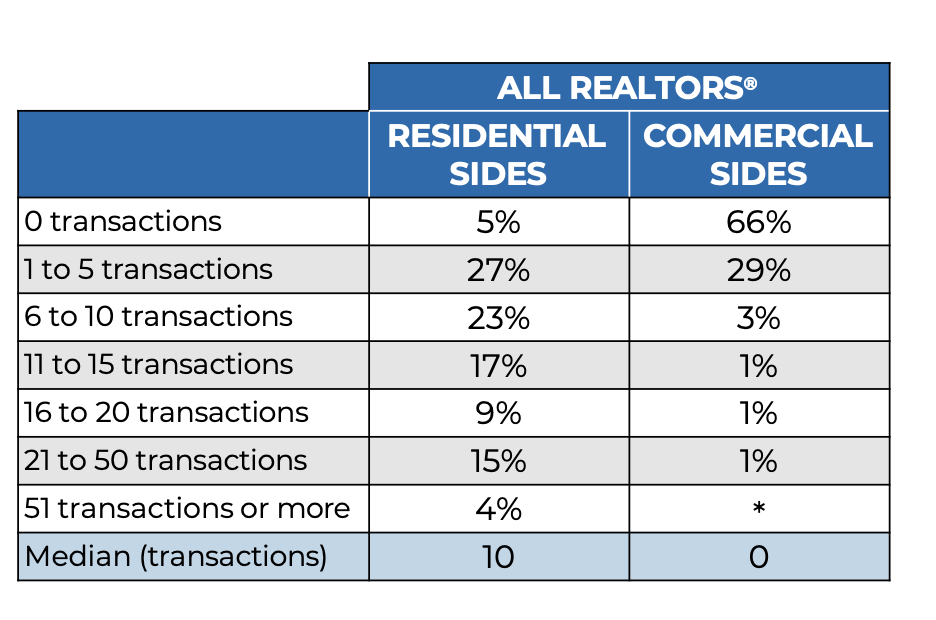
The data doesn’t suggest an easy market, and it is based on the responses of participants in the survey. But it also doesn’t support the idea that most working Realtors are inactive.
Why the Stat Resonated
Even though the number may be misleading, the reaction to it wasn’t random.
For some agents, the stat felt believable. For others, it felt convenient. Sharing it became a subtle way to signal, “I’m not like the majority,” or to highlight how much more they do compared to the rest of the field.
The chart struck a nerve because it reflects a real tension in the industry: experience and production are unevenly distributed.
The chart may have exaggerated the problem, but it didn’t invent it.
The Takeaways for Agents
1) Data matters
Agents use data every day to explain what’s happening in the market. Numbers shape conversations about pricing, timing, risk, and opportunity.
When agents share statistics online without fully understanding them, those numbers don’t stay inside the industry. They reach consumers who are trying to make sense of one of the biggest financial decisions of their lives.
If agents are going to use data to guide people, they also have to be able to look past the headline, understand the context, and explain what that data actually means for consumers.
2) Consumer perception matters
Agents often talk about how consumers misunderstand the profession.
They complain about being seen as “door openers,” about clients questioning compensation, or about the idea that anyone can do the job.
And yet, many agents have been quick to share a chart suggesting that most agents don’t close deals.
From a consumer’s perspective, the message is simple: if agents themselves are saying this, it must be true.
And once a narrative like that takes hold, it’s difficult to undo.
3) Proof matters
At the end of the day, most consumers aren’t comparing NAR reports or debating survey methodologies. They’re asking a much simpler question: “Can this person actually help me?”
Industry-wide stats matter less than individual credibility.
What shapes trust is whether an agent consistently demonstrates expertise through clarity, experience, and results. How they explain the market. How they articulate strategy. How they show that they’ve done this before.
Trust is no longer granted by default. It’s built through clarity, experience, and the ability to make complex information understandable.
The Plays Agents Can Run
In a world where numbers go viral and context gets lost, the most effective response isn’t arguing about data. It’s changing how you show up.
1) Know your data before you share it
Don’t just repeat a stat because it’s trending. Understand where it came from, what it measures, and what it doesn’t. If you can’t explain it clearly to a client, it probably doesn’t belong in your content.
2) Translate numbers into meaning
Data only matters when people understand it. Instead of posting charts, explain what they mean for buyers and sellers in your market. Context is what turns information into trust.
3) Show proof
As Sharran Srivatsaa says, “Proof over promise.” Consumers care less about what you claim and more about what you’ve done. Share real examples of strategy, outcomes, and decision-making, not just branding or slogans.
4) Make expertise visible, consistently
Proof isn’t a one-time post. It’s a pattern. The agents who stand out are clearer, more specific, and more transparent about how they work.