

For more than a decade, the housing shortage narrative has dominated every market conversation and every pricing discussion.
This week, the Mortgage Bankers Association (MBA) published a white paper projecting only 1% home price growth in 2026, then flat prices for the following two years, driven by a demand slowdown that’s structural, not cyclical.
Here’s what the white paper says and how it could change your pricing conversations with sellers.
Why Demand Is Slowing Down
The housing shortage era was built on Millennial household formation. That generation drove a decade of demand that outpaced construction and pushed prices up year over year.
Gen Z is now moving into peak homebuying age, and it’s a smaller cohort.
But that’s only part of the demand problem. Immigration dropped sharply following 2025 policy changes, and the Congressional Budget Office (CBO) now projects net immigration could go negative for at least the next few years. Without immigration recovery, the U.S. population could stop growing as soon as the early 2030s.
The MBA’s household formation projections tell the story:
- 10.1 million new households formed from 2010 to 2020
- 8.6 million projected from 2025 to 2035
- 5.1 million projected from 2035 to 2045
Slower household formation means less demand for both rental and for-sale housing. The MBA’s baseline demand projection works out to roughly 1.13 million new units needed per year from 2025 to 2035, dropping to 802,000 per year from 2035 to 2045. Builders haven’t slowed down to match those numbers.
Supply Is Catching Up Fast
Builders responded to pandemic-era price signals and kept building. Multifamily completions have exceeded the historical average every year since 2023, and those units are now hitting the market at exactly the wrong time for sellers.
The MBA estimates net supply growth of 10.6 million to 14.6 million units from 2026 to 2035. Projected demand for that same period falls between the low and medium supply estimates.
Depending on how construction activity holds up, supply could outpace demand before 2035.
Here’s where the pricing forecast lands:
- 4% home price growth nationally in 2024
- 1% projected growth in 2026
- Flat prices projected for 2027 and 2028
Rental vacancy rates have already climbed from 5.6% in 2022 to 7.3% in 2025, and the number of existing homes on the market is up approximately 30% compared to last year.
This is a national picture, and some markets are still supply-constrained. But in markets where inventory has been climbing, a listing priced on 2022 assumptions is going to sit, and a home that sits loses leverage fast.
Your Market May Already Be Living This
Sun Belt markets are taking the hardest hit right now. Builders in the South and West delivered massive amounts of new inventory right as demand cooled, and Austin is the MBA’s prime example of a market that got overbuilt.
The Northeast and Midwest are a different situation. Construction in these regions faces significant constraints from restrictive zoning and high permitting costs. Labor costs are elevated too, and all of that has kept new supply from catching up with demand.
The regional inventory picture breaks down like this:
- Sun Belt states like Texas (up 38%) and Florida (up 25%) have seen active listings rise significantly since 2020. The MBA expects price growth to slow or decline in Arizona, Texas, and Florida
- Most Northeast and Midwest states have seen active listings fall since 2020, with some states down 40% or more. The MBA expects relatively strong price growth to persist in New York, New Jersey, and Massachusetts
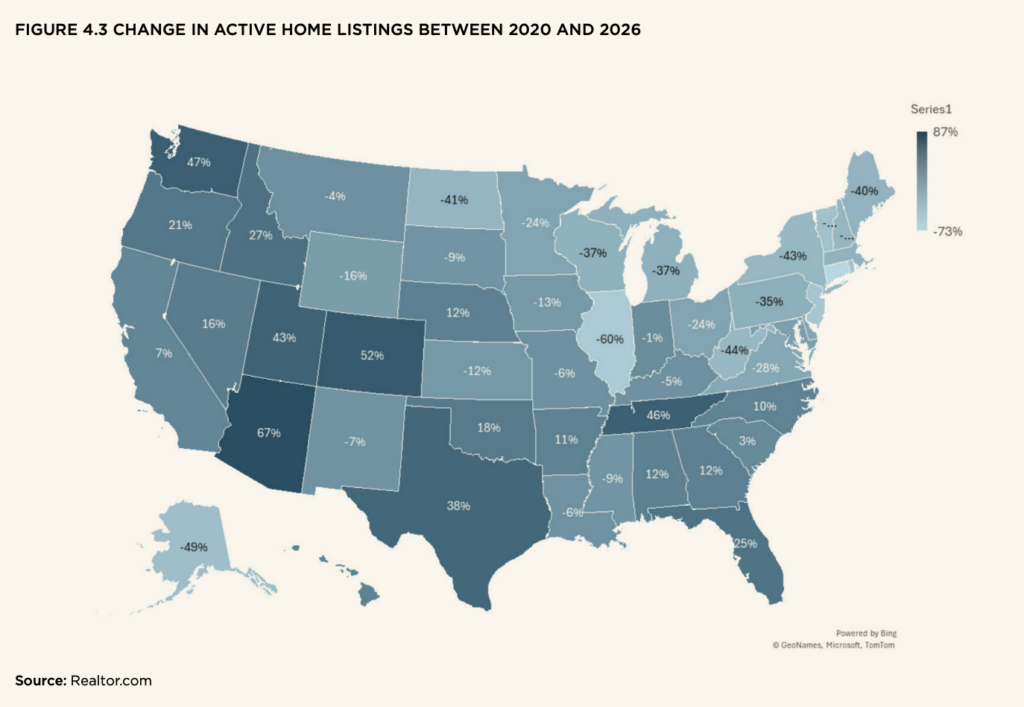
Source: MBA (Realtor.com)
Here’s what that comes down to in practical terms:
- A seller in a supply-constrained Northeast or Midwest market has more pricing power than the national headlines suggest.
- A seller in a high-inventory Sun Belt market needs realistic expectations before the listing goes live.
What Buyers Need to Hear Right Now
Right now, the mortgage payment-to-rent ratio is sitting at 1.38, which means the median buyer is spending 38% more per month on housing than the median renter. Those numbers alone are keeping many would-be buyers out of the market. Even with rent going up every year, it’s still more manageable for many renters than the costs they’d take on with a home purchase.
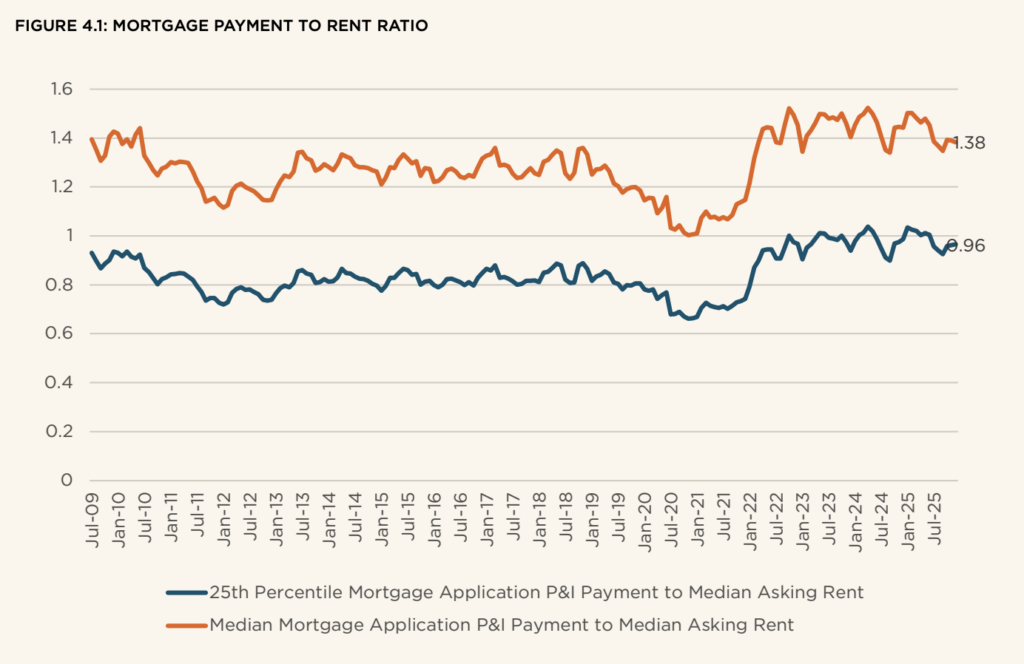
Source: MBA (Realtor.com)
On the plus side, that 1.38 ratio is down from the 2022 peak of 1.45. And with home price growth flattening and income growth outpacing those price gains in many markets, affordability is gradually improving in this respect.
But the U.S. still has a racial homeownership gap:
- 72.5% of white households are homeowner households, compared to…
- 50.9% of Latino/a households
- 45.1% of Black households
Closing that gap represents a real opportunity for agents serving underserved communities.
There’s one other detail on which NAR differs from other sources, including the NY Fed, Cotality, and the Federal Housing and Finance Administration (FHFA), and that’s the median age of the first-time homebuyer. According to MBA’s white paper:
- NAR puts it at 40 years.
- Other sources cited by MBA put it at 32 to 34 years.
In other words, be careful about citing NAR’s 40-year figure as a settled fact.
Due diligence as a real estate agent includes knowing your local housing market data, as well as data and information on the people you serve. First-time buyers in your market may look very different from those in another.
The main thing is knowing what they need from you and doing what it takes to deliver.