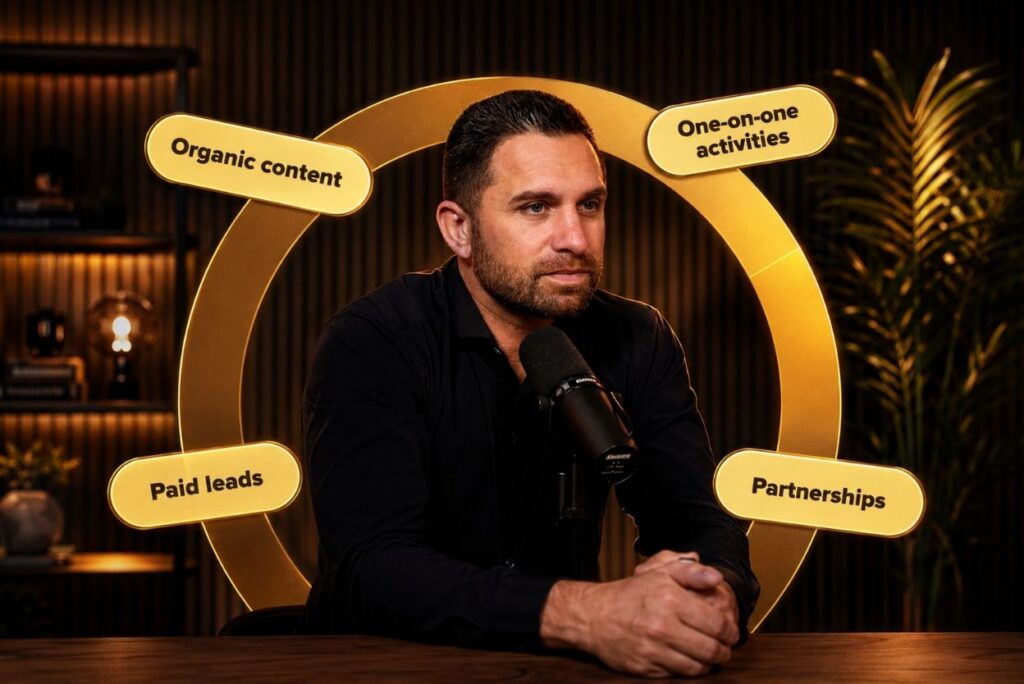
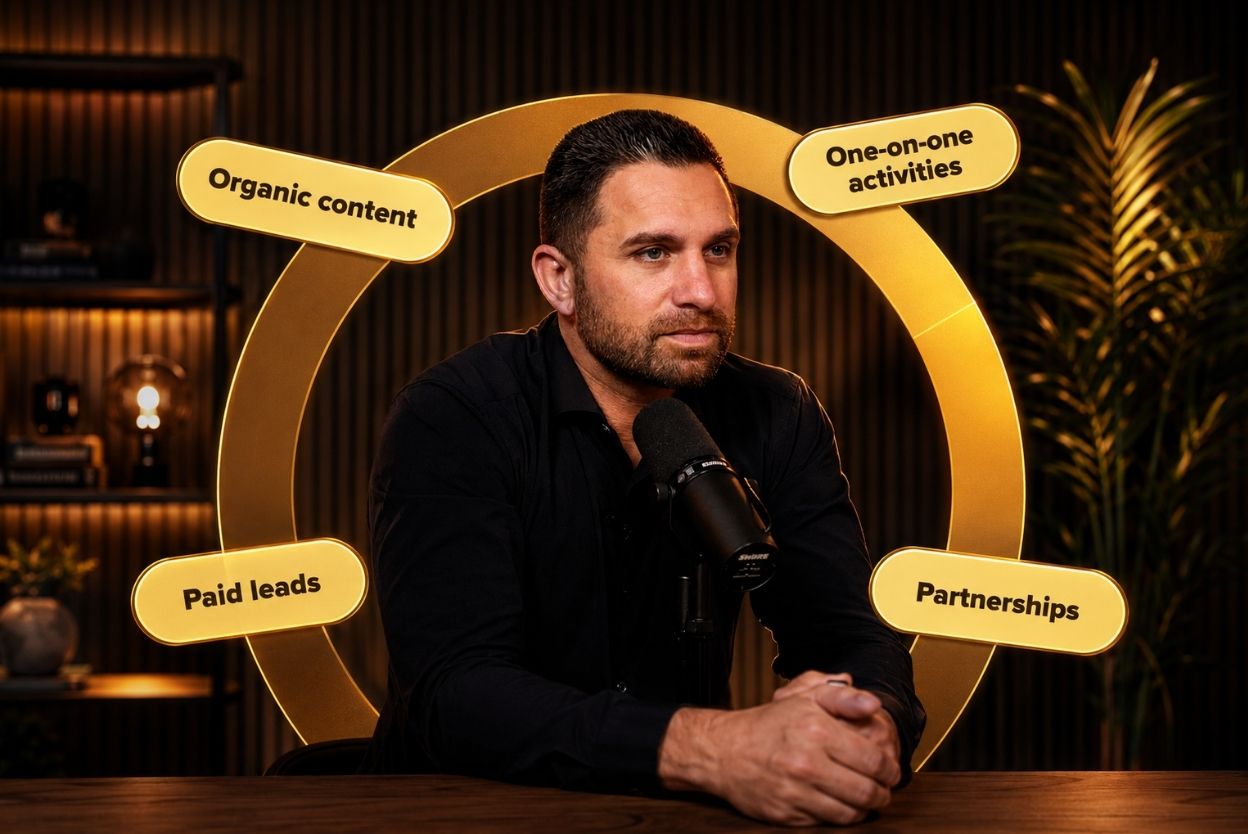

Every real estate business, whether it closed ten deals last year or two hundred, runs on the same four lead engines:
- Organic content
- Paid leads
- One-on-one activities
- Partnerships
You’re probably running all four right now without a number attached to any of them.
Here’s the exercise I walked a room through at a recent event. Once you can see the real cost of each engine, in time, in dollars, or in a piece of every check, deciding where to spend your next ninety days gets a lot easier.
Organic Content Costs Time (Unless You Pay to Speed It Up)
Organic content means one message reaching a lot of people instead of one conversation with one person at a time.
Instagram, YouTube, TikTok, Facebook, podcasts, drip campaigns, LinkedIn, Substack all count.
You can run this engine two ways.
- Put in the time yourself, and it costs nothing but hours.
- Pay a team to produce it, and you buy back your hours, and that team costs real money once you’re running it at scale.
Take Sharran Srivatsaa‘s YouTube relaunch. His team pulled his channel back, got strategic on the content and the messaging, and built a six-video series that took months to put together. One of those videos crossed a million views.
Sharran puts in around 10% of the actual production work himself. His team writes the scripts, decides on the title, the thumbnail, when it goes live.
That’s the paid version of this engine.
None of that content pays you a dollar until someone on the other end gets on a call with you. I hear this from agents running content strategies all the time: they get comments and DMs on a listing video, string together a few automated follow-up questions, and lose most of that audience before ever asking for the appointment.
Stop asking questions that keep the conversation going and start asking for the call. Here’s the message I tell agents to send once someone engages on a post:
“Hey, there’s two things that every buyer right now is asking about. Can I walk you through those? What’s the best time to shoot you a quick five minute call? Is it two or three o’clock?”
Give them a reason to get on the phone and two times to pick from.
Paid Leads Buy Speed (and Demand Follow Up)
Paid leads work the same way organic content does, except you’re paying money instead of hours to reach people.
Zillow, Google PPC, Meta ads, home valuation campaigns, all of it lives here.
These leads sit at the top of the funnel. Someone scrolling Facebook is browsing on their own timeline, six months out, 12 months out, 18 months out. They register for whatever you’re offering because it caught their eye, planning to come back to it later.
Speed decides whether that lead ever becomes a client.
Reach out within the first 30 seconds to five minutes, and the odds of turning that person into a customer go up by more than 350%.
Response time is the whole game with paid leads, along with a follow up system built for the next six, 12, and 18 months, since that lead isn’t ready to transact this week.
Running the ad is the easy part if you have the budget. Building the response system, someone answering the phone in under five minutes around the clock, or you personally never turning your phone off, costs money or costs sleep.
Either way, it costs something real.
1:1 Activities Still Work on Time and Effort Alone
One-on-one activities were the original lead engine, before anyone put a name on lead engines.
Open houses, cold calling, door knocking, events, past client outreach, circle dialing, expired dialing. Every bit of it runs on time and effort instead of a check.
Run open houses without knocking the doors around that listing, and you leave half the opportunity in that neighborhood for someone else to pick up.
I worked with a BAMx member in this exact spot. No listings, no past clients to call, but willing to make two to three hundred calls a week.
So we built her a system instead of a content plan.
- Call every agent in her own office first, then the outside brokerages, then a third layer beyond that.
- Offer to run their open houses and make them look good in front of their sellers.
She put in three hours on Monday and three on Tuesday, and picked up two to four open houses a week from cold calls alone.
Another agent in Naples closed $250 million in volume last year with one assistant. He held his open houses on Saturday and Sunday like everyone else in his market. He also opened the doors on weekday afternoons, right when serious buyers left work looking for a place to see before the weekend got crowded with competition.
Those open houses built two things at once.
- They put him in front of serious buyers heading into the weekend.
- They gave him a reason to be inside those gated communities five days a week, past the entrance gate most agents never get through.
Neighbors in those communities know who’s thinking about selling long before any agent does, and door knocking put him first in line for that information.
Here’s the line I tell agents to use when they’re introducing themselves to the neighbors around a listing, without sounding like they’re fishing for the next one:
“Hey, you might see a little bit more traffic today. I promised my seller I’d give you a heads up.”
None of this costs a dollar, only hours. Agents willing to put in the calls and the knocks still outperform plenty of paid options with that time alone.
Partnerships Trade a Percentage for a Faster Close
Partnerships solve a different problem, the cost of finding a customer in the first place. Instead of paying with your time or your ad budget, you’re paying with a piece of the commission.
Zillow, Realtor.com, referral networks, relocation companies all live in this category.
A referral business you built over twenty years might feel free because no check ever leaves your account for it. You’re paying for it in relationships, in time, and in favors owed, and that cost is real even without an invoice attached to it.
Every Engine Has a Real Cost
Every one of these four engines charges you something, in time, in dollars, or in a cut of the check. Once you can see all four costs side by side, deciding where next quarter’s effort goes gets a lot clearer.
One agent recently laid out her exact situation for me:
- 21 years in the business, done with the sweat equity grind, ready to build with leverage instead
- A referral business that used to bring in 80% of her revenue
- A Zillow Flex team she added six months earlier, with the split now sitting close to 50/50
- A podcast she wants to build as a long term brand play, competing with everything else on her calendar for the same hours
I wasn’t going to tell her to cut a referral business she spent two decades building, and I wasn’t going to tell her to walk away from Zillow leads paying her bills every month. Neither engine was coming off her plate.
The only real move left was finding something else to remove to make room for the podcast.
She reorganized her calendar around what already pays her bills, and built the podcast into the edges instead of touching either engine that funds her business today.
Her fix was to pause Zillow Flex on the one day each week she blocks off to prep and record her podcast, since that day was never her peak lead time in the first place.
Map Your Own Four Engines Before Your Next Planning Cycle
Before you write another business plan, list out what’s coming in from each of these four engines right now, and write down what each one costs you in time, in dollars, or in a percentage of the check.
Don’t kill an engine that’s already paying you just because a new one looks exciting. Check your calendar first. There’s almost always a block of hours going toward something that isn’t paying you back, and that block is where room for the next engine gets built.
Ninety days from now, you should be able to look at your four engines and know exactly what each one costs and what each one returns.
This clarity, not more hours of activity, is what moves your business forward this year.
Pick the engine that costs you the least for what it returns, and build your next 90 days around it.