

Key Details:
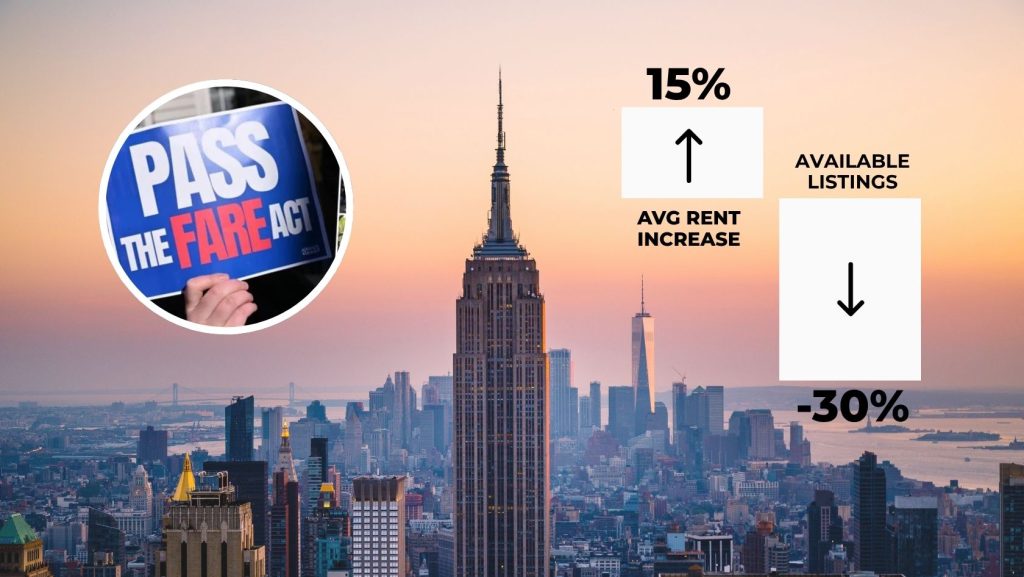
- After NYC’s FARE Act banned broker fees for renters, average rents jumped 15% in just one week, from $4,750 to $5,500.
- Nearly 2,000 listings vanished from StreetEasy, and agents are now navigating a growing “shadow market” of off-platform rentals.
- Many are reporting illegal dual pricing, sudden listing removals, and rising pressure from both landlords and frustrated tenants.
What was pitched as a win for renters has quickly become one of the most disruptive policy changes NYC’s rental market has seen in years.
Since the FARE Act took effect, rents have surged, listings have vanished, and a new “shadow market” has taken shape. Meanwhile, agents are caught in the middle of a chaotic, high-stakes game of rental chess.
The New York Post reported on the fallout. Here’s what we know so far.
What the FARE Act Changed (and What It Didn’t)
The Fairness in Apartment Rental Expenses (FARE) Act was designed to shift the financial burden of broker fees away from renters. Under the new law:
- Brokers who represent property owners can no longer charge tenants a broker fee.
- All fees a tenant owes must be included in the advertised rent and disclosed in the lease.
The idea was simple: more transparency, fewer surprise charges, and a fairer shake for tenants. But within days, it became clear the FARE Act was failing on all three counts.
The Immediate Fallout: Rents Spike, Listings Disappear
Within a week of the new law taking effect on June 11:
- The average NYC rent jumped by 15% from $4,750 to $5,500, according to UrbanDigs.
- Roughly 2,000 listings vanished from StreetEasy overnight.
- Available apartment inventory dropped by 30%.
As John Walkup, UrbanDigs’ co-founder, told The Post:
“The Manhattan rental market has seen a sharp reaction.”
Speaking of the sharp rise in asking rents across NYC, Walkup said they “suggest that landlords may be attempting to incorporate broker fees into the rent, which would transfer the cost to renters in a less direct, but very real way.”
At this point, it seems fair to ask, Did no one see this coming?
Some agents are now seeing two-tier pricing systems emerge: one price with a broker fee and a much higher one without. One example: a 3-bedroom offered for $6,800 with a fee, or $8,000 without.
That kind of pricing is now illegal under the FARE Act. But it’s still happening.
The Rise of the Shadow Market
With stricter rules on who can charge what, some landlords and agents have started pulling listings from public platforms and operating in the shadows.
- Listings are being marked as “temporarily off market” to avoid scrutiny.
- Agents are fielding backchannel calls instead of relying on public platforms.
Jason Haber, co-founder of the American Real Estate Association (AREA) and a broker with Compass, put it this way:
“We’re going to be looking for apartments again like it’s 1999…It’s going to be an odyssey.”
This so-called “shadow market” creates opacity, not transparency. And it’s already undermining consumer trust.
How This Impacts NYC Agents on the Ground
Agents are getting squeezed from both sides.
- Tenants are frustrated and confused. Some are asking to pay broker fees to get a lower rent, which is now illegal.
- Landlords still expect agents to deliver tenants—and, in many cases, even find creative ways around the law.
Brokers in NYC report listings being pulled suddenly. And those who’ve pushed back on noncompliant pricing tactics have been ghosted. And renters are caught between sharp increases in rent and a dwindling supply of options.
As one renter, Kebenae Tadesse, told The Post:
“It’s so frustrating… Brokers have repeatedly said, ‘Well, if I don’t charge you this fee, the landlord is just going to put it into your rent. It’s discouraging.”
What Agents Outside NYC Need to Know
This isn’t just a New York story. Cities across the U.S. are watching this unfold. If you’re an agent outside of NYC, this is your heads-up:
- Similar regulations may be coming to your market. Be proactive about educating your clients on how fees are structured.
- Start preparing now. Have legal-compliant marketing templates and scripts ready for landlord clients.
- Know your value. In high-conflict, high-confusion markets, the agent who brings clarity wins.
Final Thought
NYC’s FARE Act is a case study in unintended consequences. It’s also a reminder that real estate doesn’t just run on rules; it runs on relationships, communication, and trust.
What are you doing in your business to build trust with renters in your market?