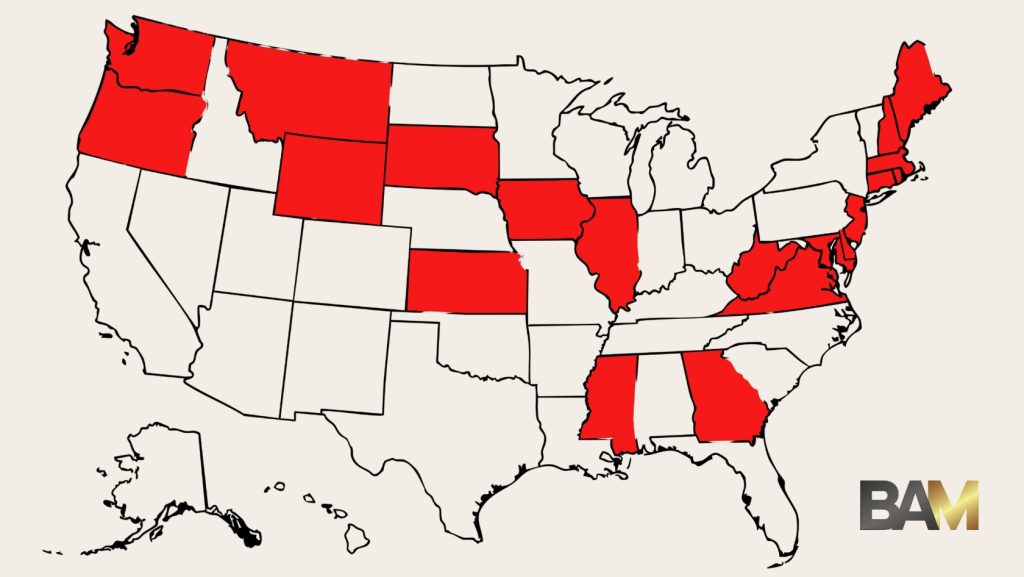


Key Details:
- Realtor.com and Fortune report that 22 states, representing one-third of U.S. GDP, are in or near recession.
- National GDP grew 3.8%, unemployment holds at 4.3%, and private employers shed 32,000 jobs in September as wage growth slows and lower-income households struggle with debt and confidence declines.
If the national economy looks solid on paper, you’re not imagining things. The latest GDP report shows growth of 3.8%, and unemployment has held steady at 4.3%.
But according to a new analysis from Mark Zandi of Moody’s Analytics, as reported by both Realtor.com and Fortune, the story changes once you zoom in at the state level. Nearly half of U.S. states are either in recession or at high risk of falling into one.
State-level data makes it clear why the U.S. economy is on the edge of recession. Based on my assessment of various data, states making up nearly a third of U.S. GDP are either in or at high risk of recession, another third are just holding steady, and the remaining third are… pic.twitter.com/DXPzn7GOrb
— Mark Zandi (@Markzandi) August 24, 2025
That split explains why so many Americans are struggling to reconcile strong national data with what they’re seeing in their own communities. It also reveals growing fault lines that could shape housing markets across the country in the months ahead.
Byron Lazine unpacked the data in Monday’s Hot Sheet:

A Nation Divided by Economic Momentum
Moody’s Analytics found that 22 states are already contracting or teetering on the edge of recession. Another third of states are “treading water,” while the final third continue to expand.
Together, those 22 states account for nearly one-third of U.S. GDP.
The country’s economic strength, at least for now, is being propped up by its biggest players. California, Texas, and New York, which together represent over one-fifth of total GDP, remain in the clear. Their size and stability are what’s keeping national growth in positive territory.
Which is why Byron added:
“What’s happening in New York, what’s happening in California, is kind of where the rest of the country is going to get their cues from.”
But that balance is fragile. In an interview with Fortune, Moody’s chief economist Mark Zandi warned that the national outlook could quickly change if those economic anchors begin to slip.
Zandi explained:
“Those two states are treading water. They’re big states, and if they go into the red, then that’ll probably take the national economy with them into recession. If they turn up and find their way through into the blue, I think we’ll be able to avoid a downturn.”
Where the Weak Spots Are Emerging
The recession risk isn’t confined to any one part of the country, with the recent Zandi tweet highlighting the biggest trouble zones.
Moody’s data shows contraction from coast to coast, though the Washington, D.C. region stands out. Government job cuts, funding reductions, and the ongoing federal shutdown have weighed heavily on D.C., Maryland, and Virginia.
Further south, Georgia has become an unexpected trouble spot. Despite its historically strong economy, the state’s manufacturing base, agricultural sector, and housing market have all softened. Zandi noted that pandemic-era migration drove costs higher and eroded affordability, leaving Georgia less resilient to today’s economic pressures.
In contrast, Southern states as a whole are still performing better than most regions, but their growth is slowing.
California and New York may be holding their ground, but both remain “tethered” to wealthier households and volatile sectors like technology and finance.
The Labor Market’s Slowing Pulse
The national job market is showing signs of strain.
According to the latest available Labor Department data, the U.S. added an average of just 27,000 jobs per month between May and August 2025. And because of the ongoing government shutdown, there was no official jobs report for September.
Private payroll data from ADP showed that 32,000 jobs were lost that month, suggesting employers are already pulling back.
While the unemployment rate hasn’t yet climbed significantly, Zandi estimated that even a modest rise to 5–5.5%, roughly 1.5 million job losses, could push vulnerable households into crisis.
As he told Fortune:
“They’ve got a job, so that’s why they’re still able to spend and remain engaged in the economy, but increasingly … the grip feels more tenuous because no one’s getting hired. You can sustain that for a while, but you can’t sustain that forever. If the layoffs do pick up, that lower-middle-income group is gonna get nailed—and they have no options, because they really don’t have much in the way of saving.”
Zandi added that lower-income households are “hanging on by their fingertips financially.”
Consumer Confidence and Household Strain
The human side of this economic divide is showing up in consumer sentiment. Private data collected during the federal shutdown points to weakening confidence, particularly among households earning under $35,000 a year.
In The Conference Board’s Consumer Confidence Survey released in September, those earning $25,000 to $35,000 felt worse about the economy than they did at the year’s low point in April. Nearly 20% of respondents said jobs were hard to find, and 25% expected the job market to worsen.
Zandi observed that while the top 20% of earners remain relatively stable, the bottom 80% are under financial stress due to lagging wage growth, higher debt, and limited savings.
What It Means for Housing
Realtor.com’s reporting presented the facts without any need for alarmist headlines, as Byron pointed out:
“Realtor.com took the report. I think they did a much better job than what (Fortune) did. And they laid it out for us. Treading water is New York, treading water is California, so not in a recession—not in expansion like your Floridas, Texases, Pennsylvanias, Carolinas…but more just treading water.
“In fact, the Moody’s analysis went on to say that New York and California are hanging on ‘by their fingernails.’ They’re not expanding by any measure, [but] they’re not in a high-risk situation where they’re in a recession. But one bad thing could push them over the edge.”
Economic slowdowns rarely stop at the doorstep of the housing market. Realtor.com senior economist Jake Krimmel warned that state-level recessions could soon start affecting real estate activity.
“Whether nationwide or localized, recessions are bad for housing markets. The direct effects of an economic slowdown are higher unemployment, less hiring, and lower wages—all killers for would-be homebuyers and all warning signs for current homeowners trying to make mortgage payments.”
That said, there are still bright spots.
Krimmel noted that states at the highest recession risk, especially in the Northeast, also happen to have some of the strongest housing markets right now. Meanwhile, Texas, Florida, and Arizona, where price growth has cooled and inventory is slow-moving, still have expanding economies that could limit the downturn’s reach.
As Krimmel put it:
“The silver lining in the case of Moody’s projections is that the states at highest risk, especially those located in the Northeast, happen to have the strongest housing markets right now. As long as local economic fundamentals and housing markets don’t weaken simultaneously, a major economic downturn is unlikely.”
The broader housing outlook is nuanced. A recession could lower mortgage rates, making homes more affordable in theory, but only buyers confident in their jobs and income would benefit. If unemployment rises or wages stagnate further, affordability alone won’t be enough to restore demand.
While national GDP and job figures still paint a stable picture, the underlying state data tells a different story, one that hints at uneven footing and potential regional cooling in both economic activity and housing demand.
For agents, this widening gap underscores the importance of understanding not just national headlines, but local economic conditions that directly influence buyers’ confidence and sellers’ motivation.
In some markets, that means preparing clients for slower activity; in others, it means helping them capitalize on continued momentum before the tide turns.