
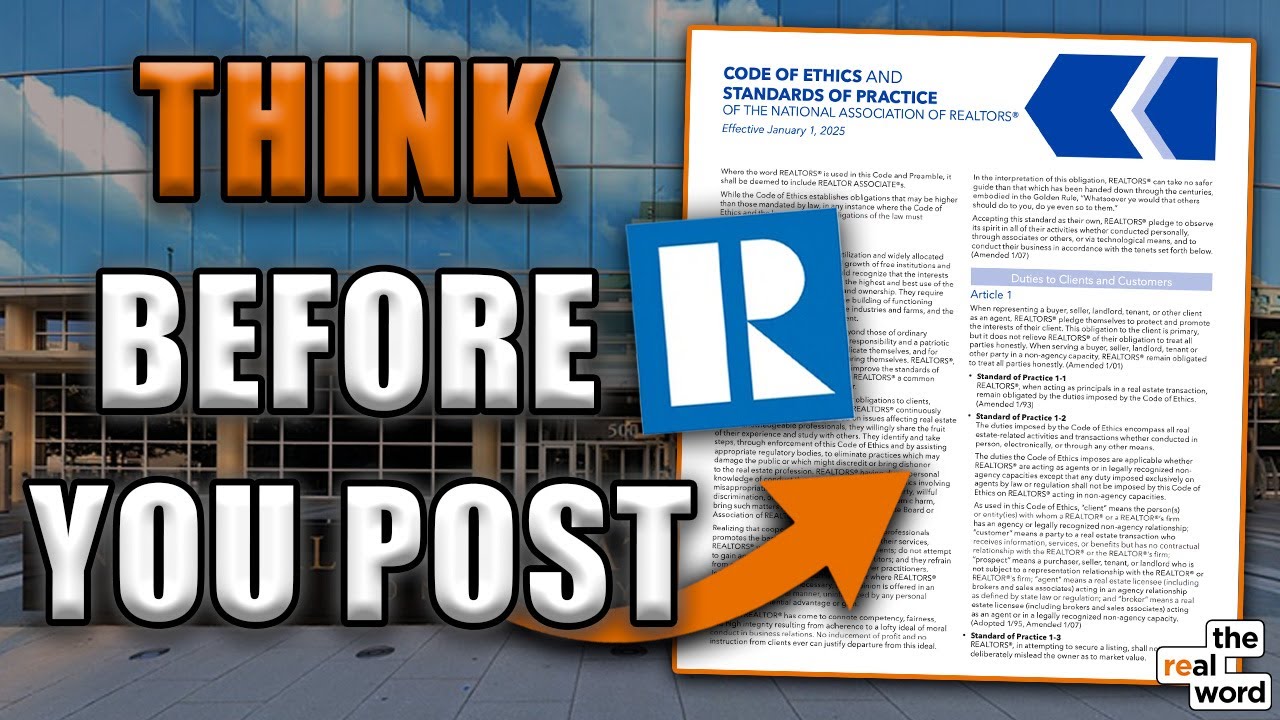
A Virginia agent might lose his license over a nine-year-old Facebook post. Texas lawmakers are pushing back. And the National Association of REALTORS® (NAR) is scrambling to clarify its speech policies.
On episode 366 of The Real Word, Byron Lazine and Nicole White dug into a Realtor Magazine article on possible changes to NAR’s Code of Ethics—and the broader firestorm surrounding a controversial free speech case in Virginia.
With state lawmakers and major brokerages calling for more autonomy, the question is no longer just about policy updates.
It’s about whether NAR still has the power or the relevance to lead.
Read on for the highlights. And make time to enjoy the full conversation:
The Controversy: A Bible Verse, a REALTOR®, and a Nine-Year Fallout
In 2015, Virginia REALTOR® and pastor Wilson Faber posted a Bible verse (Leviticus 18:22) on Facebook stating that homosexuality is a sin. Nearly a decade later, the Virginia Association of REALTORS® found it to be a violation of NAR’s Code of Ethics, citing its policy on hate speech.
Now, Faber could lose his real estate license.
Byron summed up the reality of the situation in a few choice quotes:
“When you start to support the fringes on this stuff publicly, and you’re a real estate professional, and you wonder why more of the market doesn’t want to work with you… you’re not being intellectually savvy or honest with the discussion…
“Your ability to exercise freedom of speech—I want everybody to have that ability… You have to make smart decisions with how you’re going to exercise it…”
It’s fair enough to point out that Faber’s decision to post that verse in particular would alienate those who disagree with him. But as Rob Hahn, aka Notorious ROB, has pointed out, posts like Faber’s may be offensive to many, but they do not constitute violence.
As a trade organization relying on member dues, NAR is within its rights to decide whether Faber’s membership should be revoked as punishment for his post, if they do in fact classify it as “hate speech,” according to their policy.
The question is whether NAR or the Virginia Association of Realtors has any right to decide whether Faber, whose post did not violate existing laws, should be stripped of his state-issued real estate license.
The Texas legislation discussed during the pod would prevent trade organizations like NAR from creating speech rules that override state law.
The bill would draw a hard line around freedom of speech.
NAR’s SOP 10-5: What It Is and Why It Matters Now
This June, NAR’s Professional Standards Committee will vote on changes to Standard of Practice 10-5 and Policy Statement 29, both of which govern how Article 10 of the Code of Ethics is enforced.
For context:
- Article 10 prohibits REALTORS® from denying equal services or employment opportunities based on protected characteristics.
- SOP 10-5, adopted in 2020, prohibits members from using “harassing speech, hate speech, epithets or slurs” against those protected groups.
But according to Realtor Magazine, SOP 10-5 was never meant to regulate political or religious expression—a clarification that didn’t seem to help Faber in Virginia.
Now, NAR is pushing new language to:
- Create a clearer definition of harassment, aligning with NAR’s Member Code of Conduct.
- Refocus the scope of Article 10 to apply only in professional settings, restoring pre-2021 enforcement standards.
As NAR president Kevin Sears puts it:
“The Code of Ethics is part of what distinguishes REALTORS® from mere real estate professionals. It is the foundation of our ability to earn and maintain consumers’ trust as we fulfill our mission to preserve, protect and advance the right to real property for all…
“We take any changes to the Code of Ethics very seriously, and the amendment process is thoughtful and rigorous. NAR is deeply committed to upholding principles of fair housing and equal treatment for all consumers, and these proposed changes do not change that.”
It’s Simple: Follow the Law
Both hosts question the real value of the Code of Ethics, especially when it comes to regulating speech outside of clear legal violations.
“What do you need a code of ethics for?” Byron asked. “The code of ethics should be: Follow the law. Don’t be an idiot. That should be simple enough.”
Nicole agreed: “I think a lot of it’s just, be a good person. Do the right thing.”
Their argument isn’t about whether discrimination should be punished; it should. But they draw the line when trade organizations attempt to police personal expression under vague definitions of “harassment” or “hate speech.”
As Byron put it:
“I’ve taken issue with [the Code of Ethics] for years because it can be manipulated by the good old boy and good old girl club. It can be turned into something it’s not. It can be used against agents.”
Or some of them, anyway.
Anyone tracking NAR’s scandals over the past few years knows it hasn’t exactly been consistent in its enforcement of ethical norms.
Sears’ statement that NAR’s Code of Ethics is “part of what distinguishes REALTORS® from mere real estate professionals” (emphasis added) seems a bit of a stretch.
Regarding statements that cross the line into objectively harmful (or potentially so—like screaming “Fire” in a crowded theater), Nicole pointed out:
“These are already illegal. So what’s the point of restating the law?”
What Agents Need to Watch For
Here’s what every agent should know as this story continues to unfold:
- NAR will vote on SOP 10-5 amendments in early June. The Professional Standards Committee votes June 3, followed by a Board of Directors vote June 5.
- The changes aim to protect fair housing, without overstepping. Expect a narrower scope, tied directly to your conduct as a professional.
- Free speech cases like the one in Virginia won’t go away. Whether you agree with the post or not, it’s becoming a case study in how murky the line between personal and professional speech can get.
- States like Texas are challenging NAR’s authority. More legislation is likely to follow, forcing NAR to adapt—or back off.
- MLSs and brokers are seizing power. The post-settlement industry is leaning into local control, which could mean fewer blanket rules and more fragmentation.
Final Word: Say What You Want, But Know the Cost
At the end of the day, Byron put it plainly:
“Just because you can say whatever you want doesn’t mean that it’s not going to have an impact on your business.”
Freedom of speech doesn’t mean freedom from consequences.
Especially when the market—i.e., your clients—will ultimately decide whether you’re worth doing business with.
So, where do you stand? Are NAR’s changes necessary? Or are they just damage control?