
A new battle is playing out in the real estate world. This time, it’s not about commissions or private listings. It’s about speech.
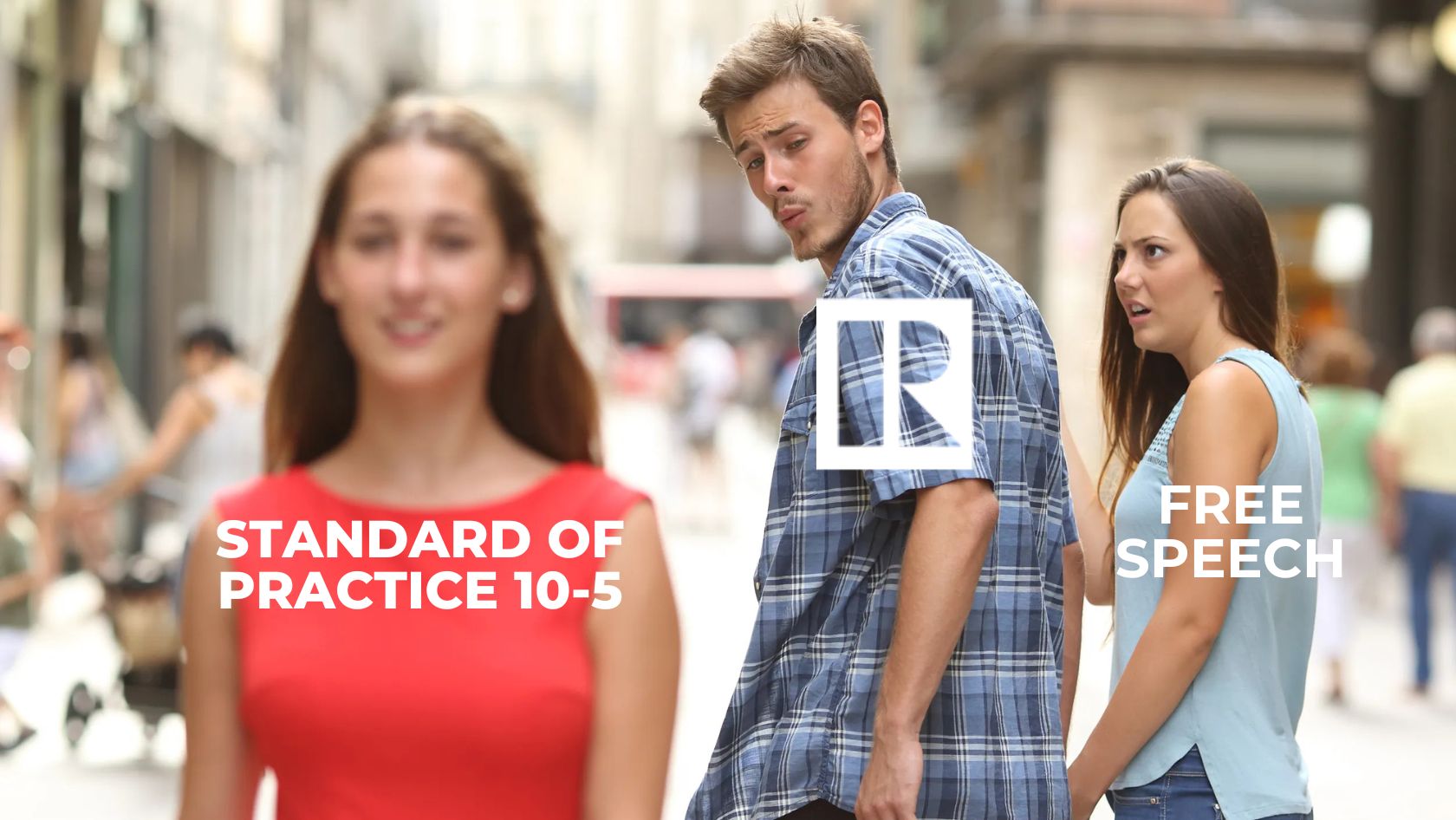
The National Association of Realtors’ (NAR) speech code—formally known as Standard of Practice 10-5—is in the spotlight, and the debate is heating up. Supporters argue it protects marginalized communities and reinforces ethical standards. Critics claim it crosses a constitutional line.
Here’s what’s happening, and what it could mean for the future of professionalism and policy in real estate.
What Is Standard of Practice 10-5?
Adopted in 2020, Standard of Practice 10-5 prohibits Realtors from engaging in discriminatory hate speech, even outside their professional activities. It was designed to raise the bar for ethical conduct and protect the public trust.
But the language has sparked sharp criticism, especially from those who believe it violates core First Amendment principles.
Rob Hahn, CEO of Decentre Labs and creator of Notorious R.O.B. substack, is one of the policy’s most vocal opponents. In a recent Substack post, Hahn applauded new legislation in Texas that could force NAR to strike the code from its books.
“Texas is about to kill NAR’s Speech Code dead. I am ready to throw a party for the victory of freedom over control, for victory of free speech and freedom of conscience.”
Texas Takes a Stand
Texas Senate Bill 2713, introduced by State Senator Mayes Middleton, would ban any trade association from:
“Denying access, membership, or participation based on various factors, including race, color, religion, sex, disability, familial status, national origin, or an individual’s exercise of freedom of speech or assembly.”
If the bill passes, it would take effect on September 1, and effectively shut down NAR’s ability to enforce Standard of Practice 10-5 in the state.
The Pushback: “Speech Has Consequences”
Not everyone is celebrating. Ryan Hainlin, founder and former CEO of the LGBTQ+ Real Estate Alliance, strongly disagrees with Hahn’s stance:
“The First Amendment was never meant to be a blunt weapon. It protects speech from government censorship—not from consequence, not from accountability, and certainly not from moral scrutiny.”
To be clear, Hahn never suggested speech was free of consequences or accountability, just that the right to free speech should not be violated by an organization’s “code of ethics.”
Hainlin counter-argues that Realtors, like members of other licensed professions, agree to a higher standard when they join. And that includes how they conduct themselves—online or off.
“Codes of Ethics aren’t just a good idea—they are expected. They are not only encouraged by federal regulators, but strongly recommended by every credible independent oversight, governance, and compliance institution in the nonprofit world.”
Reparation for NAR’s Legacy?
In further defense of NAR’s policy, Hainlin brought up the organization’s legacy of discrimination.
“For decades, the National Association of Realtors endorsed racially restrictive covenants. NAR fought to preserve redlining…
“It wasn’t until 1972—eight years after the Civil Rights Act—that NAR updated its own Code of Ethics to acknowledge that discrimination was wrong.”
He also brought up today’s homeownership rates for minority groups as evidence of the lingering effects of NAR’s legacy:
- Black Americans lag nearly 30 points behind white Americans.
- LGBTQ+ Americans face a 16-point gap compared to the general population.
- Nearly one-third of queer Americans report direct housing discrimination or bias.
What the Law Actually Says
Legally, experts say NAR’s code doesn’t violate the First Amendment. The Constitution limits government censorship, not private organizations. As Hainlin put it:
“Speech ends where another’s safety begins.”
Two landmark Supreme Court cases back that up:
- Brandenburg v. Ohio (1969) held that speech can only be restricted by the government if it incites imminent lawless action.
- Chaplinsky v. New Hampshire (1942) recognized that some speech, such as fighting words, isn’t protected at all.
That’s why many legal scholars maintain that trade organizations like NAR have the right to enforce professional codes of conduct.
That said, this isn’t just a legal fight. It’s a philosophical one.
We all know why it’s dangerous to yell “Fire!” in a crowded theater. But there is a difference between putting lives in danger and saying something insensitive or controversial. And when no one can agree on how to define “discriminatory hate speech,” the line blurs between what’s allowed and what justifies disciplinary action.
Ultimately, as Hahn puts it:
“Words are not violence. Violence is violence. Airplanes crashing into buildings and thousands of people burning to death is violence. Turns out, reality exists.”
Hainlin, for his part, concedes that freedom of speech matters, but “Justice matters more.”
Hahn’s counterpoint:
“Nay, on the contrary, without free speech, there is no justice. There can be no justice without freedom of speech and conscience. There is only oppression, silencing, censorship, finger wagging, and moral posturing … because the other side is prevented from talking.”
In the end, this debate comes down to one question: Where should the line be drawn between protecting free speech and enforcing ethical standards?
Stay tuned for more as the story develops.