


BAM Key Details:
- The FHA Annual Report to Congress shows the agency entered FY 2025 with an 11.47% capital ratio and improving borrower credit quality.
- First-time buyers accounted for 83.03% of FHA purchase loans, even as FHA expanded its market share to about 19%.
- The report highlights how today’s housing risks are rooted in affordability and home prices, not loose credit.
If you only scan housing headlines, you might assume we’re heading for another housing crash.
The thing is, the data isn’t suggesting that at all. Yes, foreclosures are up, but from record lows. And yes, plenty of would-be buyers are still waiting on the sidelines for affordability to improve.
That’s frustrating. But it’s not a sign we’re hurtling toward another Great Financial Crisis (GFC).
As an agent, you rely on real data to inform and guide your clients. You look for ways to help consumers better understand the market and the opportunities it presents, as well as the risks.
That kind of perspective is exactly what the Federal Housing Administration’s Fiscal Year 2025 Annual Report to Congress on the Mutual Mortgage Insurance Fund is designed to provide. The report offers a detailed look at FHA’s financial position, borrower mix, and risk management heading into 2026.
While risks haven’t disappeared, the structure of those risks looks dramatically different from what the housing market faced heading into 2008.
And FHA is managing those risks with far more discipline.
FHA Is Financially Strong, With Important Shifts Under the Surface
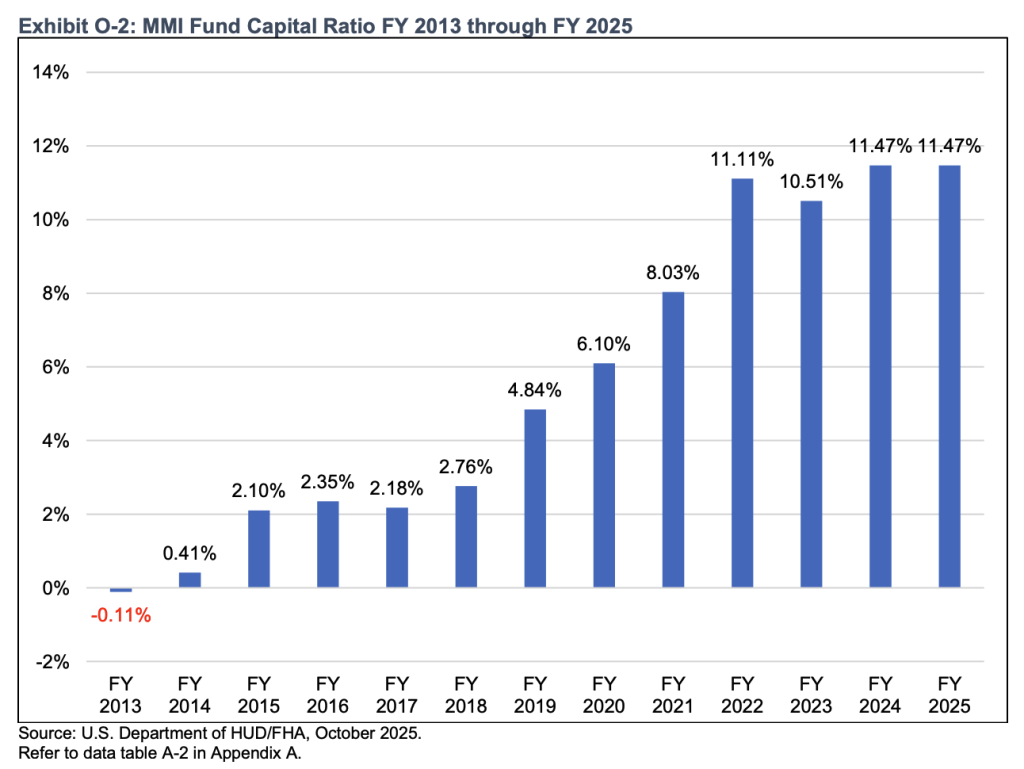
As of September 30, 2025, the Mutual Mortgage Insurance Fund capital ratio held at 11.47%, tying the highest level on record and far above the 2% statutory minimum.
Source: FHA Annual Report to Congress
Economic net worth reached $188.871B, supported by $1.647T in insurance in force.
FHA has now remained above the minimum capital threshold for 11 consecutive years, a sharp contrast to the pre-crisis period.
What stands out in the FHA report is what’s happening beneath those stable numbers. While the overall capital ratio stayed flat year over year, the mix of performance shifted.
Forward mortgage cash flows improved slightly, while reverse mortgage cash flows declined modestly. That distinction highlights where strength is building and where added caution is warranted.
The result is a system that looks steady on the surface, but is actively adjusting under the hood.
FHA Is Carrying More of the Market When Private Capital Pulls Back
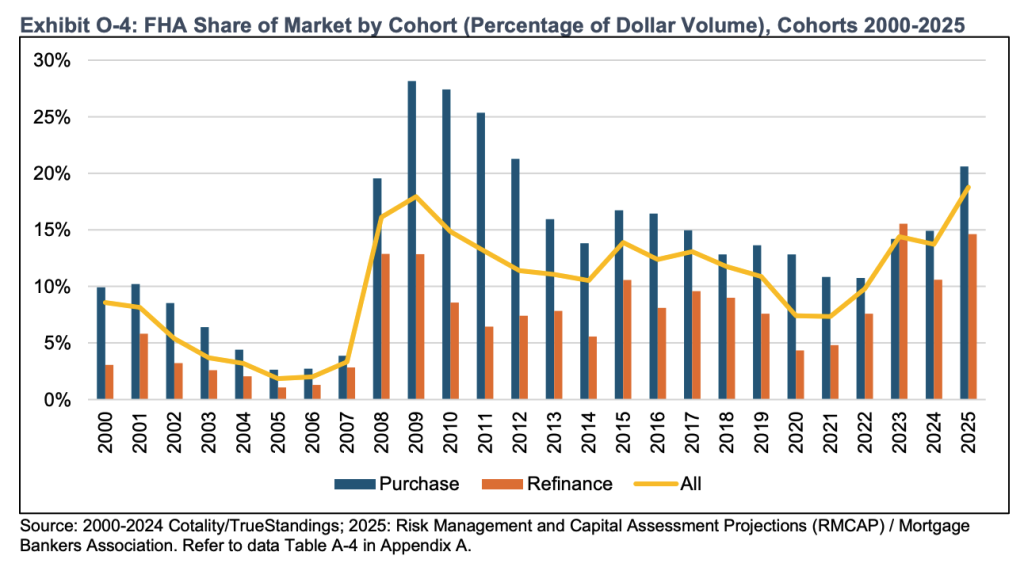
When financing options tighten elsewhere, FHA has stepped in to carry a larger share of the mortgage market, continuing its long-standing role as a backstop during tougher cycles.
In Fiscal Year 2025, FHA insured 876,502 forward mortgages totaling $274.76B in original unpaid principal balance. Active FHA insurance now covers more than 8.1M forward mortgages with over $1.6T in unpaid principal balance.
That expansion pushed FHA’s market share to about 19%, reflecting its countercyclical role as private capital becomes more selective.
Source: FHA Annual Report to Congress
First-Time Buyers Are Driving FHA Lending, With Stronger Credit Profiles
FHA’s borrower mix continues to reflect its core mission, but with a noticeably stronger credit backdrop.
First-time buyers accounted for 83.03% of FHA purchase endorsements in FY 2025, representing 538,642 purchase loans. That share has remained consistently high across multiple market cycles, even as affordability pressures have increased.
At the same time, borrower credit quality has improved meaningfully. Average FHA borrower credit scores reached 679, the highest level in more than a decade. And scores have increased for four consecutive years.
FHA notes in its annual report that stronger credit profiles have helped offset higher monthly payment pressure tied to rising home prices and mortgage rates.
This combination is critical when comparing today’s market to the years leading up to the Great Financial Crisis. Back then, credit standards were deteriorating as volume grew. Today, access remains broad, but borrower quality is improving rather than eroding.
FHA’s Loudest Underwriting Risk Flag Is About Layering
FHA updated how it measures underwriting risk after determining that its prior methodology understated exposure.
The agency now focuses on three overlapping risk layers:
- Credit scores below 640
- Debt-to-income ratios above 40%
- Loan-to-value ratios above 95%.
Loans carrying all three risk layers now make up 8.4% of the FY 2025 cohort, up from 2.6% in 2013. FHA reports these loans show early payment default rates roughly three times higher and average loss rates about 2.5 times higher than the rest of the portfolio.
FHA is not pulling back from first-time buyers or low down payments, but it is being more precise about combinations of risk that historically perform worse, something largely missing before 2008.
Stress Tests Reveal How Different Today’s Risk Profile Is
FHA evaluates risk using a combination of sensitivity tests and more than 100 historical scenario replays dating back to 1954.
To better isolate downside risk in the current environment, the agency also introduced a new scenario called “2007Q2 Replay Flat,” which removes the unusually strong home price appreciation recorded from 2011 through 2025.
Under that modified scenario, FHA modeled a capital ratio of 4.42%, still more than double the statutory minimum. The agency also states plainly that home price declines of 25% or more are the primary driver of negative net present value outcomes across both forward and reverse mortgage portfolios.
That modeling needs to be viewed alongside FHA’s long-term home price data.
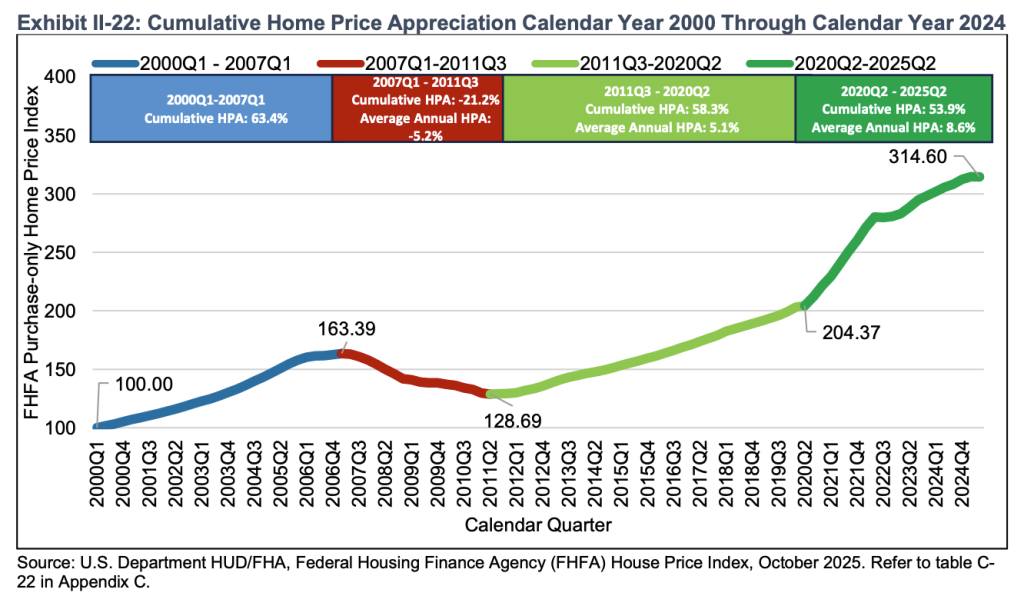
In the annual report, FHA includes a chart tracking cumulative home price appreciation from calendar year 2000 through calendar year 2024, which shows a clear pattern: sustained, nationwide price declines are rare and historically tied to extreme conditions.
Source: FHA Annual Report to Congress
Outside of the 2007–2011 housing crash, national home prices have not experienced prolonged, double-digit declines. Even during periods of economic stress, including the early 2000s recession, the pandemic, and the rapid rate hikes of 2022–2023, prices generally flattened or slowed rather than collapsing.
That context explains why FHA treats large price declines as stress scenarios rather than baseline expectations.
The kind of price behavior that produces negative outcomes in FHA’s models has only occurred in the presence of a catastrophic shock marked by widespread credit failure and forced selling, conditions that are not reflected in today’s borrower credit profiles or lending standards.
As a result, today’s systemic risk is far more closely tied to future home price movements than to the loose credit environment that defined the lead-up to the Great Financial Crisis.
Bob Broeksmit, CMB, the president and CEO of Mortgage Bankers Association (MBA), made the following statement regarding the release of FHA’s annual report:
“Strong underwriting standards and prudent risk and loss mitigation practices across HUD, FHA lenders, and servicers continue to underpin a sound FHA program, marked by robust capital reserves.
“MBA shares the Trump administration’s goal of making homeownership more affordable and appreciates FHA’s efforts this year to streamline its single-family financing programs, cut red tape, and remove housing construction barriers…”
What This Means Heading Into 2026
FHA’s annual report shows how today’s housing risks differ from past cycles.
FHA is financially strong. Its borrower mix reflects improving credit quality alongside sustained first-time buyer participation. And its risk management approach is more targeted and data-driven than it was in past cycles.
Broeksmit’s statement ends with this:
“With the Mutual Mortgage Insurance Fund holding a very high capital reserve of 11.47%—well above the 2% statutory minimum—we will review the report in greater detail to assess whether any policy changes are warranted to improve affordability and access to homeownership in 2026, including a potential reduction in FHA’s annual mortgage insurance premiums.
“Any such changes should be calibrated responsibly and informed by a careful evaluation of the program and the economic factors behind the rising serious delinquency rate to ensure the program remains safe, sound, and sustainable.”
The housing market today faces affordability challenges, not the kind of loose credit environment that defined the mid-2000s. FHA’s role as a stabilizer reflects that shift.
So, the final takeaways:
- FHA’s borrower profile today looks fundamentally different from past downturns.
- Capital strength and improving credit quality contrast sharply with pre-2008 conditions.
- Risk management is increasingly focused on layered exposure, not broad access.
- FHA’s expanding role helps explain why today’s housing market stress does not mirror the lead-up to the Great Financial Crisis.
Taken as a whole, the FHA data points to a market adjusting to constraint and cost, not one unraveling from excess.