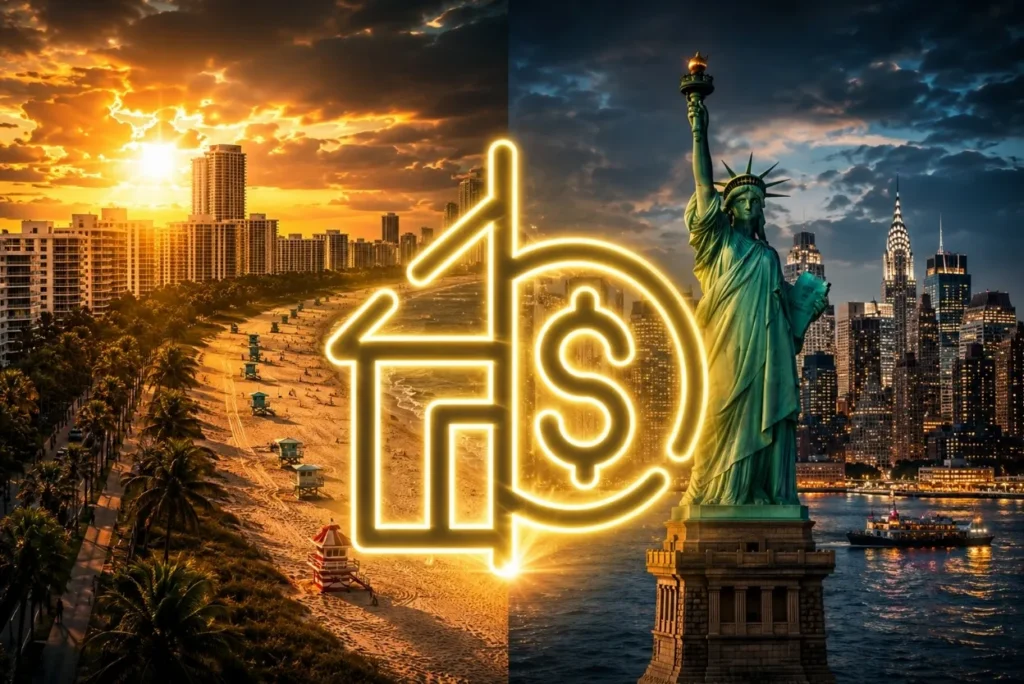


For the first time on record, the Miami metro area is now more expensive to live in than greater New York City.
Earlier this week, Bloomberg reported on the US Bureau of Economic Analysis‘s latest annual price-comparison report, built on 2024 data. South Florida’s consumer price index has jumped 36% since 2019, the biggest increase of any metro tracked by the Bureau of Labor Statistics except Tampa, which sits four hours up the coast.
For years, agents have leaned on the “no state income tax + cheaper everything” pitch to convince New Yorkers to abandon the cold and taxes of NYC for “sun and savings” in Miami.
Here’s what changed and what it means for your conversations with relocation clients.
3 Line Items Driving Miami’s Cost Increase
Miami buyers still get more space for their money on paper. Everything that comes after the purchase price has gotten a lot more expensive.
- Median price per square foot: $357 in Miami versus $537 in New York (Realtor.com, June)
- Miami home prices up 79% since Covid (S&P Case-Shiller)
- Average Florida home insurance premium: $8,292 last year, four times what New York State homeowners pay (Insurify)
- Miami-area property taxes up 62% since 2019, more than double the national average (ATTOM)
One Miami couple was hit with a $35,000 special assessment this year on top of their $1,200-a-month condo dues.
Corcoran agent Michael Buttacavoli sees these costs reshaping how South Florida buyers approach a purchase.
“It’s no longer just about the purchase price. It’s about the total cost to own.”
The Buyer Pool Splits by Price Point
Miami is still pulling in the ultra-wealthy. Mark Zuckerberg, Larry Page, Sergey Brin, former Starbucks CEO Howard Schultz and Palantir CEO Alex Karp have all bought property there recently, and Ken Griffin’s Citadel has picked up roughly 5 acres in Brickell for its new headquarters.
Douglas Elliman agent Ben Jacobs, licensed in both New York and Florida, sees a different pattern below that level, the merely well-off rather than the ultra-wealthy.
“Those buyers (well off but not ultra-wealthy) are not moving to South Florida.”
Part of the reason is how the two states tax their residents:
- Florida’s top 1% of earners pay just 2.7% of their income in sales, excise and other state and local taxes.
- Its poorest fifth pay 13.2% (Institute on Taxation and Economic Policy)
- New York’s top 1% pay 13.5% in state and local taxes. Its poorest fifth pay 11.1%
The no-state-income-tax math still works out differently for every buyer, depending on where they’re moving from and what they earn.
Long story short, Miami’s cost of living has caught up to New York’s. Whether that changes a relocation decision comes down to the specifics of each move.