


Key Details:
- The National Association of Realtors’ Q3 2024 report highlights how persistently low housing supply is driving affordability challenges, with median home prices rising 3% in September for the 15th straight month of year-over-year gains.
- In nearly 80% of major metro areas, housing supply fell short of demand, creating significant shortages in regions like New York, Honolulu, and Connecticut.
According to data from the National Association of Realtors (NAR) for the third quarter of 2024, median home prices were up 3% year over year in September 2024, marking the 15th consecutive month of annual gains.
Judging by NAR’s Housing Shortage Tracker Insights, the primary driver behind that steady climb is low housing supply. And the market with the most significant shortage is the New York-Newark-Jersey City, NY-NJ-PA metro, with one single-family building permit issued for every 23 new jobs.
That said, 23 is an improvement over September of last year, when the same NY-NJ-PA metro area had one single-family permit for every 32 new jobs. Honolulu, HI, also saw an improvement in its index—from one permit per 35 new jobs in 2023 to one per 18 in 2024.
Supply Constraints Driving Up Prices
The main driver of high home prices is the limited supply of available homes, particularly in metro areas with strong job markets and high population growth. This makes it more difficult for many would-be homebuyers in these areas to find a home they can afford.
While employment in the construction sector is growing at three times the rate of overall employment since the pandemic, supply growth in high-demand areas has not been able to keep up. Factors contributing to the widespread supply shortage include:
- Limited construction workforce
- Insufficient building permits
- Zoning restrictions
NAR’s Housing Shortage Tracker, which measures single-family permits per new job in 172 U.S. metro areas, showed nearly 80% of these areas have too few housing permits relative to job growth. A balanced housing market typically sees one new single-family housing permit issued for every two new jobs, but most metros fell short of this standard last quarter.
Markets with the Biggest Housing Shortages in September 2024
Of the 10 markets with the biggest housing shortages for single-family units, six are in the Northeast, with three of those in Connecticut.
Top 10 Areas with Housing Shortage for Single-Family Units:
- New York-Newark-Jersey City, NY-NJ-PA: One single-family permit per 23 new jobs in September 2024—down from 32 jobs in September 2023
- Urban Honolulu, HI: One permit per 18 new jobs—down from 35 jobs one year ago
- New Haven, CT: One permit per 18 new jobs—down from 20
- Miami-Ft Lauderdale-West Palm Beach, FL: One permit per 16 new jobs—down from 19
- Bridgeport-Stamford-Norwalk, CT: One permit per 14 new jobs—down from 19
- Champaign-Urbana, IL: One permit per 14 new jobs—down from 21
- Hartford W-Hartford E-Hartford, CT: One permit per 14 new jobs—unchanged from one year ago
- Oxnard-Thousand Oaks-Ventura, CA: One permit per 13 new jobs—down from 31
- Syracuse, NY: One permit per 13 new jobs—down from 17
- Buffalo-Cheektowaga, Niagara Falls, NY: One permit per 11 new jobs—down from 13
Markets with the lowest housing shortages—where the ratio was equal to 1:
- Ocala, FL
- Myrtle Beach-Conway-North Myrtle Beach, SC-NC
- Memphis, TN-MS-AR
In addition, several metros were close to the balanced ratio of one single-family permit for every two new jobs, including:
- Spartanburg, SC
- Crestview-Fort Walton Beach-Destin, FL
- Shreveport-Bossier City, LA
By the end of Q3 2024, only 35 major metros had a housing shortage index at or lower than the historical average of 2. But 87% of the metros analyzed experienced a decrease in their index from September 2023 to September 2024, signaling a trend toward a stronger supply of single-family homes.
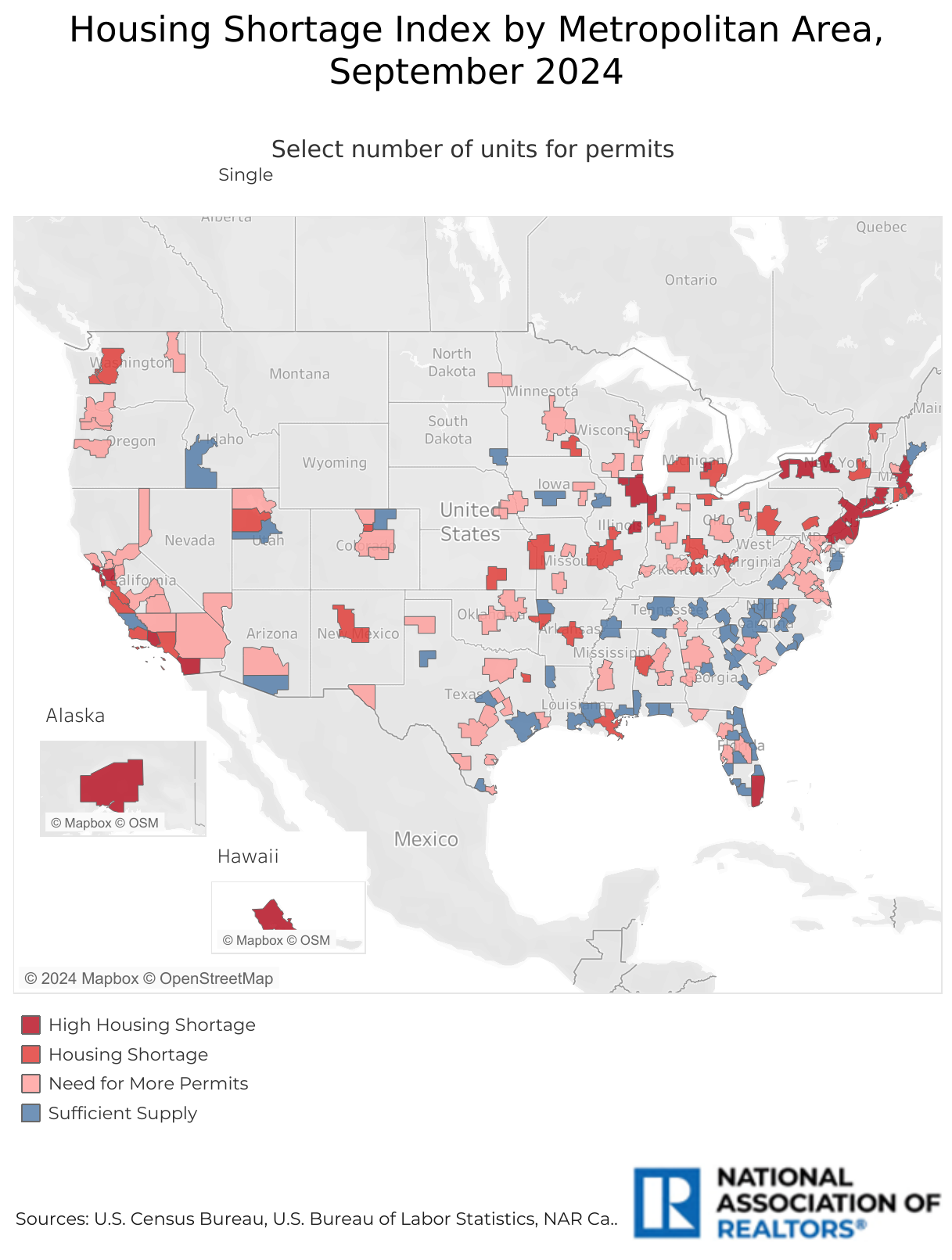
Use the interactive map in the original report to see how many permits are issued for each new job in your market.