


Fannie Mae’s latest Home Price Expectations Survey (HPES) forecasts a deceleration in national home price growth over the next two years.
After 6% growth in 2023, the expert panel anticipates annual price increases slowing to 4.7% in 2024 and 3.1% in 2025. Panelists agree that the lack of housing supply remains an issue—estimating a shortage of 2.8 million homes in the U.S.
Key Takeaways from Fannie Mae’s Q3 Home Price Expectations Survey
The Q3 2024 survey brought together over 100 housing and mortgage industry experts and academics to provide a comprehensive forecast of national home price changes for the next five years. The latest Fannie Mae Home Price Index (FNM-HPI) estimates, released in partnership with Pulsenomics, LLC, highlight a trend towards more moderate growth compared to the past year.
Slower Home Price Growth Predicted
The panelists’ latest predictions indicate a gradual deceleration in home price appreciation
- 2024: Expected growth of 4.7%.
- 2025: Expected growth of 3.1%.
- 2026: Expected growth of 3.3%.
These projections reflect a broader trend towards normalization in the housing market following the rapid price increases observed in recent years. Despite expectations of a slowdown, the current outlook reflects a slight uptick from the panel’s previous forecast of 4.3% for 2024 but a downward revision from the earlier estimate of 3.2% for 2025.
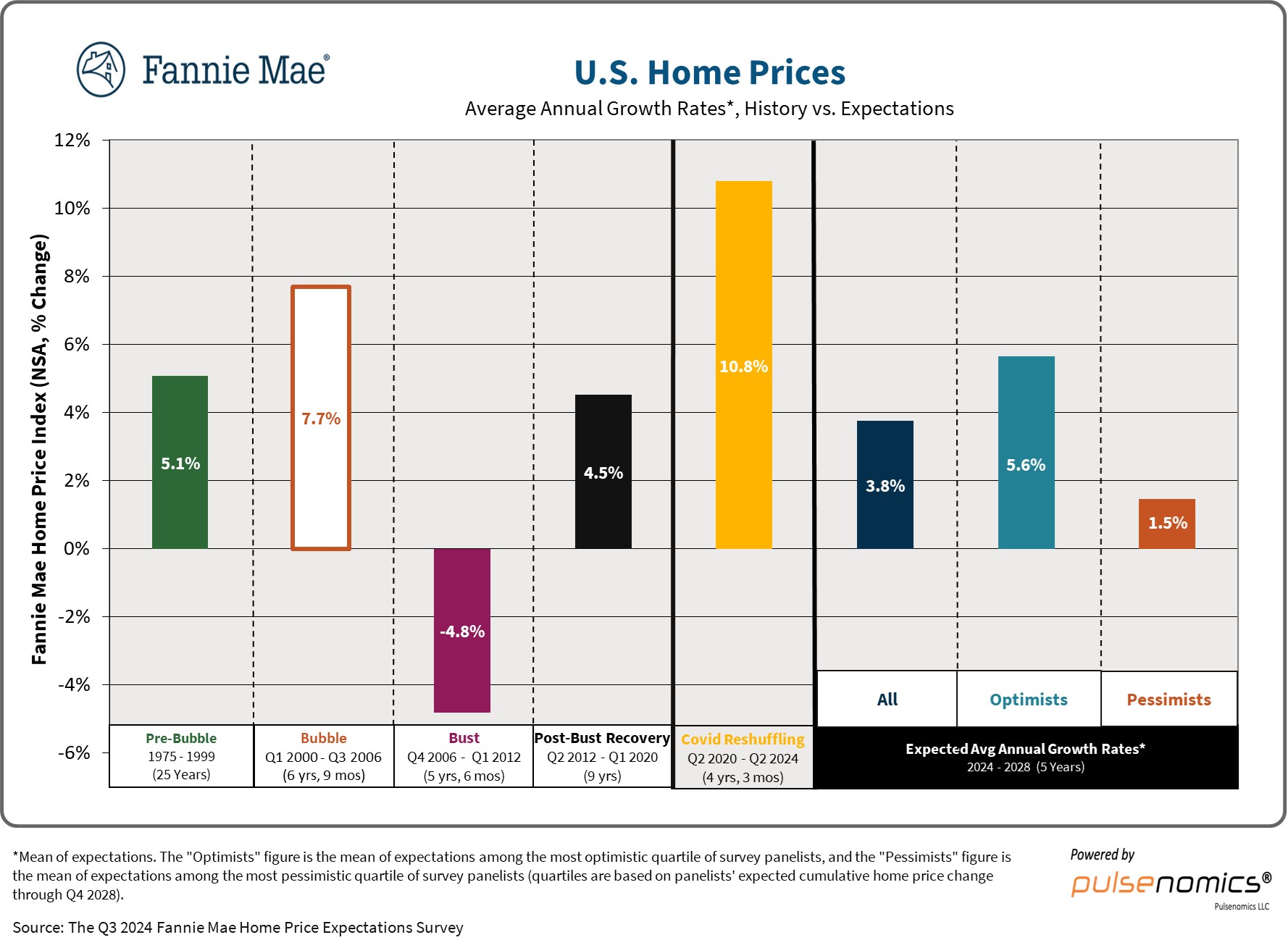
During the “Covid Reshuffling” period from Q2 2020 to Q2 2024, home price growth increased by 10.8%. Looking ahead, the panel’s expected average annual growth rate over the next five years (2024-2028) is 3.8%. More optimistic panelists anticipate a 5.6% increase in home price growth, and pessimists expect a 1.5% increase over the same time period.
Continued Supply and Affordability Challenges
Mark Palim, Vice President and Deputy Chief Economist at Fannie Mae, noted that the group “believe(s) the nation to be short approximately 2.8 million homes. We’ve previously estimated the shortfall to be more than 4 million.”

“Despite stretched purchase affordability for most consumers, strong home price appreciation has persisted, largely due to inadequate supply. Our panelists overwhelmingly agree that there is a fundamental lack of housing in the U.S. relative to underlying demographic factors.”
Palim further highlighted that while recent measures have shown stronger-than-expected home price growth, the primary issue remains a housing supply shortfall. This is compounded by concerns about the potential effectiveness of proposed policy reforms to meaningfully increase supply in the near term.
The Impact of Zoning and Permitting Reforms on Housing Supply
This quarter’s survey also explored the potential impact of various state and local policy reforms on housing supply. Experts generally agree that changes in zoning and permitting could help alleviate the ongoing housing shortage in the U.S., where an estimated 2.8 million homes are needed to meet demand.
However, opinions were split on the potential impact of these reforms, with most panelists predicting only a “moderate” or “insignificant” effect over the next five years.
The survey highlighted several policy reforms that could positively influence housing supply:
- Expedited Construction Permitting: Some panelists believe that speeding up the construction permitting process would have the most significant impact on increasing the housing supply.
- Expanded Zoning for Multifamily Housing: Increasing zoning allowances for multifamily housing developments could provide a meaningful boost to the market.
- “Missing Middle” Housing Development: Enabling more “light touch density” or “missing middle” housing options could help bridge the gap in available housing types, particularly in urban areas.
Despite the optimism around these measures, 63% of panelists expressed skepticism about the likelihood of widespread enactment of these reforms within the next five years.