Nobody needs another “2026 housing forecast” article. You need the numbers, fast, in a format you can actually use when someone asks, “So what happens next year?”
That’s why we built this roundup as a chart-first reference guide. This is a year-long resource designed to live in your bookmarks, get pulled up mid-conversation, and quietly do the heavy lifting when buyers and sellers want clarity.
In the sections below, you’ll find the latest projections for home sales, price growth, inventory, and mortgage rates from a wide mix of industry sources, all plotted side by side so you can spot the ranges, the outliers, and where the “consensus” is forming.
Use the charts to set clear expectations for 2026, grounding your advice in concrete, visual data. Think of this as the perfect complement to the scripting frameworks you’ll rely on.
Forecasts and data for 2026 were compiled from the following sources:
- Realtor.com
- Zillow
- National Association of Realtors and NAR’s Quarterly Housing Market Outlook
- Fannie Mae’s Home Price Expectation Survey and Housing Forecast (table)
- Cotality (fka CoreLogic)
- Mortgage Bankers Association (MBA) (via Yahoo Finance)
- Capital Economics
- Compass
- Wells Fargo
- Bright MLS
- Redfin
- National Association of Home Builders (NAHB)
Let’s dive in.
Home Sales Predictions for 2026

Sales forecasts are the closest thing we get to a “temperature check” on the market’s willingness to move. When projections rise, it usually signals some combination of improving affordability, loosening rate pressure, more inventory to shop, or simply pent-up demand finally getting tired of waiting.
The charts in this section help you show the difference between a market that’s thawing and a market that’s overheating.
- Capital Economics: Peaking early 2026 at 4.35M (before sliding back down to 4.25M by end–2026)
- Realtor.com: 4.13 M (+1.7%)
- Fannie Mae: 4.373M (+7.8%) (Existing Home Sales for 2026)
- Wells Fargo: 4.207M (Total Existing Home Sales)
- MBA: +6.3%
- Zillow: 4.26 M (+4.3%)
- Bright MLS: 4.51M (+9.0%)
- NAR: +14%
- Compass: +4%
Sales tell you whether people will transact. Prices tell you what they’ll pay when they do. That’s where the forecasts get even more opinionated.
Home Price Predictions for 2026

Price forecasts are where you’ll see the widest spread, because pricing depends on local supply, local demand, and how rate-sensitive your buyers are.
It also depends on whether 2026 is a “move-up year” (more discretionary sellers) or a “must-move year” (life events driving decisions regardless of rates). Same country, very different outcomes.
These charts are useful because they let you frame appreciation expectations as a range, not a promise. That makes your pricing conversations calmer, and your “what should we offer” conversations more grounded.
- Compass: +0.5%
- Realtor.com: +2.2% (Existing-Home Median Price Appreciation)
- Fannie Mae: +1.3% (Annual Q4/Q4)
- Wells Fargo (Case-Shiller): +3.5%
- MBA: -0.3%
- Zillow: +1.2%
- Bright MLS: +0.9%
- NAR: +4.0%
- Cotality (fka CoreLogic): +4.3% (October 2025–2026)
- Capital Economics: “Around 2%” increase in 2026 & 2027 (Case-Shiller 20-City HPI)
Prices are the outcome. Inventory is the fuel. If you want to explain why forecasts differ, you almost always end up talking about how many homes will actually be available.
Housing Inventory Predictions for 2026
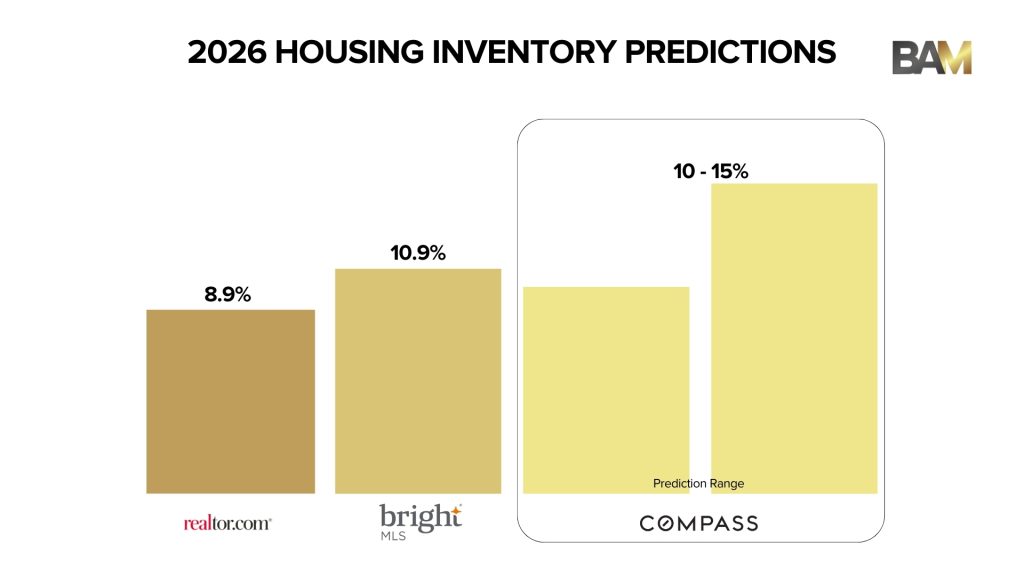
Inventory is the leverage point for almost every other metric. More supply tends to reduce bidding wars, increase days on market, and give buyers back some dignity. Less supply tends to do the opposite, even if demand is only “fine,” not frenzied.
The charts in this section help you explain why two experts can agree on rates and still disagree on prices. If one assumes inventory meaningfully improves and another assumes it stays tight, their price projections will land in different zip codes.
- Realtor.com: +8.9% (Existing Home For-Sale Inventory)
- Bright MLS: +10.9% (to 1.426M)
- Compass: +10-15% in 2026 to just over 850,000 total homes by Dec 2026
Inventory sets the stage, but mortgage rates still decide how many people can afford a ticket into the theater. So let’s look at where the top forecasters think rates go next.
Mortgage Rate Predictions for 2026

Rate forecasts are always a little humbling, because they sit at the intersection of inflation, jobs data, bond markets, and global chaos.
Still, they matter because even small differences change monthly payments, qualification, and what “affordable” looks like for a given household.
These charts give you a simple way to show the range most forecasters expect, and where the risk sits if rates stay higher for longer. It’s also a helpful reset when clients fixate on a single number they heard on the internet and treat it like a guaranteed timeline.
- Fannie Mae: 6.0%
- Zillow: 6.00% or Above
- Bright MLS: Above 6.0%
- NAR: 6.0%
- Wells Fargo: 6.18%
- NAHB: 6.2%
- Realtor.com: 6.3% average (and 6.3% by year-end)
- Compass: 6.4% average
- MBA: 6.4%
- Capital Economics: 6.5% by year-end 2026
Once you’ve got the range for rates, you can connect the dots. Rates influence affordability, affordability influences demand, demand meets inventory, and the outcome shows up in sales and prices.
Bookmark this post and use these charts as visual aids in your conversations with buyers and sellers in the months ahead. And if you’re a BAMx member, done-for-you social versions of these graphs are already available in the December 12 content drop!
Not a member yet? Sign up for a free 7-day trial and grab the charts. Then jump into the weekly role play mastermind on Tuesday mornings at 9:00 am ET for practice and live feedback.