

On the June 23 episode of The Walk Thru, we discussed some bombshell news from eXp Week: as the fastest-growing brokerage, it has $0 in debt.
But is that really the case? Let’s dive in.
Slides from eXp Week
During eXp Shareholder Summit in June, eXp shared the following slide. It states eXp Realty had $0 of year-end debt in 2021. It also details year-end debt from other brokerages, including Real Brokerage, RE/MAX, Compass, Redfin, and Realogy.

Balance Sheet Data
We took a look at the reported numbers from eXp’s slide and compared them to the public Consolidated Balance Sheets in each brokerage’s 10-K Form, accessed from U.S. Securities and Exchange Commission (SEC).
Based on what eXp reported about debt for other brokerages, here’s where the numbers matched up for each of the following:

While all these numbers are from the “Liabilities” section of the balance sheets, some are honed into specific debt, while others encompass the company’s total liability.
Liability vs. Debt
Before we continue, let’s break down the differences between liability and debt. To put it simply, debt refers to money that is borrowed and must be repaid in the future. Liability includes both short-term and long-term financial obligations, including salaries, leases, and taxes.
On a balance sheet, debt is typically reported in a long-term liability section or debt section. Short-term liabilities are often reported in current liabilities.
Now, let’s move on to eXp.
eXp Balance Sheets
eXp stated they have $0 in year-end debt. Considering there is no section on the eXp balance sheet with ‘long-term debt’ or ‘long-term liability,’ this makes sense.
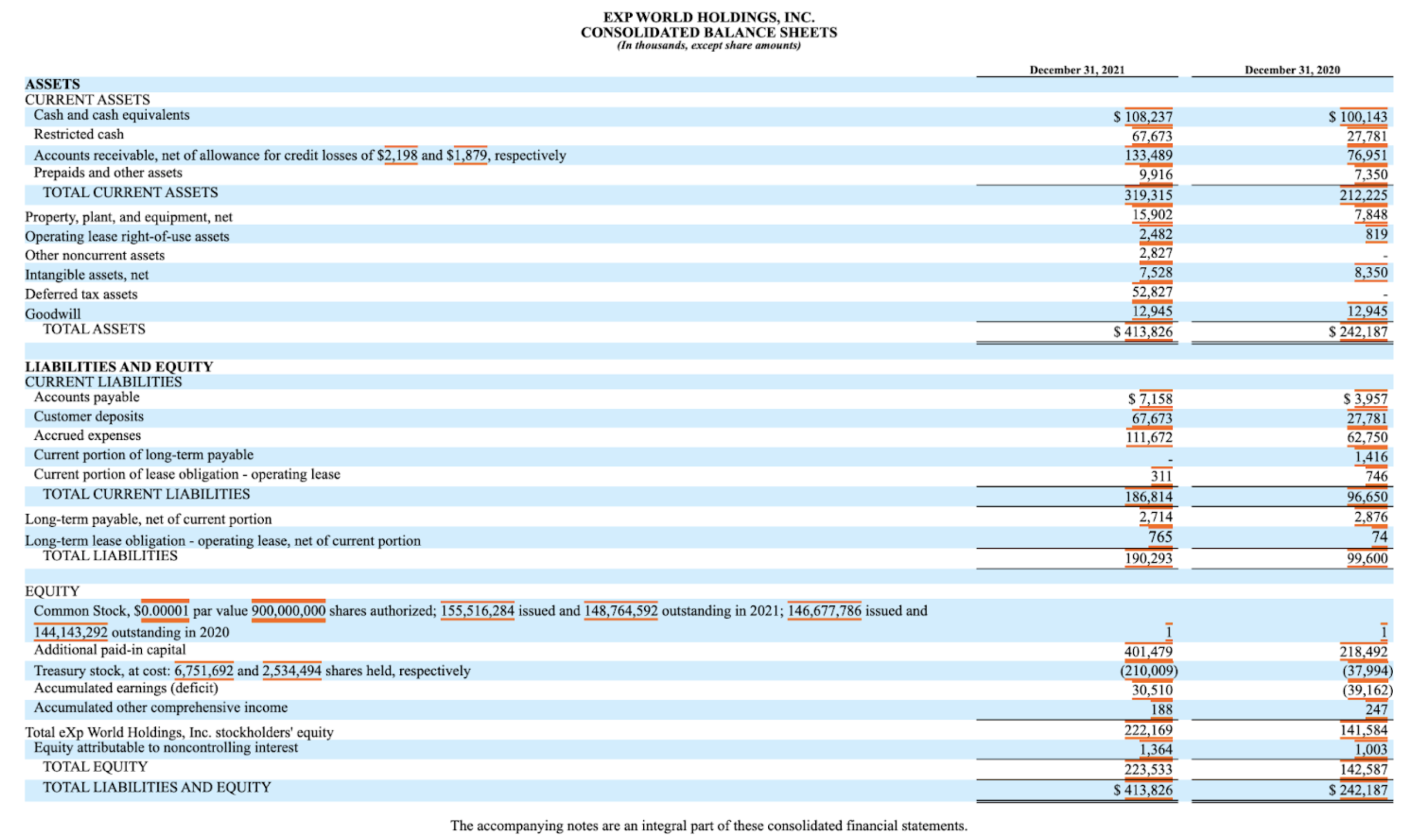
eXp’s sheets do show $190,293,000 in “Total Liabilities” for items including accounts payable, customer deposits, accrued expenses, current portion of long-term payable, current portion of lease obligation, and long-term lease obligation. In other words, typical business expenses.
Redfin and Real’s Total Liabilities
Now, let’s take a closer look at the balance sheets for the other brokerages.
Based on eXp’s slide, the numbers reported for Real Brokerage and Redfin came from their “Total Liabilities.” Here is a look at Real’s Consolidated Balance Sheet, as an example:

Similar to eXp’s balance sheet, Real’s total liabilities include expenses such as accounts payable and accrued liabilities, lease liabilities, and accrued stock-based compensation.
And just like eXp, Real’s sheet does not have a section for ‘long-term debt’ or ‘long-term liabilities.’ Which would mean Real also ended the year with no debt. This is why the reported numbers from eXp’s slide caught Tim Macy’s eye.

“I’ve talked to (Real’s) leadership on multiple occasions and verified that we have no large long-term debt. The only liabilities we have are from normal operating activities.”
Is eXp cherry-picking numbers?
Along with eXp’s numbers showcasing total liabilities for Real and Redfin, there doesn’t appear to be consistency with where the remaining numbers were found.
After digging through balance sheets and speaking to a financial advisor to verify accuracy, it looks like eXp did not use any generally accepted accounting principles (GAAP) when posting numbers on their slide.
As we stated earlier, eXp is the fastest-growing brokerage – there’s no denying that. And according to their balance sheet, they don’t have long-term debt, true to what was shared at the 2022 eXp Shareholder Summit.
But other values shared don’t match publicly available sources for year-end debt, especially those where total liabilities were showcased.
So our question is:
Did eXp purposefully pull data from different sections to make themselves look better?