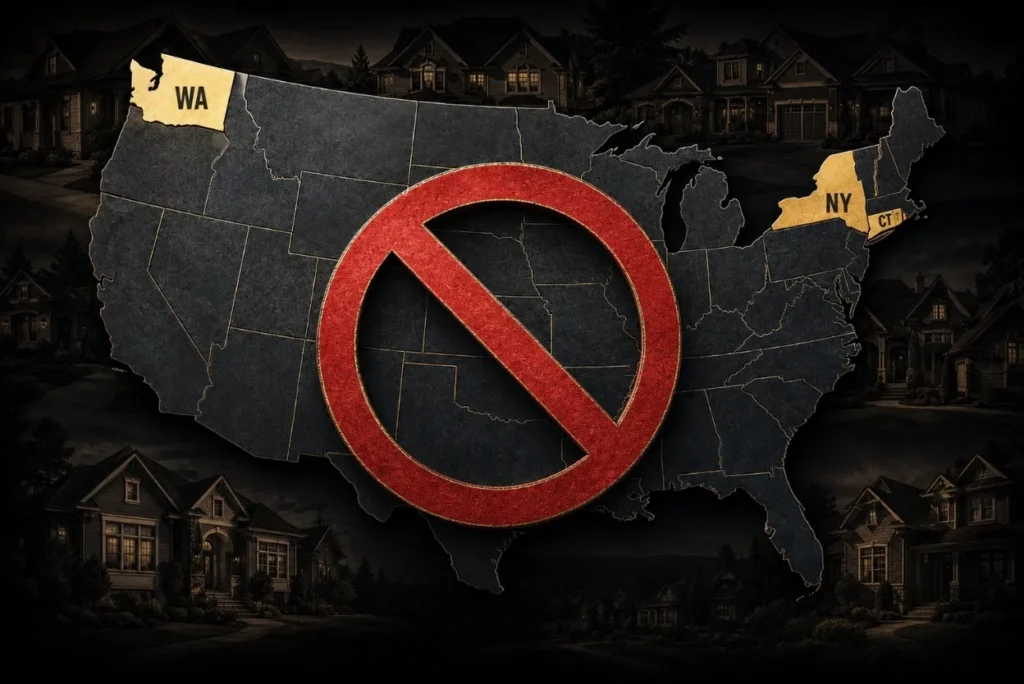
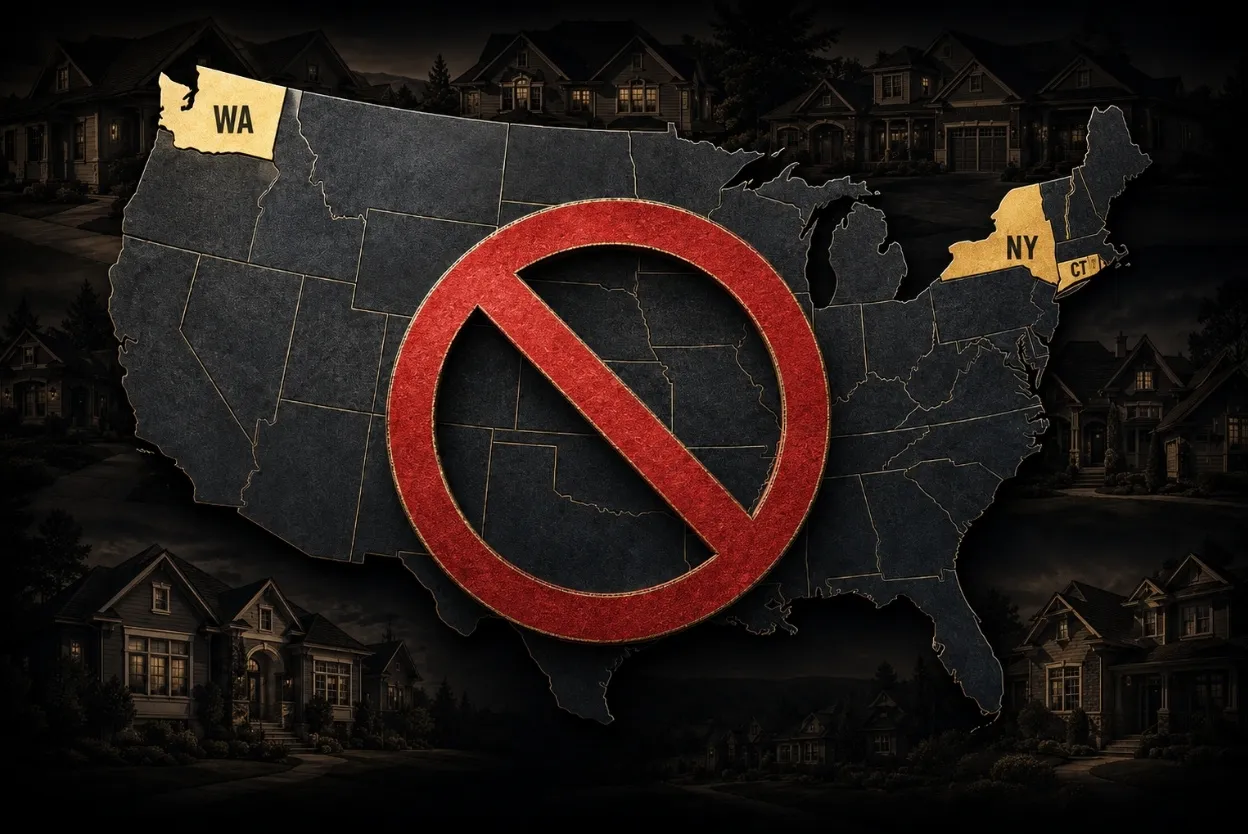

Three states have moved to ban or restrict private listings in 2026, and more are lining up.
Connecticut and New York are the two most recent steps to take steps toward banning private listings. Washington state was the first to ban private listings, set to go into effect this week.
Byron Lazine, Lisa Chinatti, and Tom Toole discussed the bans on last Friday’s Knowledge Brokers Podcast.

Here’s what the laws require, what they allow, and how to talk about it with sellers.
The State-by-State Crackdown on Private Listings
In March, Washington Governor Bob Ferguson signed a bill to prohibit real estate brokers from marketing a listing to an exclusive group if not also marketed to the general public.
The law is set to go into effect on June 11.
Connecticut followed in late May, when Governor Ned Lamont signed SB 340, which will require residential properties and multifamily properties of up to four units to be publicly marketed, unless a seller explicitly opts out. Connecticut’s law is set to go into effect on October 1.
New York’s bill passed the state Senate 60-0 and is awaiting a signature from Governor Kathy Hochul. Illinois and Hawaii both have similar proposals in the works.
Here’s where each state stands:
- Washington: Ban already signed, effective June 11, 2026
- Connecticut: Gov. Ned Lamont signed SB 340 on May 27; takes effect October 1, 2026
- New York: Fair and Transparent Real Estate Listing Act passed the state Senate 60-0; awaiting Gov. Hochul’s signature
- Illinois and Hawaii: Similar legislation proposed
What These Laws Actually Require (and Allow)
The core requirement across all three states is the same: if a seller wants to list their home, it has to be publicly marketed on free or publicly accessible platforms.
In New York, marketing has to start immediately once the seller decides to list. Private networks, exclusive broker circles, and pocket listing arrangements are off the table by default.
That said, sellers can still opt out. Here are the rules for each state:
- Connecticut: Seller must explicitly opt out by signing a standardized form that outlines the trade-offs of listing privately; violations carry a fine of up to $5,000 or license suspension
- New York: Seller must sign a disclosure form acknowledging the listing will receive “reduced visibility to buyers and tenants” and “may reduce the number of offers” received; violations carry a fine of up to $5,000 or license revocation, up from a previous $2,000 cap
James Dwiggins posted about the New York legislation on Facebook.
Tom read part of the post before summing up his take:
“Imagine you’re on one side of the table, and you’re talking about someone’s asset and saying, ‘Hey, this is a great way to go with private exclusives.’ And then they (sellers) have to sign that disclosure. “It sounds like you’re saying one thing, but I wonder what the pitch is going to be like…”
Byron recalled a past episode of Knowledge Brokers where he predicted other states would move to ban private exclusives after Washington state’s bill passed.
“When they made that bill and then put it into law, I said, ‘Watch. Other states are gonna take notice of this, and other states are going to follow suit. Why? Because you’ve got midterms coming up. You’ve always got election cycles coming up, and this is a checkbox as states [and] lawmakers protecting consumers… And these bills can move through very quickly when you have bipartisan support.”
Sellers who want to go private can still do it, but they have to sign a form that spells out the financial risk in plain language.
Your job is to make sure they understand what they’re signing before they sign it.
What Agents Need to Know
The numbers from two recent studies (one from Zillow another from Bright MLS) say public marketing gets sellers more money, more offers, and a faster sale. So while an opt-out is there if sellers want it, the new laws state they’ll have to sign a form acknowledging they’re taking on that risk themselves.
Get familiar with the opt-out disclosure requirements and the penalties so you can walk a seller through their options (and the risks/rewards involved with each) before they ask.
Byron stated:
“The right way to disclose this is ‘There is a law—a state law—that states homes must be available on the market. So, you are opting out of that’ … So, for anybody who is shilling a private network to every single listing appointment that they go on, as opposed to pulling it out of their back pocket for 0.01% of sellers… For any agent that is shilling this to 100% of sellers as the ‘golden ticket’ to getting your home sold, in the states that have a law against it, is advising their clients against a law that is in place to protect them. “That disclosure needs to be clearly stated to consumers so they understand the risks.”
Lisa shared how Massachusetts’ state law spells out the risks for home sellers leaning toward the private listing option, as well as the requirements for both sellers and their listing agents.
As Byron summed it up:
“I don’t think it will be very long before a majority of the states across the country adopt this law.”