
Key Details:
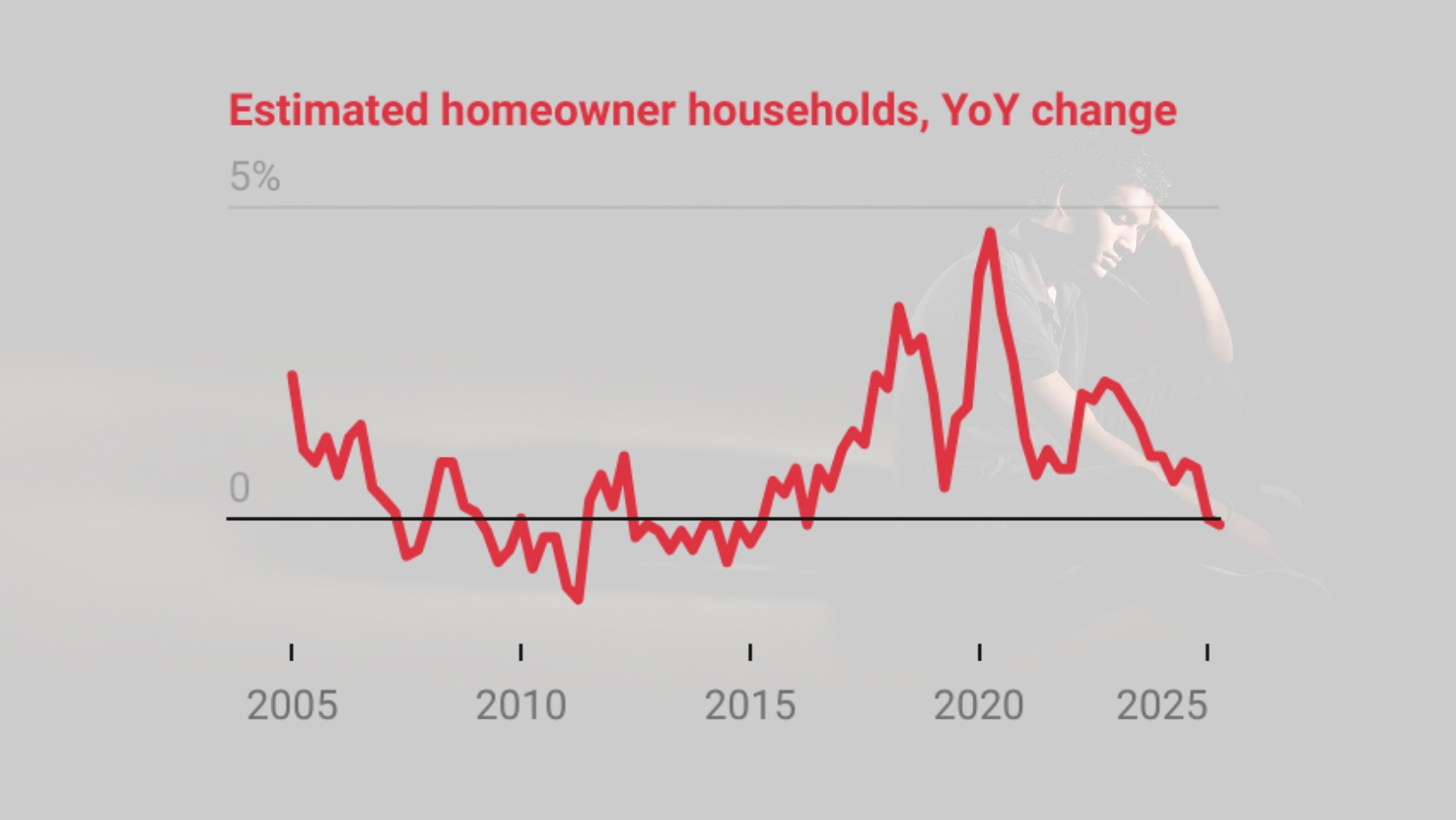
- Redfin reports U.S. homeowner households fell 0.1% year over year in Q2 2025 to 86.2 million, marking the first decline since 2016.
- Renter households jumped 2.6% to 46.4 million, one of the largest increases in recent years.
- The median home sale price rose 1.4% in July to $443,867, while mortgage rates averaged 6.56%.
For nearly a decade, the number of homeowner households in America has steadily climbed.
That streak just ended.
According to a new Redfin analysis of U.S. Census Bureau data, the number of homeowners in the second quarter of 2025 fell 0.1% year over year to 86.2 million households.
It’s a marginal dip, but the first decline since 2016.
Meanwhile, renter households jumped 2.6% to an estimated 46.4 million. That increase marks one of the largest year-over-year gains in recent history.
Taken together, these numbers show a subtle but important shift in housing dynamics at the national level, with regional variations that matter for both buyers and renters.
Byron Lazine broke down the numbers in yesterday’s Hot Sheet.
Read on for the highlights.
Why the Shift?
Redfin’s head of economic research, Chen Zhao, attributes the slowdown in homeownership growth to affordability challenges and shifting life choices.
In Zhao’s words:
“America’s homeowner population is no longer growing because rising home prices, high mortgage rates and economic uncertainty have made it increasingly difficult to own a home. People are also getting married and starting families later, which means they’re buying homes later, another factor that may be at play.”
Housing Market Snapshot
Affordability remains at the center of this trend. On the national level:
- The median home sale price in July rose 1.4% year over year to $443,867, setting a record for the highest July on record.
- Mortgage rates averaged 6.56% in recent weeks. That’s more than double the pandemic-era all-time low, but slightly improved from a peak above 7% earlier this year.
- The homeownership rate now sits at 65%, edging down from 65.6% in the same quarter of 2024.
- The rentership rate rose to 35%, compared with 34.4% a year earlier.
While those numbers reflect national conditions, it’s important to note that mortgage rates, as well as home prices, can vary locally, which affects affordability and ownership trends in different markets.
Regional and Metro-Level Variations
National averages only tell part of the story. Some metros continue to maintain high homeownership rates, while others tilt more heavily toward renting. Los Angeles, CA, is a case in point for the latter set, since renting is generally more affordable here than buying a home.
These regional and metro-level breakdowns are critical for agents to understand, since local affordability and demographic patterns may run counter to national headlines.
Top 10 Metros with the Highest Homeownership Rates
- North Port, FL (79.5% homeownership vs 20.5% rentership)
- Baton Rouge, LA (78.6% homeownership vs 21.4% rentership)
- Charleston, SC (76.9% homeownership vs 23.1% rentership)
- Cape Coral, FL (74.0% homeownership vs 26.0% rentership)
- Albuquerque, NM (73.5% homeownership vs 26.5% rentership)
- Rochester, NY (73.0% homeownership vs 27.0% rentership)
- Indianapolis, IN (72.1% homeownership vs 27.9% rentership)
- Tucson, AZ (72.0% homeownership vs 28.0% rentership)
- Phoenix, AZ (71.8% homeownership vs 28.2% rentership)
- Cleveland, OH (71.7% homeownership vs 28.3% rentership)
10 Metros with the Lowest Homeownership Rates
- Los Angeles, CA (46.4% homeownership vs 53.6% rentership)
- New York, NY (49.4% homeownership vs 50.6% rentership)
- San Diego, CA (51.7% homeownership vs 48.3% rentership)
- Las Vegas, NV (52.3% homeownership vs 47.75 rentership)
- San Jose, CA (53.9% homeownership vs 46.1% rentership)
- San Francisco, CA (54.0% homeownership vs 46.0% rentership)
- Oklahoma City, OK (55.9% homeownership vs 44.1% rentership)
- Austin, TX (56.9% homeownership vs 43.31% rentership)
- Miami, FL (57.5% homeownership vs 42.5% rentership)
- Honolulu, HI (58.3% homeownership vs 41.7% rentership)
Renting on the Rise
The surge in renter households signals both lifestyle choices and financial realities.
In Thursday’s Hot Sheet, Byron recalled a recent conversation with a mentor of his about her kids, who are now out of college and working, and in no hurry to become homeowners.
“She’s like, ‘They have absolutely no interest in owning a home anytime soon. They like bouncing from city to city, being mobile, being flexible. And so, they’ve got no interest in that responsibility’ …
“There is a huge contingent of young people who want the stability of a home. Yeah, there’s a large group of young people that want the flexibility of going job to job. But at some point, that, too, will get tiresome. That, too, will get old. That, too, will kind of burn you out. And ultimately, the American Dream is still alive and well…”
With home prices pushing higher and borrowing costs still elevated, more households are opting to rent longer. That also means millions of Americans are missing out on home equity growth, traditionally one of the most reliable paths to long-term wealth.
The trend doesn’t mean homeownership is off the table for younger generations, but it does suggest delayed timelines for many. In the meantime, rental demand is likely to remain elevated, which could influence both multifamily construction and rental pricing in key markets.
What This Means for Real Estate Professionals
For agents, the story here isn’t just about a small dip in homeownership. It’s about understanding how affordability pressures are shaping consumer behavior, and how that can change the way you market, advise, and build relationships.
Key takeaways for agents:
- Use the national decline in homeownership to open conversations with clients who are undecided about buying vs. renting. Localize the story with your market data.
- Highlight affordability shifts when counseling first-time buyers. Many are weighing rent increases against mortgage payments, and context matters.
- Frame renting as a short-term strategy, but reinforce the long-term benefits of building equity when conditions allow.
America may have hit pause on its homeownership streak, but that doesn’t mean buyers are gone. For many, they’re simply waiting for the right mix of affordability, stability, and timing.
Agents who understand the nuances, and can explain them clearly, will be best positioned to serve both sides of the market.