


The idea of a “silver tsunami” — a wave of older homeowners leaving behind their large, empty homes — has been floated as a potential solution to the nation’s housing crisis.
The theory is simple: as aging homeowners downsize or pass away, their properties would flood the market, increasing supply and driving down home prices.
Unfortunately, that theory glosses over one critically important detail. New research from Zillow sheds light on exactly why empty-nesters selling their homes won’t make a significant difference in affordability for most would-be buyers.
In a nutshell, the homes vacated by empty nesters are located far from where they’re needed most.

Even if we did see a ‘silver tsunami,’ a look at the map tells me it wouldn’t really move the needle in terms of solving our housing affordability crunch. These empty-nest households are concentrated in more affordable markets, where housing is already more accessible — not in the expensive coastal job centers where young workers are moving and where more homes are most desperately needed.
Empty Nest Households Outnumber Families in Need
Nationwide, empty nest households numbered 20.9 million in 2022—up from 20.2 million in 2017. These households currently outnumber by 2.6 times the 8.1 million families doubling up with non-relatives (i.e., those likely in need of their own housing) in 2022.
The number of those families has increased by 500,821 since 2017, compared to a 703,892 increase in empty nest households during the same period.
While these numbers might suggest a potential supply of homes, the reality is more complex. For empty nesters to significantly impact affordability, their homes would need to be concentrated in markets with the worst housing shortages.
Unfortunately, the majority of these empty nester homes are located in more affordable areas, far from where housing demand is highest.
Empty nest households tend to be located in markets where housing is already relatively affordable—and demand from younger buyers is lower.
U.S. Metros with the highest shares of empty nest households:
- Pittsburgh (22% of households are empty nesters)
- Buffalo (20%)
- Cleveland (20%)
- Detroit (19%)
- St. Louis (19%)
- New Orleans (18%)
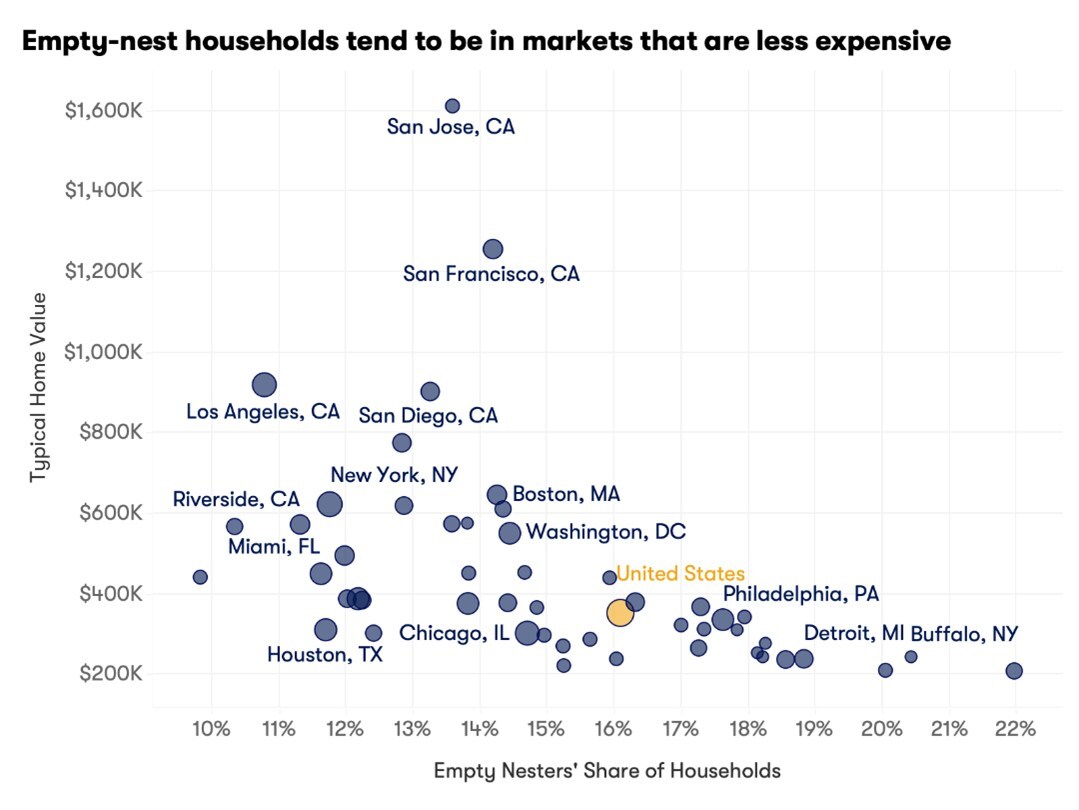
On the other hand, expensive coastal markets with strong job centers have far fewer empty nest households. These markets, where young professionals often relocate, have an empty nest share below the national average of 16%, limiting their influence on housing supply.
Markets with the highest concentrations of younger households (under 44) include:
- Austin
- Salt Lake City
- Seattle
- Denver
- Oklahoma City
Markets with the most recent movers among Millennials and Gen Z include:
- San Jose
- Austin
- Denver
- Oklahoma City
- San Antonio
- Seattle
- Washington DC
The numbers don’t lie: the areas where housing shortages are most severe are not the areas with a significant share of homes owned by empty nesters.
The Real Fix: Building More Housing
Even with the prospect of a “silver tsunami” — homes owned by older generations entering the market — these properties won’t solve affordability challenges in high-demand regions.
Without a significant shift in migration patterns or remote work opportunities drawing people to the Midwest, empty nest homes are unlikely to alleviate pressure in expensive coastal markets.
The real solution lies in building more homes. Increasing housing supply, particularly through denser construction, remains the best strategy to address affordability. For the time being, though, local zoning restrictions and home builder fees are still driving up the cost of new construction, making new homes less accessible to lower-income homebuyers.