
Your buyer calls you mid-deal and says, “I think we should back out.”
Most agents either panic and defend the deal, or they just let it die. Both are wrong.
Today, I’m giving you the exact framework we use when buyers get cold feet so you can save the deal without ever coming off like you’ve got commission breath.
And if you want to actually practice these conversations live (not just read them), you can join our weekly role play masterminds inside the BAMx Sales & Conversion tier. Start your free trial here.
Understanding Buyer Psychology: Cautious vs. Cold Feet
Sometimes the cautious buyer is just that. They’re strategic, they’re smart, they want to cross all their t’s. They want to make sure they’re getting into the right property.
Then there’s another buyer who wears caution as a disguise when the reality is they’ve got cold feet and they don’t know what step to take next.
It’s our job to deliver confidence and comfort by sharing our knowledge and understanding of the market and by making that next step clear.
Without that, it’s no wonder they’re having second thoughts.
The Two Types of Buyer Objections You Need to Recognize
Every cold feet conversation falls into two categories. Once you see this, everything gets easier.
- Macro objections
- Deal-specific objections
Macro sounds like this:
- “I’m not sure if this is the right time to buy.”
- “Rates feel high.”
- “What if we’re buying at the top?”
- “What if there’s a recession?”
- “The economy feels weird right now.”
Deal-specific sounds like this:
- “These items on the inspection worry me.”
- “The appraisal came in $5,000 low.”
- “What if this house needs constant repairs?”
Here’s what’s actually going on. A buyer stressing over a global headline is in the same emotional place as a buyer stressing over a minor inspection item. Both are dealing with uncertainty and fear of regret.
Once you understand that, you stop reacting to the surface and start solving the real problem.
Slow the Buyer Down and Re-Anchor Their Goals
This is the point where the deal either stabilizes or falls apart.
When a buyer says they want out, they’re trying to get relief from the pressure they’re feeling in the moment.
If you move too fast, you lose them. If you agree too quickly, you lose the deal.
Slow everything down.
You’ve already done the hard work upfront. You know what they want and why they want it. Bring them back to that conversation.
Start by grounding the situation in what hasn’t changed.
You want to guide them through a few key checkpoints:
- The location they said they wanted
- The monthly payment they were comfortable with
- The lifestyle and layout that fit their family
Confirm those are still intact before getting into objections. If those are still true, you’re dealing with hesitation.
From there, separate what’s actually happening.
You’ve got two forces at play:
- Issues tied to the house or the transaction
- Outside noise tied to the market or headlines
When those get mixed together, everything feels bigger than it is. Pull them apart so the buyer can see clearly.
Now you can guide the decision by setting up a clear A/B choice between staying in the deal and walking away.
Clarity comes from slowing the process
How to Build Trust
This is where you either build trust or lose it.
Buyers are paying attention to how you show up in this moment. They’re trying to figure out if you’re protecting them or protecting the deal.
Start by acknowledging what they’re feeling. Keep it simple and direct.
“Totally get it. Makes a ton of sense. I hear what you’re saying.”
Repeat their concern back to them so they know you’re listening.
Then normalize it.
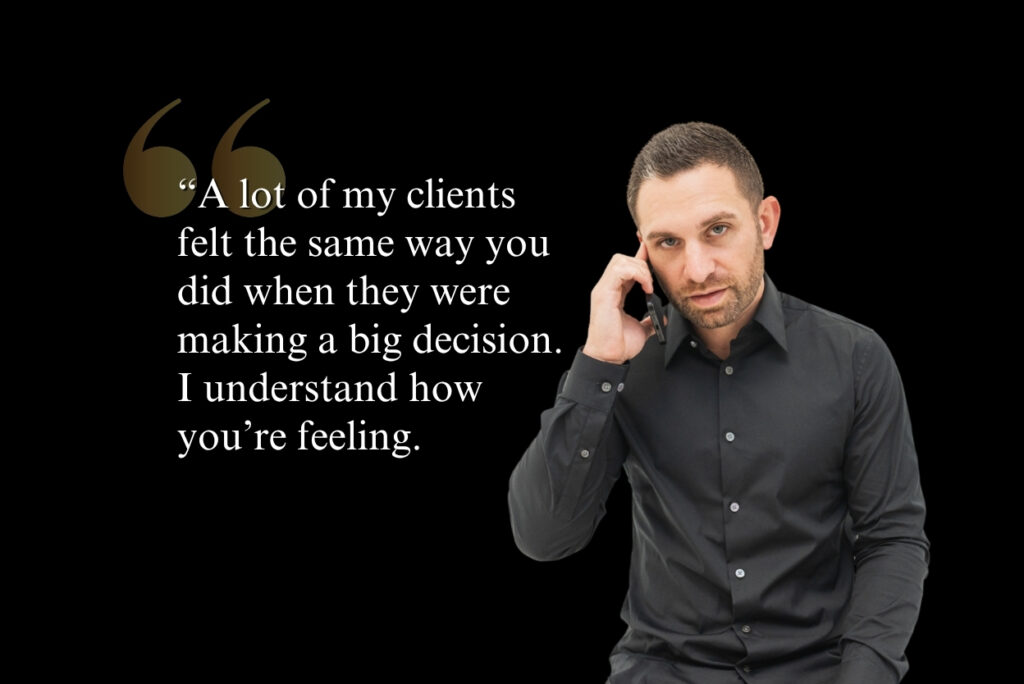
“A lot of my clients felt the same way you did when they were making a big decision. I understand how you’re feeling.
“What they found was taking a little bit of time to make sure this is the right move, really thinking through why you’re doing this in the first place, is going to give you clarity on whether you want to move ahead or not.
“So remember when we toured this home, you told me you liked [this] and [this] and [that] because it worked for your family. Has that changed at all?”
“If it has or it’s not the right move, let’s kill the deal now. Let’s walk away.”
Then stop talking.
Silence is where the decision starts to take shape. Let them think it through. Let them respond without interruption.
One of the worst things you can do in your conversations is talk over the silence. This is the part most agents struggle with: not knowing what to say in real time.

The Exact Script to Handle Buyer Cold Feet Conversations
Once you’ve acknowledged and normalized, you take control of the pace.
Ask for permission to guide the conversation.
“Can I walk you through this for 10 minutes so whatever you decide, you feel confident it’s the right decision for you?”
Wait for the yes. Don’t move forward without it.
Then rewind to what matters.
“Cool. Let’s rewind for a second. When we started, you told me the most important things were X, Y, and Z.
For this home, do we still have the location you wanted?
Are we still hitting the monthly payment?
Does the layout and lifestyle you wanted still match?
Has anything changed on these three items?”
Give them space to answer. Don’t rush to fill the silence.
If those answers are still aligned, bring clarity to what’s happening.
“So let’s figure out if this new concern actually changes the math or if it’s just noise.”
That new concern could be tied to anything from geopolitical uncertainty to the recent spike in mortgage rates. By now, you should have some clarity on what exactly is making them nervous.
And by saying, “Let’s figure this out…” line, you’re doing two things:
- You’re putting their concern in context so they can see more clearly how it could impact their decision.
- You’re letting them know they’re not in this alone.
Keep your tone calm. Keep your pace slow. Stay focused on the decision in front of them.
How to Separate Real Concerns From Emotional Noise
At this point, you need to get specific.
You’re not guessing what’s bothering them. You’re asking directly.
“Is your concern more about this particular house because we’re in the middle of a negotiation, or something we discovered about it?
“Or is this about buying a home at all right now because of [rates, recession, economy, whatever]?”
Let them answer. Don’t jump in to interpret it for them.
Once you know where the concern sits, it’s easier to see the next step.
If it’s tied to the house, walk them through their options.
“We can ask the seller for repairs, we can ask for a credit, or we can do a combination of both.
“If we get that done, does it take this from ‘I’m nervous’ to ‘I’m comfortable and prepared’?”
Then stop talking, and let them respond.
If it’s tied to the market or the economy, you zoom out and reframe the decision so they can see it clearly.
How to Handle Appraisal Gaps Without Losing the Deal
Appraisal gaps get emotional fast. The number feels big in the moment, even when it’s small in context.
Bring it back to scale.
“On the appraisal being $5,000 short in this price range, that’s about half a percent of the purchase price. Appraisers can be slightly high or low either way.
“The real question is, if another buyer paid this price, would you think they overpaid, or would you say that makes sense for this home and the area?”
Now you’re moving the conversation out of fear and into perspective.
Then bring it back to options.
“If we negotiate, split the difference, or do a rate buy-down, does it make this feel like a strong and fair deal for you?”
Let them answer. They’re buying the home and the life that comes with it.
Over time, a half percent has no real impact on how they feel about the home.
The A/B Close: How to Help Buyers Make a Confident Decision
Now you zoom out and simplify the decision.
“Let’s zoom out. You’re not choosing between safe versus risky. You’re choosing between option one, this home matches everything, or option two, walk away.”
Keep the focus on the two paths in front of them. Lay it out clearly so they can see what each decision looks like.
If they move forward:
- They secure a home that fits what they said they wanted
- They move ahead with a property that aligns with their goals
- They accept the known trade-offs that come with it
If they walk away:
- They step out of this deal and remove the current pressure
- They go back into the market and restart the search
- They take on a new set of unknowns with the next opportunity
Every option comes with trade-offs. Your role is to make those trade-offs visible so they can make a decision they’re comfortable with.
Then bring it back to the question that matters.
“There’s uncertainty on both paths. The question is, which uncertainty do you prefer?”
How to Stay Fiduciary and Let the Buyer Decide
This is where you reinforce your role.
You’re here to help them make a decision they can stand behind.
Say it clearly.
“Neither path is wrong. One is committing to this home with the trade-offs we already know. The other is choosing to wait for a different opportunity with its own unknowns.”
Give them space to process that.
Then bring in time.
“If you look back three to five years from now, which decision do you think you’ll respect more? Moving forward on a home that fits what you wanted, even though it felt uncomfortable at first, or passing on it and hoping something similar shows up later?”
Pause again.
You’re helping them think beyond the moment. You’re helping them see the decision from the other side of it.
Stay calm. Stay neutral. Let them work through it without interruption.
Fight for the Home or Reset the Search
Once they’ve had time to process everything, you bring it back to a clear decision.
“Whatever you decide, I’m in your corner based on everything you told me from day one. My professional opinion is this is a very strong fit for what you wanted.”
Give them your read. Keep it grounded in what they told you, not what you want.
Then walk them through both outcomes.
“If your gut says you still want this home and you’re just scared, my job is to help you stay in, negotiate hard for you, and protect you through closing so you can move in.”
“If your gut says this is not the right home anymore, my job is to help you get out cleanly and find the right one.”
Now you bring it to a decision.
“So knowing all that, do you want me to go fight for you on this home, or do you want me to cancel and reset the search?”
Then stop. Let them answer.
This Is Where You Earn the Deal
This is the moment that defines how you operate as an agent.
When buyers get cold feet, they’re looking for clarity. They need someone who can slow things down and walk them through it.
Handle this the right way, and you build trust that carries into the next conversation, whether they decide to move forward with the deal or walk away and keep looking.
Stay calm. Stick to the framework. Let them think.
Then let them decide.
This is one of those conversations you don’t want to wing.
You can read this once and try to remember it…or you can actually practice it until it becomes second nature.
Inside BAMx, we run weekly role play masterminds where agents practice these exact conversations live, with real feedback from billion-dollar producers.
Start your 7-day free trial and get the full scripts and access to the next session.