


Key Details:
- The Realtor.com® February Rental Report shows a decline in rent affordability in 26 major U.S. metros, despite a slight dip in rent prices.
- February 2023 marks the seventh consecutive month of single-digit rent increases for 0-2 bedroom units, and rent growth has accelerated for two-bedroom units for the first time after 12 months of slowing.
The Realtor.com® February Rental Report is in and, judging by the numbers, rent affordability is getting worse.
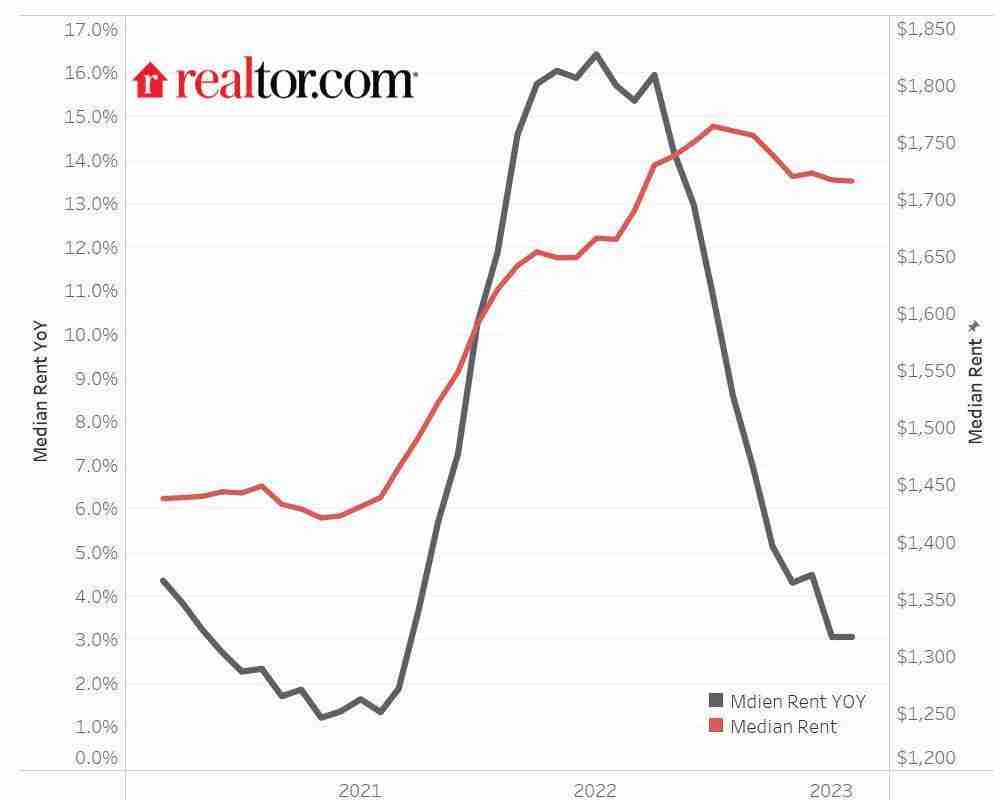
February marked the seventh consecutive month of single-digit rent increases for 0-2 bedroom units (3.1% year-over-year). And rent growth has accelerated for two-bedroom units for the first time after 13 months of slowing from January’s peak of 16.4%.
With many Americans spending more than they can afford each month on rent, it’s no wonder consumer sentiment on renting is heading downhill.
Here’s what you need to know.
Rent affordability is worsening despite small rent declines
According to the rental report, the median rent for 0-2 bedroom units in the 50 largest metros declined to $1,716, a $1 shave from the previous month and $48 below the peak.
Compared to February 2022, that median rent is up by only 3.1%, but it’s $296 (20.8%) higher than in February 2020 (pre-pandemic). Renters earning the typical household income spent 25.3% of it on rent—compared to 24.8% a year ago. And in 8 of the top 50 metros, typical renters spent more than 30% of their income on rent.

The general rule of thumb is that you shouldn’t spend more than 30% of your income on housing, but the data shows that in eight of the 50 largest metros, many renters are doing just that. Slowing rental price growth is a positive for renters, but it’s important to put this in context. This means that affordability is worsening at a slower pace in many markets; it’s not getting better.
Rent growth is accelerating for 2-bedroom units
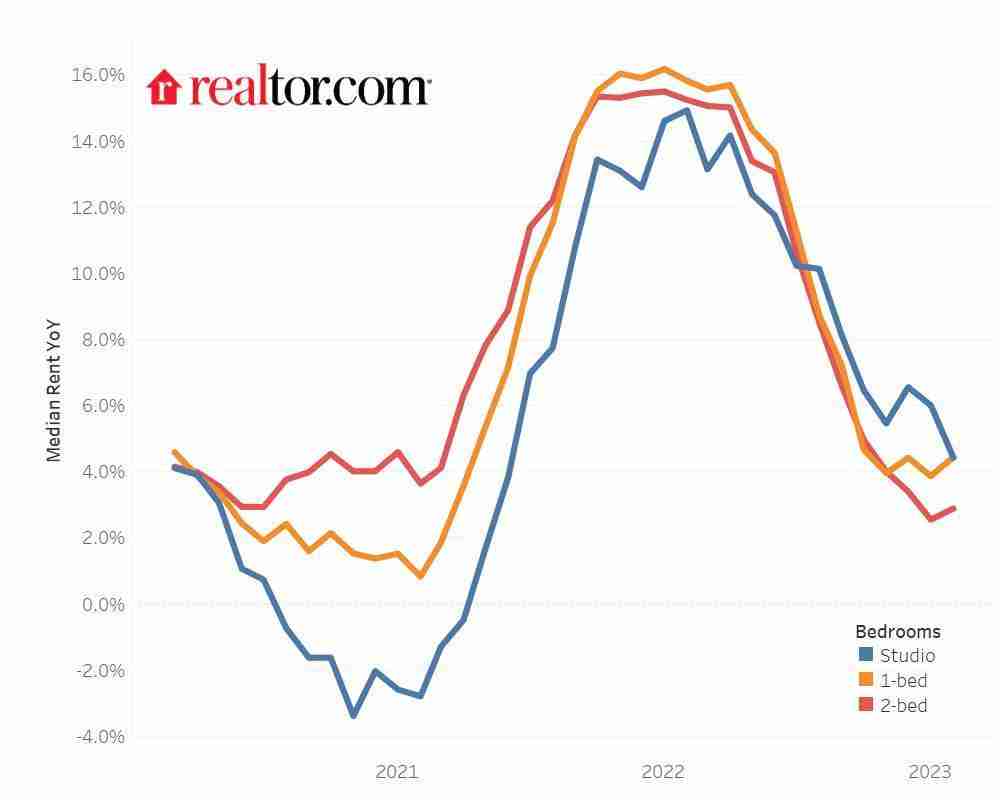
After a year of slowing, rent growth has picked up for two-bedroom units, though the rate of growth is still smaller than for studios and one-bedroom units.
Median rent by unit size:
- Studio: $1,463, up 4.4% ($62) year-over-year
- 1-bed: $1,621, up 4.4% ($69) year-over-year
- 2-bed: $1,890, up 2.9% ($53) year-over-year
The least affordable U.S. metros
Across the U.S., Americans are spending more than 30% of their salary on rent. In the least affordable metros, the median rent for a typical 0-2 bedroom unit cost more than 30% of the median household income.
With a median rent 1.4 times higher than the maximum affordable rent for the median household, Miami was the least affordable metro for renters in February 2023.
The eight least affordable rental markets in Feb. 2023:
- Miami-Fort Lauderdale-West Palm Beach, FL – $2,349 or 42.3% of income
- Los Angeles-Long Beach-Anaheim, CA – $2,864 or 39.2% of income
- New York-Newark-Jersey City, NY-NJ-PA – $2,895 or 37.5% of income
- San Diego-Carlsbad, CA – $2,844 or 36.6% of income
- Riverside-San Bernardino-Ontario, CA – $2,145 or 32.5% of income
- Boston-Cambridge-Newton, Mass.-NH – $2,829 or 32.0% of income
- Orlando-Kissimmee-Sanford, FL – $1,769 or 31.1% of income
- Tampa-St. Petersburg-Clearwater, FL – $1,691 or 31.1% of income
All eight of the above high-rent metros are situated along the coast, with Florida (three markets) and California (three markets) dominating the list.
Midwest markets offer relative rent affordability
Opposite those pricey coastal markets, the Midwest leads the way in rent affordability.
Oklahoma City ranked as the most affordable rental market in the February report, with residents paying a more manageable 17.4% of their household income on rent. The median rent for a typical 0-2 bedroom unit in Oklahoma City was 58% of the maximum affordable rent for the median household.
The top five most affordable rental markets (ranked by the share of income going to rent):
- Oklahoma, City, OK (17.4%)
- Columbus, OH (18.2%)
- Minneapolis, MN (19.0%)
- Cincinnati, OH (19.4%)
- Kansas City, MO (19.8%)

While these American Heartland markets still offer relative affordability, they are not immune to price hikes. As we saw in the January Rental Report, these markets are experiencing some of the fastest year-over-year price growth in the country. Before signing a lease, it’s important to take a good look at your monthly income and expenses and make sure that the payments won’t stretch your budget too much.
Top takeaways for real estate agents
Renters in your area are just as likely to benefit from your knowledge of current trends in housing costs and what they can do to minimize them, even if they’re not presently inclined (or able) to buy a home.
Do what you can to increase your awareness of their options. Any additional amount they can save in the short-term can contribute to an eventual down payment on a home.
Be the advocate they need now, so you can be the first agent they think of when they or someone they know is ready to transact.