

Key Details:
- A new report by StorageCafe shows housing inventory in exurbs has grown nationally by 15% over the past 10 years, surpassing suburbs at 14% and principal cities at 10%.
- Population growth in exurbs is also in the lead at 16%, followed by suburbs at 13% and principal cities at 9%.
- Millennials and Gen Z are driving demand for larger suburban and exurban homes in search of a lower cost of living, attractive surroundings, and a slower pace of life.
Millennials and Gen Z are leading other generations in their demand for suburban and exurban homes, according to a new report by StorageCafe.
Millennials are in the parenting stage, which makes larger homes and backyards more of a must-have. That stronger demand is contributing to a revival of suburban living.
Gen Zers, for their part, are drawn to exurbs for their lower cost of living and closer proximity to wide open spaces.
In this study, an exurb is broadly defined as an area with fewer than 250 residents per square mile in the first year of StorageCafe’s 10-year analysis.
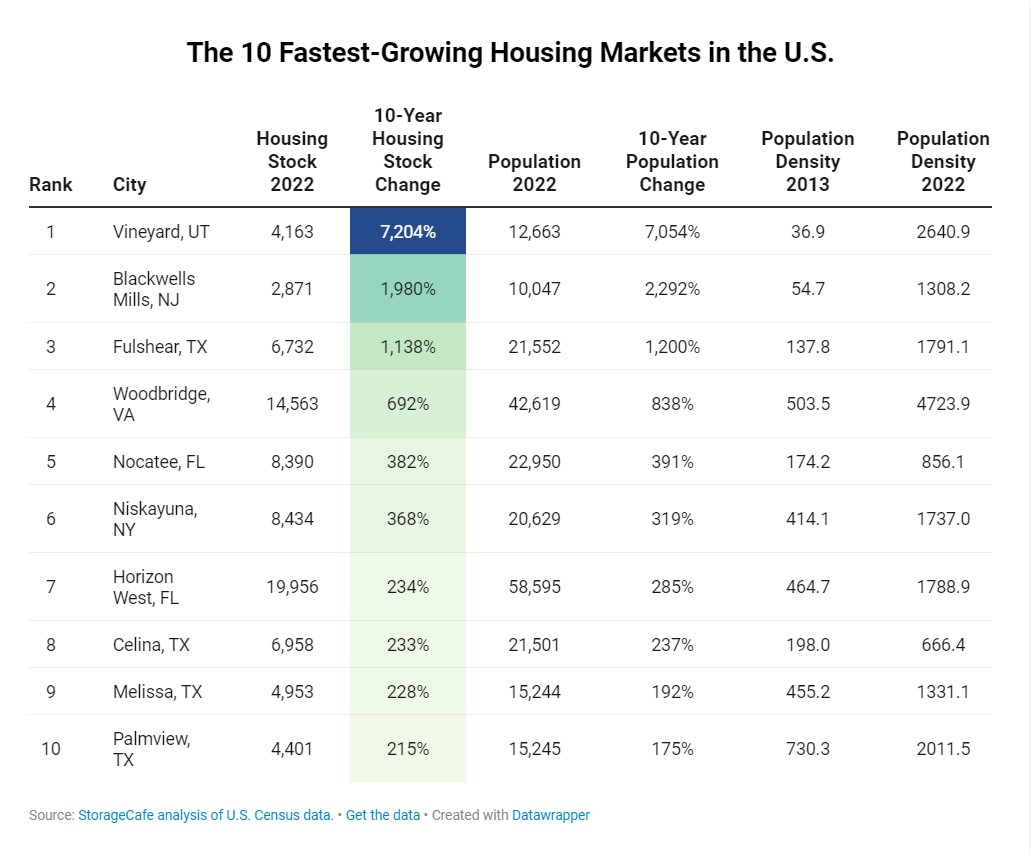
These smaller markets have experienced significant growth during that time. In fact, five of the top 10 markets with the fastest-growing housing inventories over the past decade were exurbs, which have now, thanks to their increased population density, graduated to suburban status.

In a landscape characterized by flexible work setups and the post-pandemic search for more space, suburban and exurban areas are growing faster than urban cores. High-growth suburbs are emerging in areas with natural scenery, especially appealing to remote workers and retirees, as well as in places with high-performing schools near medium or large metro areas with strong job markets, even when that means paying a premium on housing.
This suburban boom allows people to enjoy more living space and provides access to more diverse housing, but it also complicates efforts to bring employees back to urban offices. The full impact of this major migration shift remains to be seen, as suburban and exurban living continues to reshape residential and work environments.
Housing inventory and population growth across exurbs, suburbs, and cities
Over the past decade, housing inventory in exurbs has gone up 15%, surpassing suburbs at 14% and principal cities at 10%. Exurbs have also led in population growth at 16%, followed by suburbs at 13% and principal cities at 9%.

Why exurb and suburbs have grown in popularity
Remote work, which is here to stay (in its various forms), has reduced the need to live close to urban job centers, freeing remote workers to choose homes in areas with other compelling advantages:
- Lower cost of living—including housing costs
- Larger homes
- Bigger backyards
- Family-friendly walkable streets
- More trees and better access to wide open spaces
- Closer-knit communities
- Infrastructure improvements—like high speed internet access
- Newer, more modern homes with attractive amenities
- Proximity to urban hubs
Suburban and exurban life also tends to cost less than city life in major U.S. metros. The relative affordability of suburbs like Blackwells Mills, NJ, has drawn millennials and Gen Zers away from expensive urban areas as suburban home prices have increased more moderately.
As a result, Blackwells Mills has seen its population grow from under 1,000 in 2019 to over 10,000 in 2022 due to the pandemic-driven migration and homebuying boom. Housing inventory in this suburb increased nearly 20 times over the past 10 years.
Infrastructure improvements in suburban neighborhoods is another draw—like high-speed internet access in suburbs like Celina, TX, which make it extra-appealing for remote workers.
From 2013 to 2022, Celina’s housing inventory tripled, and its population grew by 237%. Other suburbans in the Dallas-Fort Worth–Arlington, TX, metro area, including Melissa and Prosper, also saw significant growth in their housing inventories and population density.
Suburban expansion in markets like Nocatee, FL, and Woodbridge, VA, comes with modern housing options for new residents, along with lifestyle amenities that appeal to both Millennials and Gen Zers—among them proximity to urban hubs and all they have to offer.
Housing inventory in Nocatee has grown from 1,800 units to nearly 8,400 in the past 10 years.
The shift among Millennials and Gen Zers toward suburban and exurban living reflects a deep desire for a more balanced lifestyle that combines work-from-home flexibility with greater access to nature and more community-oriented environments.
Texas and Florida lead other states in suburban growth
Seven of the 20 fastest-growing suburbs are in Texas, with Dallas suburbs highly favored for job opportunities, while Austin and Houston are known for their robust tech industries.
- Fulshear (#3)
- Celina (#8)
- Melissa (#9)
- Palmview (#10)
- Manor (#13)
- Prosper (#15)
- Fate (#18)
Five of the top 20 are in Florida:
- Nocatee (#5)
- Horizon West (#7)
- Silver Springs Shores (#11)
- Davenport (#12)
- Wildwood (#14)
Sitting at the top of the list is Vineyard, UT, which has seen explosive growth in both housing inventory and population, mainly due to the influx of young families and remote workers looking for spacious homes and community amenities.
Housing inventory in Vineyard has grown from 57 units in 2018 to 4,163 units in 2022. Population has gone up from 177 in 2013 to 12,663 in 2022, with a current population density of 2,641 people per square mile.
Horizon West, FL, has seen a 234% increase in housing inventory, largely due to its proximity to Disney World.
Growth stats for other suburbs in the top 20:
- In the Midwest: Whitestown, IN, went from 1,300 housing units in 2013 to 3,800 units in 2022. Amelia OH, had 2,000 housing units in 2013, which grew to nearly 5,300 in 2022.
- On the West Coast: Airway Heights, WA, saw its housing inventory grow from 1,200 units in 2013 to over 3,000 in 2022. The population here grew by 70% while the average household size went down from 5.2 to 3.5 people.
- Housing Growth in Midsize Cities: Frisco, TX, and Enterprise, NV, both saw housing inventory increases of roughly 70% over the past 10 years. Frisco went from 43,000 housing units in 2013 to nearly 74,000 today, with significant growth in multifamily units.
- Housing Growth in Large Cities: Austin, TX, experienced a 23% increase in housing inventory, largely due to its thriving tech scene. And Seattle, WA, even with home prices doubling to more than $880,000, saw 21% growth in housing units.
Read the full report for more information, including metro-level data and methodology.