In 2024, 22% of residential Realtors said they’d experienced a situation that made them fear for their personal safety or their personal information, according to NAR’s own Member Safety Residential Report.
September is REALTOR® Safety Month, a good time to look at what that number is hiding: the strangers agents let into their cars, the empty houses they walk through alone or with someone they’ve only talked to once over the phone.
We’re looking at what NAR’s data shows, what real incidents from the past two years reveal about the risks agents face, and how AI is helping shrink the gap between staying safe and staying in business.
What NAR’s Report Found
NAR‘s 2024 Member Safety Residential Report surveyed 1,423 residential members. Their responses highlight some of the safety risks in the life of a residential real estate agent.
Here’s what stood out:
- 22% of residential members experienced a situation in 2024 that made them fear for their personal safety or their personal information
- Members felt least safe during an open house (34%), after receiving a threatening or inappropriate message (31%), and during a showing (31%)
- 40% met a new or prospective client alone at a secluded location or property in the past 12 months, up from 35% in 2023
- 86% showed properties alone in 2024
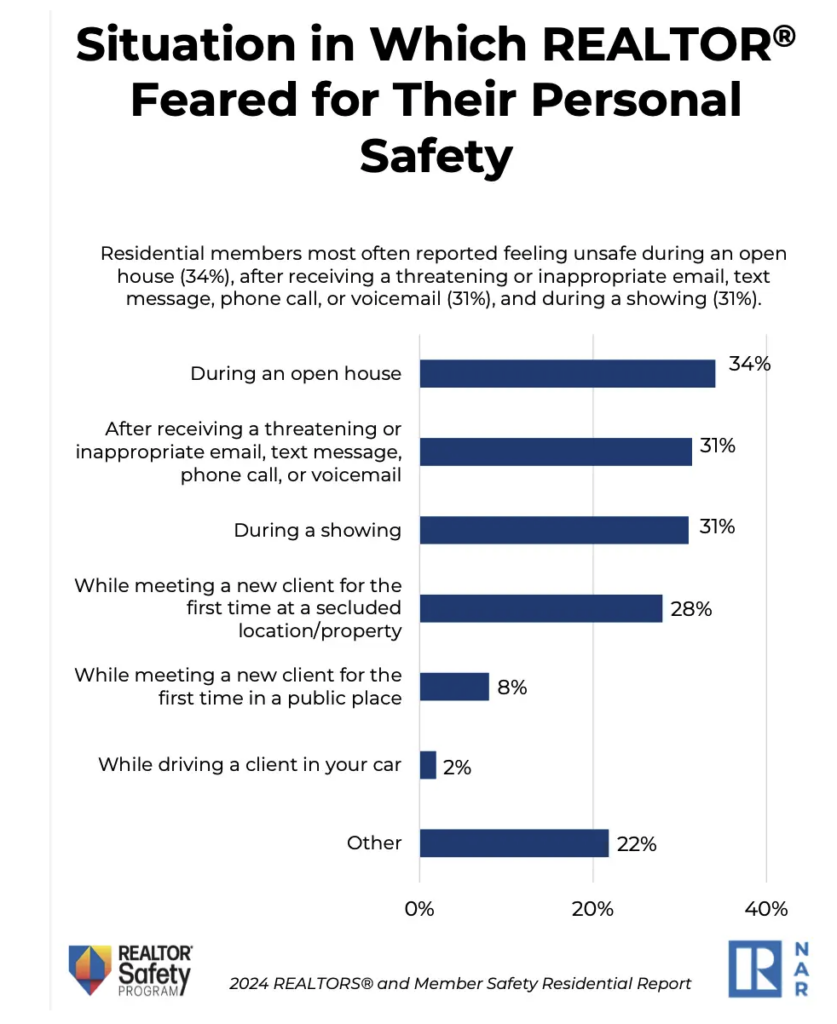
Source: NAR
NAR does have a REALTOR® Safety Program, but as of 2024, only 25% of members knew it existed, even though 79% of the members who did know about it found its resources helpful.
Nearly all (96%) of survey respondents said they hadn’t been the victim of a crime while working as a real estate professional, and most days end without incident.
Yet the exposure (and the risk) stays roughly the same from one showing to the next, which is why the fear keeps showing up in the numbers year after year.
The Physical Risk Agents Take on Every Showing
Two out of three residential REALTORS® are women. In 2024, they reported fearing for their safety at more than double the rate of men: 25% compared with 12%.
The following cases highlight the risks agents face just doing their jobs:
- Florida agent Sara Trost was shot and killed in 2021 while waiting outside a home to conduct a showing. Her case is still working through the courts, with her killer now arguing self-defense.
- A Kentucky agent was locked inside a home and threatened with violence in 2025 by a man trying to force a contract for a property he had no claim to. He escaped and drove himself to the sheriff’s office.
- In April 2026, a Surrey, BC agent named Xyrina Gutierrez was nearly trapped in a basement suite by a man posing as a wealthy prospective buyer. He fabricated a towing emergency to stop her from leaving before she got out safely.
Speaking of that last incident, the agent’s local real estate board later warned members after learning the same man had targeted more than 30 Realtors over 15 years.
Hindsight is great if you survive the lesson, but some agents haven’t. And too many have found themselves in situations that could have gone much worse. Which is why NAR and others in the industry have looked for solutions to prevent these situations from ever happening.
And a growing number of AI tools are helping.
How AI Could Help Close the Safety Gap
Niall Phelan is a Florida agent and the founder of Agent Buddi, an AI tool built to catch the moments where agents are most exposed.
He talked through the idea on NAR’s Change Agents podcast.
Phelan says the industry has forced agents to choose between staying safe and making a living, since caution costs time, and time costs commission.
He points to four moments in an agent’s day that carry the most risk:
- A new lead coming in with little to no vetting behind it, often through a website or a portal like Realtor.com
- Driving between showings while trying to answer client questions on a phone
- The showing itself, alone with someone the agent has just met
- An ongoing client relationship that starts to feel wrong, with the agent still showing homes because the commission is on the line
And because agents tend to underestimate that risk, Phelan said:
“Any time you turn up to a house with a client you haven’t spent significant time with, the level of risk involved in that is much higher than you probably anticipate.”
Agent Buddi tries to cover each of those moments with a mix of automation and live monitoring:
- Running a background check on new leads and flagging anything beyond a minor traffic offense
- Recording showings with the client’s consent and listening for signs of distress
- Prompting the agent for a PIN if it picks up signs of trouble, and alerting a response team connected to 911 if the PIN is entered wrong twice
Tools like this are new, and the industry doesn’t have hard, verified numbers yet on how many agents they’ve protected.
What Phelan describes is a genuine attempt to fix a blind spot that’s existed in real estate for years: agents alone in a stranger’s house with no one checking in until the showing ends.
NAR Safety Resources for Realtors
REALTOR® Safety Month is a reminder more than a solution on its own. NAR has resources built for this, and a few tools from other parts of the industry are worth pairing with them.
The REALTOR® Safety Network is where to start. Run by NAR, it can issue national alerts when a REALTOR® goes missing or faces a broad threat, and it takes reports for situations that don’t rise to that level.
For something more hands-on, NAR’s webinar “Staying Safe in Real Estate: Practical Strategies for 2025” walks through situational awareness, cybersecurity, fraud prevention, and personal protection techniques agents can use on their next showing.
On the lockbox side, SentriKey (the app behind SentriLock boxes many associations use) includes an automated check-in alert. Agents set a scheduled check-in for a solo showing, and if they miss it, the app notifies emergency contacts on its own. It’s a safety net built into a tool agents open several times a day.
NAR also runs Right Tools, Right Now, a rotating monthly list of vetted discounts and resources for members. The lineup changes every month and has included things like a free webinar on spotting AI-generated fraud, alongside discounts on business and branding tools that have nothing to do with safety directly.
Since it’s not a dedicated safety hub, think of it as a resource to check on now and then, not the first stop for safety information.
None of this replaces good judgment on a showing. It gives agents backup for the moments when judgment alone isn’t enough, which, as years past have shown, happens more than anyone wants to admit.