


Most listing presentations fall apart long before pricing ever comes up.
In fact, most fall apart in the first five minutes.
During one of the most popular BAM webinars ever, Sharran Srivatsaa and Andrew Undem broke down exactly how a high-converting listing appointment actually works. Not just what to say, but when to say it. Phase by phase. Line by line.
Because great listing agents don’t wing it, they move through a predictable sequence. And when that sequence is clear, the appointment feels different.
You walk in prepared. You guide the conversation. You walk out knowing you ran it well.
In this article, we’ll outline the 7 phases of a high-converting listing presentation so you can see the structure behind it.
But the full language, including all 27 lines you can actually use in your listing appointments, lives in the printable PDF.
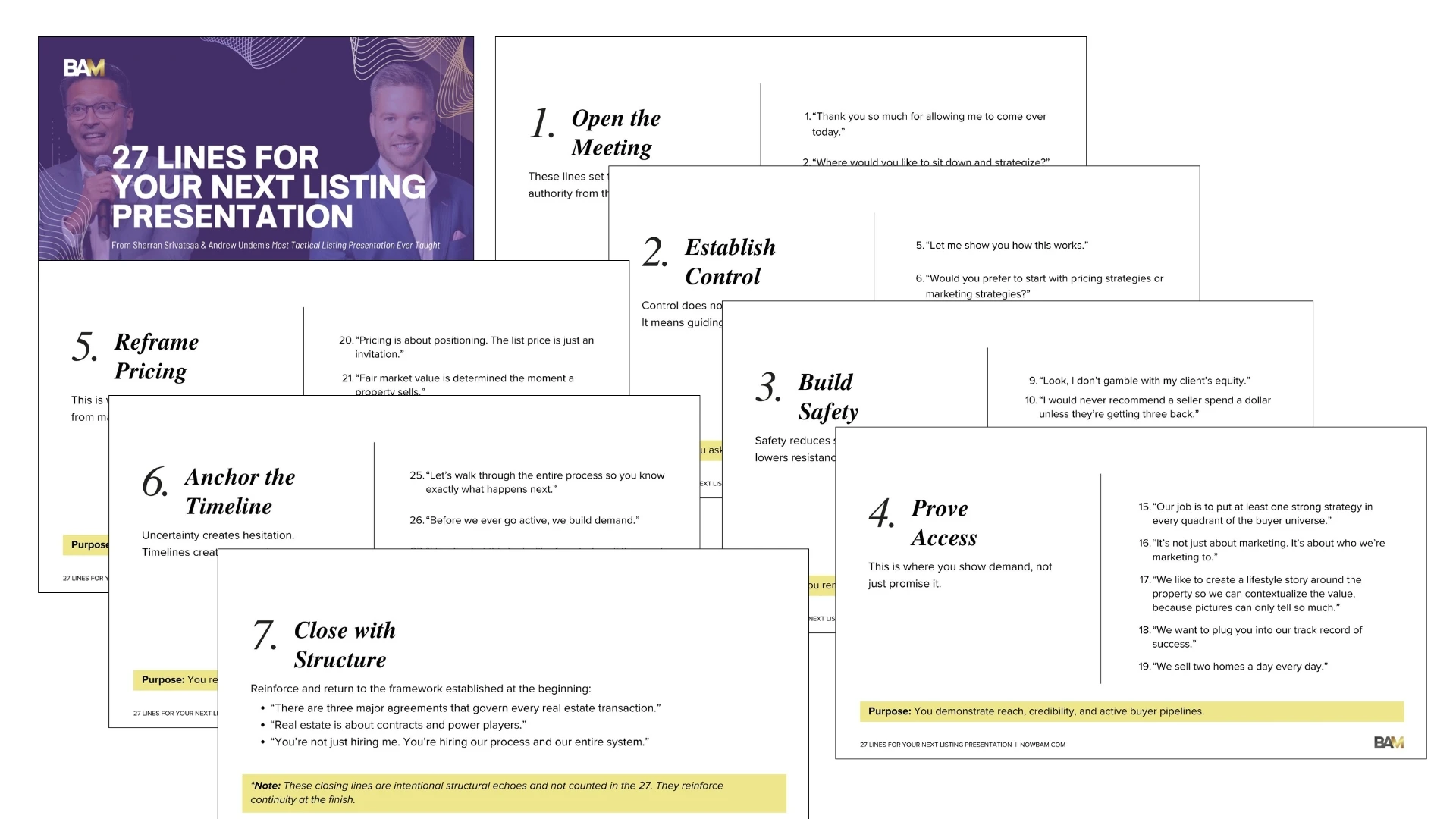
Download the printable PDF with all 27 lines▾
Because understanding the phases helps. Having the words in your back pocket is what changes how you show up when it counts.
Now, let’s start where every strong listing presentation begins: the first five minutes, when you either frame the room or spend the rest of the meeting trying to get it back.
Phase 1: Open the Meeting
The first five minutes decide who’s leading. And we’re not talking about your stats. Or your marketing plan. Or your opinion on…anything.
It’s your posture.
When you walk into a listing appointment, the seller is sizing you up immediately. Are you confident? Are you structured? Are you guiding this conversation, or reacting to it?
Even something as simple as “Where would you like to sit down and strategize?” subtly elevates the meeting from casual conversation to business planning session.
And when Andrew says, “Real estate is about contracts and power players,” he’s doing something even more important: reframing the entire appointment from opinion-sharing to decision-making.
After all, you’re not there to “see what they think.” You’re there to guide a transaction.
Open strong, and the rest of the meeting has a backbone. Because once the room is framed, the next objective is control.
Phase 2: Establish Control
Control means directing the conversation, not dominating it.
Most listing appointments drift when the agent reacts instead of leads. A seller raises a concern. The agent defends. The seller jumps ahead to commission. The agent backtracks. Suddenly, the meeting feels scattered. The air gets thick with tension. The seller checks their watch (again).
Andrew avoids that entirely. He uses questions and transitions that keep him in the driver’s seat without ever sounding forceful.
For example, “Would you prefer to start with pricing strategies or marketing strategies?” gives the seller choice, but within a controlled framework.
Either way, the conversation moves forward on his terms.
“What made you ask that just now?” slows the moment down and brings the discussion back to root concerns instead of surface objections.
Control like this keeps the appointment structured. It prevents tangents. It maintains momentum.
And once you’re guiding the flow instead of reacting to it, you can move into something sellers care about even more than control.
Safety.
Phase 3: Build Safety
Sellers are thinking about one thing above all else: avoiding a costly mistake.
Overpricing and chasing the market. Underpricing and leaving money on the table. Choosing the wrong agent. Missing the window. Looking foolish.
If you don’t address that fear directly, it shows up later as hesitation.
Andrew handles it early, using language that replaces uncertainty with protection and randomness with process.
When you say, “I don’t gamble with my clients’ equity,” you’re communicating standards. You’re positioning yourself as a fiduciary, not a promoter.
Saying “I would never recommend a seller spend a dollar unless they’re getting three back” reframes expenses as investments. It turns staging, prep, and marketing into ROI conversations.
When you say, “You’re not just hiring me. You’re hiring our entire system,” you’re reducing the risk of hiring one person. You’re offering infrastructure.
Safety is structured reassurance. Once a seller feels protected, the conversation changes. They’re no longer bracing (or checking their watch). They’re listening.
And when they’re listening, they want proof. Which brings us to phase four.
Phase 4: Prove Access
At this point in the appointment, the seller is asking one question: Can you actually get this done?
They want evidence. Showing them all the things you do for each client only works if you can also show that what you do actually works.
Marketing talk is easy. Real, numbers-backed production is harder. Access is what separates the two.
Andrew shows how demand is built and where buyers actually come from. He walks sellers through what he calls the buyer universe, making it clear that every category of potential buyer is accounted for.
One of Andrew’s lines, “We sell two homes a day every day,” anchors everything in production. It communicates experience without theatrics.
When you anchor everything in process, you shift the focus from effort to results.
Sellers want to know their home will be seen by the right people at the right time. Clear language around access answers that question.
Once access is established, the most sensitive part of the appointment comes into focus.
Pricing.
Phase 5: Reframe Pricing
This is where most listing appointments get uncomfortable.
Pricing carries emotion. Ego. Expectations. Financial pressure. If you treat it like a debate, it becomes one.
But, as Sharran has taught, when you approach pricing as positioning, it separates sales price from list price.
When you describe the list price as an invitation, you shift the focus from ego to strategy. When you outline multiple pricing approaches, you move from opinion to options.
When you ask whether upgrades were made for resale or livability, you ground the conversation in reality instead of assumptions. Pricing becomes a positioning discussion, not a tug-of-war.
Once that shift happens, the remaining obstacle is uncertainty about what happens next.
That’s where timeline control comes in.
Phase 6: Anchor the Timeline
Uncertainty slows decisions. Sellers can handle market shifts. They can handle negotiations. What creates hesitation is not knowing what happens next.
Andrew removes that hesitation by walking through the entire process in advance. He assigns dates. He outlines milestones. He makes the abstract concrete.
When you say, “Let’s walk through the entire process,” you signal leadership. When you explain that demand is built before going active, you demonstrate foresight.
Clarity builds confidence. And confidence accelerates decision-making.
With the timeline defined, the appointment has direction.
Now it’s time to formalize it.
Phase 7: Close with Structure
By the time you reach the close, the work has already been done.
You’ve framed the room.You’ve guided the conversation.You’ve built safety.You’ve proven access.You’ve positioned pricing.You’ve mapped the timeline.
The close is the continuation of that structure.
At this stage, Andrew returns to the same framework he established in the opening minutes. That repetition is intentional. It signals consistency. It reassures the seller that nothing about this process is improvised.
Here’s the language he circles back to:
- “There are three major agreements that govern every real estate transaction.”
- “Real estate is about contracts and power players.”
- “You’re not just hiring me. You’re hiring our process and our entire system.”
Notice what’s happening.
The contracts line reinforces that this has always been about structure. The power players line reminds the seller this is a professional transaction, not a casual conversation. The system line brings the focus back to process and execution.
Reusing these lines at the close shows the seller that the presentation hasn’t wandered off the grid. It reaches a natural close by following a deliberate path from beginning to end.
That consistency builds safety. The seller feels guided. The strategy feels tested.
And, by design, the outcome feels engineered rather than “lucky” or hoped for.
Which is why, when a listing presentation feels structured from start to finish (and especially when it follows a framework like this one), signing the agreement becomes the natural next step.
Download all 27 lines from Andrew Undem and Sharran Srivatsaa
If you’ve ever left a listing appointment replaying the conversation in your head, this framework changes that.
When you know the phases, you walk in with a plan.When you have the language, you guide the room.And when you guide the room, more of your appointments turn into signed clients.
We put all 27 lines from Andrew Undem and Sharran Srivatsaa’s listing presentation framework into a printable PDF so you can study them, practice them, and bring them into your next appointment. Grab them below: