

Key Details:
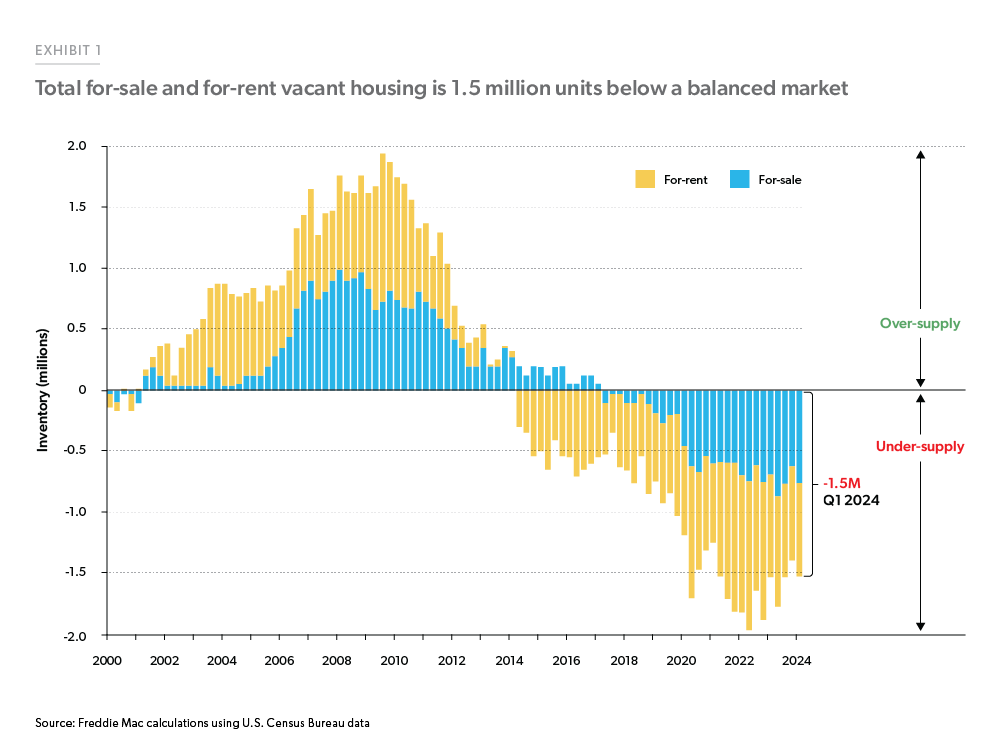
- According to Freddie Mac’s U.S. Economic, Housing, and Mortgage Outlook report for May 2024, U.S. housing supply is 1.5 million shy of the units needed to restore balance to the housing market.
- That figure includes both for-sale and for-rent housing units. Total vacancies still fall short of demand, but the shortfall of affordable housing units is more pressing.
Freddie Mac released its U.S. Economic, Housing, and Mortgage Outlook report on May 16th, right in the middle of the second quarter of 2024.
And its take on the housing shortage—specifically the number of housing units needed to bring balance back to the housing market—is about 5.5 million short of the number that’s been making the rounds.
Lance Lambert, founder of ResiClub, covered Freddie Mac’s take on the housing shortage in a recent article:
“The U.S. housing market is short at least 760,000 for-sale housing units and short another 760,000 for-rent housing units, according to Freddie Mac economists…That combines for a total shortage of at least 1.5 million units.”
Byron Lazine reviewed the numbers in yesterday’s Hot Sheet; watch it here for the full breakdown:
For-sale and for-rent housing is 1.5M shy of a balanced market
Total housing supply in Q1 2024 was at 146.4 million units—up 1.6 million from the same time last year. That figure represents an additional 1.4 million total occupied housing units and 0.2 million vacant units.
Compared to homeowners, renters made up a large share of that increase in occupied units:
- Renter-occupied units went up about 1 million over the last year, while the rental vacancy rate remained unchanged at 6.6% over Q1 2024.
- Owner-occupied units increased by around 0.6 million, while the homeowner vacancy rate fell from 0.9% in Q4 2023 to 0.8% in Q1 2024.
To bring both vacancy rates—rental and homeowner—back to historical averages, the U.S. would need to add 1.5 million vacant for-sale and for-rent housing units.
Without that, markets for both for-sale and for-rent housing will remain under pressure.
Another caveat: the vacant housing undersupply metric does not account for latent housing demand or the fact that not all vacant housing units are for sale or for rent. So, the figure for vacant housing undersupply almost certainly underestimates the total housing shortage.
Overall, Freddie expects tight inventory and higher-for-longer mortgage rates to continue working against home sales volumes as high housing costs price out many prospective buyers, while would-be sellers locked into rates of 5% or lower have less incentive to move.