
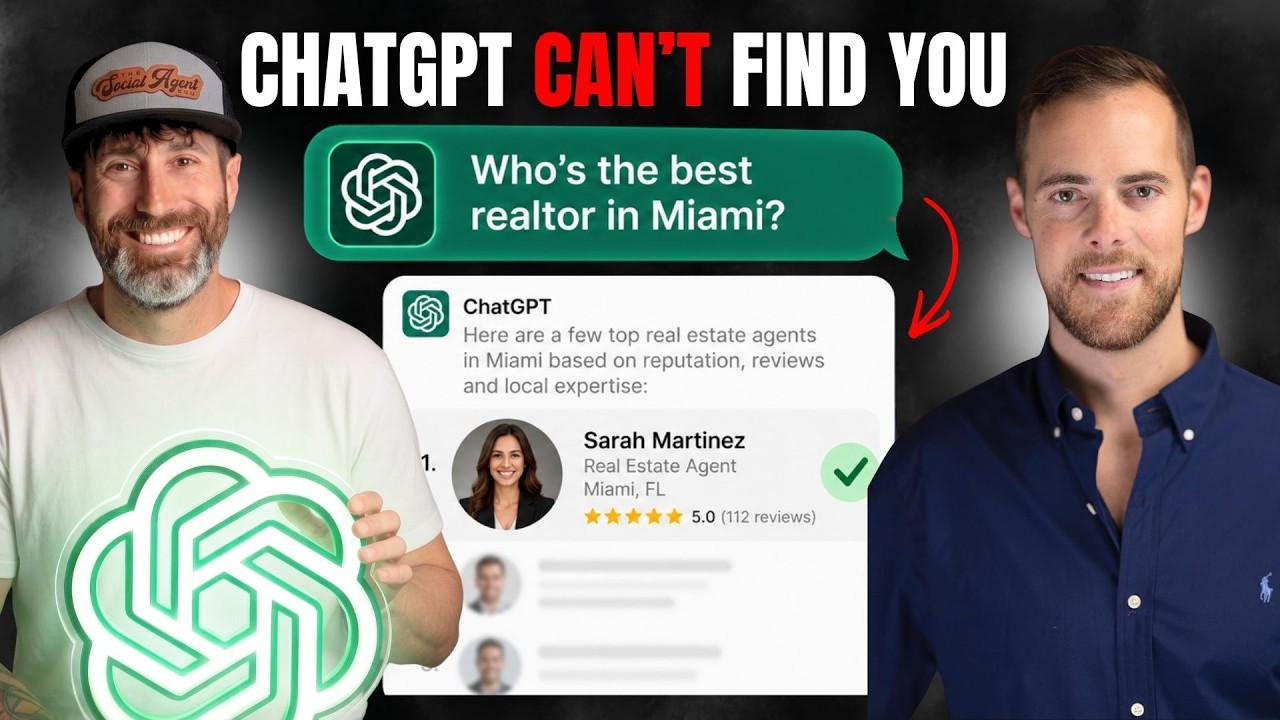
Type “best real estate agent in [Your City]” into ChatGPT right now, and it’ll give you a name. But most agents couldn’t tell you why that name and not theirs, let alone how to change that.
Last week, The Broke Agent sat down with real estate marketing coach Will Draper, who explained exactly how that name gets surfaced, what AI search tools look for, how they rank the options they can see, and what agents can do to get recommended.
As AI gets more and more advanced, the rules for getting recommended keep changing, which is why we talk to people who are continually testing AI to see what’s working now, what used to work but doesn’t anymore, and what agents are doing that almost guarantees invisibility.
Draper shared a five-part framework agents need for AI tools like ChatGPT, Claude, Perplexity, Gemini, etc., to recommend them when consumers are searching for the best agent nearby.
Those five pieces:
- Foundation
- Authority
- Relevance
- Proof
- Media
Get all five right, and your name starts turning up when a local buyer or seller asks AI who to call.
Read on for Draper’s playbook and the steps you can take to make it yours.
Foundation Starts With Fixing Your Profile Information
Before AI can recommend you, it needs a clear picture of who you are. It needs the same name and brokerage listed on every profile online, in the same market, across Zillow, Realtor.com, Homes.com, your brokerage website, and smaller directories like Birdeye or Fast Expert.
One thing to keep in mind if you change brokerages more than once over a career: old listings tend to stick around online long after you’ve moved on. Draper says that leftover information confuses AI models trying to build a picture of who you are today.
He recommends you build one positioning statement in three lengths, then use the same wording everywhere:
- One sentence, the elevator pitch version
- 750 characters, matching the character limit on a Google Business Profile, reused across every directory
- 1500 characters, the longer bio version for a website about page
The statement needs to name who you help. A line about buying or selling a dream home says nothing about that.
Draper puts the whole idea in one line:
“It’s not about tricks and hacks. It’s about reputation and clarity.”
Authority Comes From What Other Sources Say About You
Once your information is consistent, AI checks whether other sources back up what your profile claims. Your bio can say anything about your track record. Outside sources are what back that claim up.
Draper points to four kinds of sources that carry weight:
- Brokerage profile pages, the kind you get when you join a brokerage
- Major real estate directories like Zillow and Realtor.com, and what the reviews on them say
- Third-party publications and podcast mentions
- Press releases, with a catch explained below
Some agents pay for press releases claiming to be the best agent in a market when that isn’t true. That might work for a little while, but Draper expects that loophole to close within months.
“I guarantee you in six months that will not work anymore because that is paid media. Currently, Open AI does not distinguish between paid media and organic media, right? So, they don’t know this press release that says you’re the best means you’re actually the best.”
Relevance Is Built Through Scenario Specific Case Studies
Foundation and authority set up your profile. Relevance is what connects it to a real search.
Buyers and sellers don’t type “best agent in Charleston” into AI as often anymore. They type out their situation: two kids, a $700,000 budget, a move from New Jersey, a timeline tied to a job relocation.
AI breaks that kind of message into pieces. It picks out the keywords and runs several searches behind the scenes instead of one, trying to match the right specialist to the right scenario.
View this post on Instagram
Draper described the mechanics of how that works:
“It’s basically taking the sentence somebody types in, identifying all of the keywords in there, and running multiple queries based on all the different keywords and phrases it recognizes in there—and not just running one search, it’s running many, many, many searches across these different scenarios and trying to connect the dots between what is this person actually asking and who’s the best person to recommend to them and who can show relevance, who is accomplishing this same scenario.”
Here again, as with social media content, it pays off to get specific about the people you serve in the content associated with your brand.
Draper’s clients have already seen it play out in real deals:
- A Windermere, Florida agent generated an estimated $20 million in production from ChatGPT-driven leads in about two months
- One case study about a client relocating from the UK led to a $5 million listing appointment within two weeks
- A Houston agent got a listing appointment after ChatGPT quoted his Google Business Profile back to a prospect, word for word
Draper calls this clustering. Instead of writing a case study for every kind of buyer or seller, pick two or three real specialties and build case studies around those.
Proof Means Reviews With Real Context
AI pays attention to reviews too, and what a review says decides more than how many exist.
One agent started ranking first in ChatGPT for “discount agent” searches in her market. Her Realtor.com bio had one sentence about saving clients money on commission, backed by one matching review.
Draper explains what made the difference:
“It doesn’t care about the number of reviews. It cares about what’s actually in the review.”
Clients don’t want to write a detailed review the day they close on a home. Draper has started writing the review himself and sending it to the client to copy and paste, so specific details make it into the review rather than a generic five-star rating.
Media Should Amplify Your Positioning, Not Create It
Media comes last on Draper’s list for a reason. Its job is to support the positioning built through the other four steps.
AI can read the captions on a social post today. It doesn’t watch the video. Draper expects that to change as plugins for video analysis catch on.
Draper calls one approach the boring content strategy: plain, talking-head videos that answer real questions you get all the time, posted on a consistent schedule.
The numbers from two of his clients make the case:
- One agent’s boring content series contributed to a $68 million pipeline over several months
- A single two-minute, unedited video about a tax scenario generated eight appointments and an estimated $500,000 in business
Generic tips like “three ways to sell your home fast” don’t do much anymore. A specific scenario, tied to a real market and a real situation, is what gets picked up.
So, here’s the whole point of media in Draper’s words:
“Media should amplify your positioning. It shouldn’t be responsible for creating your positioning.”
Ask a Different Question
Draper says most agents ask the wrong question. Draper closes on the question he wants you asking instead:
“I think people should stop asking ‘How [do] I rank in ChatGPT?’ Okay, stop asking how do I rank in it? You want to ask what would ChatGPT need to know about me to actually recommend me?”
Foundation is the place to start, since the other four steps build on accurate, consistent information.
Pick one directory this week and rewrite the bio with a real positioning statement rather than a generic line about finding a dream home.
The other four steps get a lot easier once that’s in place.