
Let’s get real for a second: If you’re not showing up everywhere your clients spend their attention, you’re already falling behind.
As real estate agents and business owners, our job is simple: get in front of people, consistently and with value. That’s why marketing in all six frequencies of communication is no longer optional. It’s the standard.
So, today, I’m going to break down exactly what those frequencies are, how we use them on our team every single day, and how you can implement them in your business—without burning out or spending hours reinventing the wheel.
Let’s get into it.
The Six Frequencies of Communication
This strategy is something I learned from my good friend Luke Acree, President of ReminderMedia. It’s shaped how we think about marketing across our entire team.
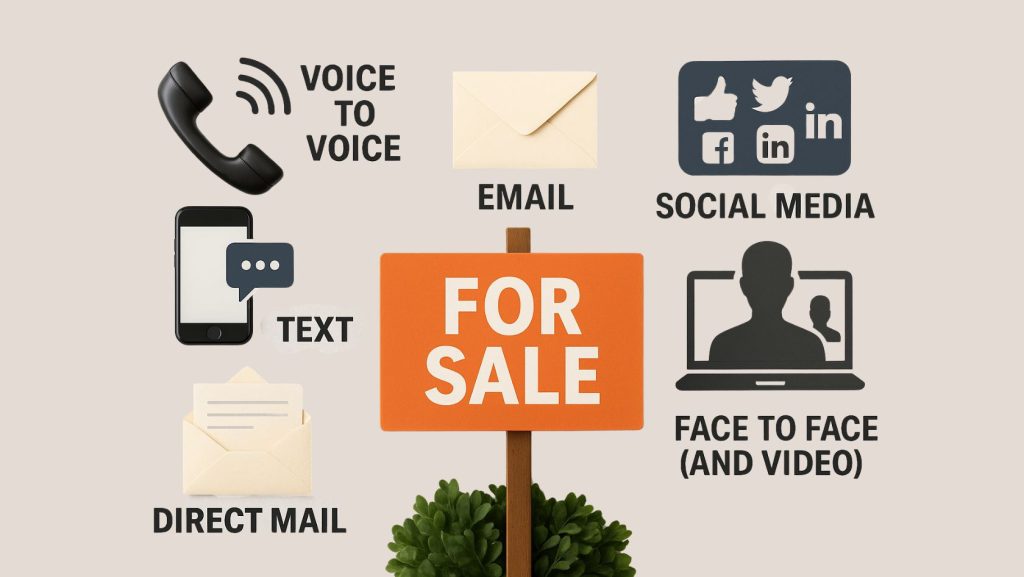
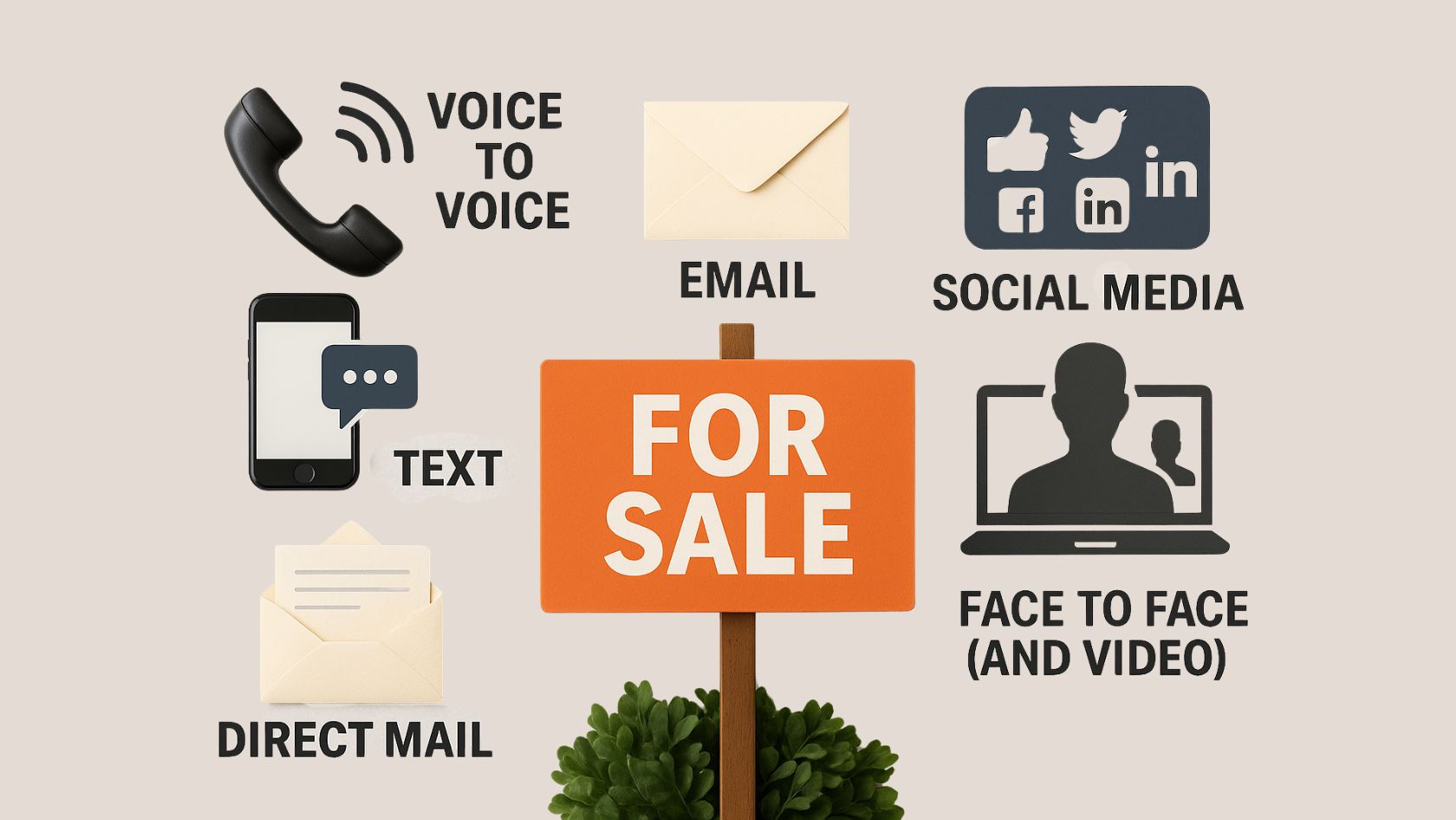
The six frequencies are:
- Voice to Voice
- Text
- Social Media
- Direct Mail
- Face to Face (and Video)
These channels cover how people consume information today. And if you’re not active in each one, you’re missing opportunities to build trust, stay top of mind, and create conversion.
Let’s break them down one by one.
1. Voice to Voice: Still the GOAT
Voice-to-voice communication is your number one tool for building real, human connections. And no surprise—it’s my favorite.
We run a two-pronged approach here:
- 25 Relationship-Based Calls Per Week: These aren’t “Hey, are you ready to buy/sell?” calls. They’re intentional check-ins—birthday wishes, home anniversaries, “just thinking about you” voicemails. Calls that deliver emotional value. That’s how you stay in the conversation without sounding like a pushy salesperson.
- 100 Prospecting Calls Per Day: This is where the rubber meets the road. These are your nurtures, your hot leads, your pipeline. I’m using a simple script based on market data—e.g., “Prices are up. Inventory’s up. Rates have settled. How does that impact your real estate plans?“—and working my CRM hard. Because I know if I hit my call numbers, I’ll hit my appointment goals.
Bottom line: Phone calls create conversations. Conversations create clients.
2. Text: Reaction Over Conversation
Texting isn’t a replacement for phone calls—it’s a supplement. A great text message creates a reaction, opens the door, and earns you a response. Then you follow up with a call to create a conversation.
On our team, we send a weekly time-sensitive text, templated inside Follow Up Boss. These go out after voicemails to contacts we missed or those we’re nurturing. Example:
“Hey, I tried you a couple times. Let me know how you’d like to move forward—would love to chat.”
Other solid options?
- “Did you see what mortgage rates did last week?”
- “Inventory just spiked—curious if you want a heads-up on any good deals?”
- “I know moving might not be a priority right now, but let me know if you want to stay in the loop.”
These messages are short, relevant, and deliver some sort of insight or value.
Pro tip: Use services like BAMx to pull prewritten templates that actually sound like you, not a robot.
3. Email: Consistency = Visibility
Email is far from dead—if you do it right. Here’s our cadence:
- Tuesdays: A weekly video email featuring our YouTube show, giving market updates, consumer education, and topical insights. We’ve sent this every week since 2016.
- Thursdays: A written email linking to a blog post hosted on our site, often provided by content partners like BAMx. Topics vary—what tariffs mean for new construction, changes in affordability, loan programs you should know, etc.
- As Needed: Conversion-minded emails that hit harder. These highlight things like, “Purchase applications just jumped,” or “Here’s what the Fed said this week.” We use charts, visuals, and simple AI prompts to generate the copy, then polish it up so it’s on-brand.
The result? Three distinct styles of email communication every single week: relationship-building, educational, and conversion-focused.
4. Social Media: Create Once, Distribute Everywhere
Social isn’t just a branding play. It’s another frequency. Here’s how we do it:
- Monday: Motivational video
- Tuesday: Clip from our AM radio show (value-based)
- Wednesday: Full Agent Hacks episode
- Thursday: Agent wins, tweet graphics, or quick value reels
- Friday: Another high-value radio clip
We know which platforms each piece will land on, and our marketing team handles the distribution. Not every post hits every channel, but the message stays consistent. This keeps us present across Instagram, YouTube, Facebook, and LinkedIn—without burning out.
If you don’t have a team yet, start simple. Batch content. Use editing tools like CapCut. And most importantly, post with purpose.
5. Direct Mail: The Forgotten Powerhouse
Direct mail works, especially for past clients and your sphere. We send 17 pieces a year, planned in advance and spaced out every three weeks.
Here’s what that includes:
- Quarterly staples: Market data, a Google Map of sales in their neighborhood, top local events per season
- Seasonal extras: Invitations to client events, updates on charitable drives like backpack fundraisers, and community involvement
We outsource distribution through companies like ReminderMedia. If you’re trying to do this manually, stop. Outsource it and keep it moving.
6. Face to Face (and Video): Your Highest Conversion Channel
In-person and video-based interactions are where conversions go up. Why? Because people trust who they know—and who they’ve seen.
Here’s what we do:
- Three to four client events per year: Santa photos, pumpkin patches, spring socials.
- Pop-bys: 2–4x per year—beer for the Super Bowl, carving kits for Halloween, pies for Thanksgiving. Tangible moments that stick.
And don’t sleep on video. Every appointment gets a personalized pre-appointment video. If we don’t sign the listing or buyer on the first meeting, they get a post appointment video too.
We also send regular video messages in email blasts and text. It’s still face-to-face—even if we’re not in the same room.
The Takeaway
Is this a lot? Absolutely.
But here’s the reality: Most agents aren’t doing half of this. If you’re the one showing up in all six frequencies, consistently and with value, you will dominate over time.
Don’t try to implement it all at once. Start with the easiest for you—then layer in the rest. Write out your plan. Batch your content. Use the tools. And most importantly—stay consistent.
Because this isn’t a short game. This is about staying relevant in the long term. And the agents who think long term? They win.