


Key Details:
- A new analysis from LendingTree, based on microdata from the U.S. Census Bureau 2022 American Community Survey, shows single women are still more likely to be homeowners than single men.
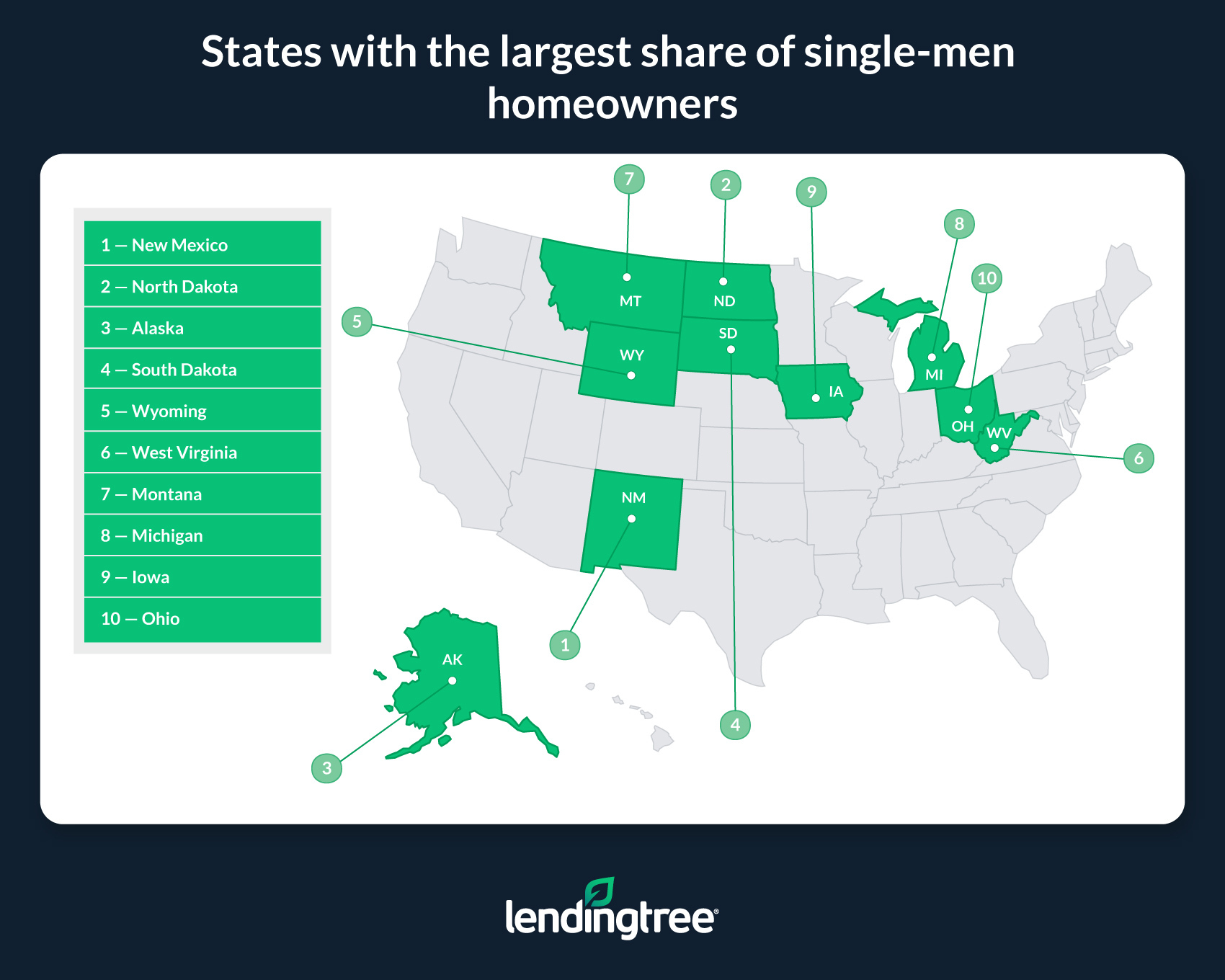
- States with the highest share of single-women homeowners are Delaware, Louisiana, and Mississippi, while states with the highest share of single-men homeowners are New Mexico, North Dakota, and Alaska.
- The homeownership gender gap in 2022 is wider than it was the year before.
A new LendingTree analysis shows single women are still more likely to be homeowners than single men.
According to the U.S. Bureau of Labor Statistics, a woman’s median weekly earnings are still, on average, only 83% of men’s. But while that suggests men are generally more well-off financially than women in the U.S., in one area, single women are coming out ahead.
The latest LendingTree analysis of U.S. Census Bureau 2022 data shows a higher rate of homeownership among single women living by themselves compared to single men living by themselves in 47 of 50 states.
Single women in the U.S. own 10.95 million homes—2.71 million more than the 8.24 million homes owned by single men.
Another way to put it, single women own an average of 12.93% of owner-occupied U.S. homes, compared to 10.22% owned by single men.
The same analysis also shows a widening homeownership gap between single women and single men compared to the previous year (2021). Single women across the U.S. owned 10.76 million homes in 2021—2.64 million more than the 8.12 million owned by single men.
That 2.64 million difference is slightly lower than the 2.71 million gap in 2022.
States with the highest shares of single-women homeowners
States with the largest shares of homes owned and occupied by single women:
- Delaware—15.34% owned and occupied by single women, compared to 9.45% by single men, for a gap of 5.89 percentage points (ppts).
- Louisiana—15.19%, compared to 10.71% for single men, for a gap of 4.48 ppts.
- Mississippi—14.84%, compared to 10.85%, for a gap of 3.99 ppts.

States with the highest shares of single-men homeowners
Alaska, North Dakota, and South Dakota are the only states where single men own and occupy a larger share of homes than single women.
States with the highest shares of homes owned and occupied by single men:
- New Mexico—14.49% of households owned and occupied by single women, compared to 12.85% by single men, for a gap of 1.64 percentage points (ppts).
- North Dakota—10.66% owned and occupied by single women, compared to 12.74% by single men, for a gap of -2.08 ppts.
- Alaska—10.28% owned and occupied by single women, compared to 12.44% by single men, for a gap of -2.16 ppts.
In South Dakota, the homeownership gap between single women and single men is -0.68 ppts.
States with the widest gender gaps among single homeowners
Delaware, which has the largest share of homes owned and occupied by single women, also has the widest homeownership gap between single women and single men.
- Delaware—-5.89 percentage points (15.34% by single women vs 9.45% by single men)
- Maryland—5.21 ppts (14.01% by single women vs 8.80% by single men)
- Massachusetts—4.97 ppts (13.18% by single women vs 8.21% by single men)

Source: LendingTree
Factors contributing to a higher homeownership rate among single women
Here are some of the reasons why single women are more likely to own a home in most states:
- Single women are statistically more likely to make sacrifices to attain homeownership—though this is a general trend and not universally the case.
- Women generally live longer than men and are more likely to report being widowed. So, some who are now single homeowners could be living in homes they purchased with the spouse they outlived.
- Not all single women have median weekly incomes lower than those of single men.
In fact, data from the Pew Research Center show women under the age of 30 earn at least as much as men younger than 30 in 22 U.S. metro areas, including New York, Washington, D.C., and Los Angeles. In 107 metros, they earn 90% to 99% of what men under 30 earn.
Those comparable incomes, in combination with a stronger desire to own a home, could factor into the higher homeownership rates for single women.
That said, it’s worth pointing out that single women having a higher homeownership rate doesn’t mean they’re, on the whole, better off financially than single men.
And while some have suggested women are more likely to benefit disproportionately from life-changing events like divorce, the evidence doesn’t support that. Generally speaking, women are more likely than men to struggle financially after a divorce.
So, there’s still work to be done in this country (among others) to address economic imbalances among genders.
Read the full LendingTree report for more information, including methodology.