

Key Details:
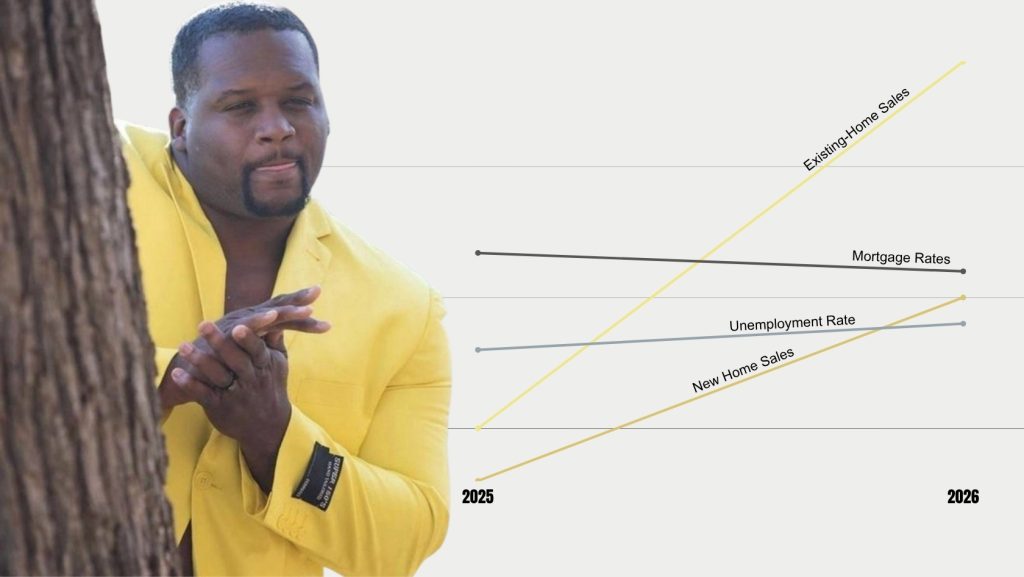
- NAR’s latest forecast projects a 14% jump in existing home sales for 2026 and a 4% increase in home prices, following an estimated 3% gain by the end of 2025.
- NAR also expects mortgage rates to ease to an average of 6% next year after holding near 6.7% in 2025.
- Rising mortgage applications, up 31% year over year, signal demand already building ahead of 2026.
2025 has been a grind for most of the industry. The market stagnation has been tough to navigate, but the latest data suggests a shift is finally happening.
According to the latest forecast from the National Association of REALTORS® (NAR), presented by Chief Economist Lawrence Yun at the recent NAR NXT conference in Houston, the housing sector is set for a major rebound.
After a year of flat activity, the data suggests steady job growth and stabilizing rates are setting the stage for a double-digit jump in activity next year.
Yun projects a 14% nationwide increase in existing home sales for 2026. This optimism comes from shifting economic fundamentals that are finally breaking in favor of housing.
Addressing the attendees at the Residential Economic Issues and Trends Forum, Yun provided a clear outlook for the coming year, saying, “Next year is really the year that we will see a measurable increase in sales.”
Read on for the highlights from NAR’s forecast.
Will Home Prices Drop in 2026?
Clients are constantly asking if prices are going to drop. Despite increased inventory in some sectors, the national outlook remains one of appreciation rather than depreciation. The forecast indicates that rising sales volume won’t come at the cost of price stability.
Yun was clear about the trajectory of home values.
“Home prices nationwide are in no danger of declining.”
Current projections show home prices climbing 4% in 2026, following an estimated 3% increase by the end of 2025. This continued growth is supported by persistent supply shortages and a resilient labor market.
New construction is also expected to contribute to this momentum, with new-home sales projected to rise 5% next year.
Where Are Mortgage Rates Headed Next Year?
Affordability is still the biggest obstacle for your buyers, but we’re starting to see some movement.
While the days of 3% interest rates aren’t likely to return due to inflation and federal borrowing factors, the trend line is moving in the right direction. After averaging roughly 6.7% throughout 2025, rates have already begun to drift downward.
Yun offered a realistic perspective on what to expect regarding financing costs.
“As we go into next year, the mortgage rate will be a little bit better. It’s not going to be a big decline, but it will be a modest decline that will improve affordability.”
The forecast calls for rates to average around 6% in 2026. Even this minor decrease could be the catalyst needed to unlock substantial buyer activity.
Current Market Momentum and Mortgage Applications
We aren’t just waiting for 2026 to see changes; the recovery is already starting to show up in the numbers. The recent end to the record-breaking 43-day government shutdown has removed a significant delay factor from the market, and buyer interest is surging.
Recent data from the Mortgage Bankers Association (MBA) signals that demand is waiting in the wings. Yun highlighted this upward trend as a key indicator of market health.
“Mortgage applications have been consistently above last year, implying that people’s desire to enter the market has been consistently positive.”
In fact, in the latest week reported, mortgage applications for home purchases surged 31% higher compared to one year ago.
The Changing Demographics of Home Buyers
Even with better numbers, this isn’t going to be an even playing field. The market is increasingly defined by a divide between those who already hold equity and those trying to break in.
NAR Deputy Chief Economist Jessica Lautz highlighted this disparity during the session.
“We have haves and have-nots. First-time home buyers are really struggling to get in, while those who have housing equity are building credit.”
This divide is evident in the plummeting market share of first-time buyers, which has dropped to an all-time low of 21%, well below the historical norm of 40%. Consequently, the median age of a first-time buyer has risen to 40, according to the results of NAR’s latest survey.
Meanwhile, the upper end of the market is thriving, with sales in the $750,000 to $1 million range seeing the largest gains.
Data-Backed Strategy for Price Reductions
With the seasonal slowdown here, getting the price right matters more than ever. Homes that linger on the market require aggressive adjustments to attract attention. Yun presented specific data on average price cuts based on how long a property has been listed.
“It requires some price reduction in order to move the home. Homes that sit on the market for long … will need to reduce the price to attract buyers.”
If you’re managing listings that are stagnating, consider these average reduction benchmarks based on days on market to guide your conversations with sellers.
- 0–14 days on market: 4.9% cut.
- 15–30 days on market: 6.1% cut.
- 31–60 days on market: 7.3% cut.
- 61–90 days on market: 9% cut.
- 91–120 days on market: 10.6% cut.
- Listings over 120 days: 13.8% cut.
That said, every property is different, and your job as a real estate professional is to help your clients choose a pricing strategy based on their goals and what your local data is telling you.
By understanding these data points, from rate projections to demographic shifts, you can better position your clients, particularly those looking to transact in the coming year, to take advantage of the incoming recovery.