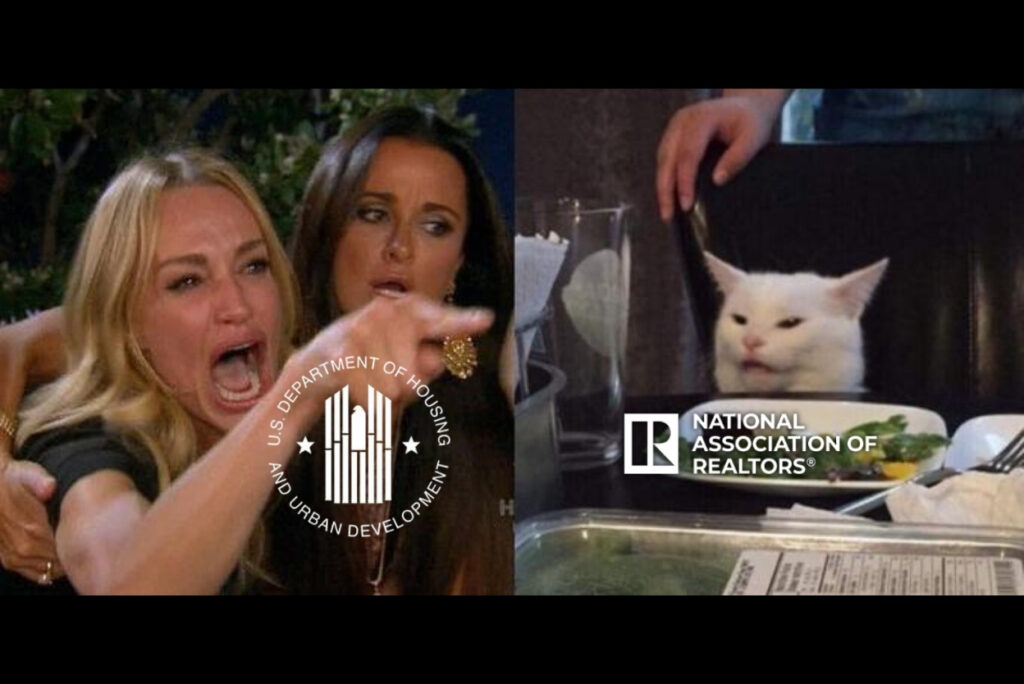


On April 24, 2026, the U.S. Department of Housing and Urban Development issued a “Dear Colleague” letter clarifying that sharing neighborhood crime rates and school quality information does not violate the Fair Housing Act, as long as it’s done consistently and without discriminatory intent.
HUD Secretary Scott Turner framed it as removing a barrier: “Americans should not be left in the dark about vital facts like neighborhood safety or school quality. HUD is making clear that real estate professionals can openly and lawfully provide this information in an equal and consistent manner to American families.”The letter also called out the National Association of Realtors (NAR), Realtor.com, Redfin, and Trulia directly, citing specific articles and decisions by name. NAR’s response agreed that consumers deserve access to the data, but reminded agents that how you discuss these topics still matters.
Here’s what you need to know, and what you should actually do.
What is HUD accusing NAR of?
HUD’s letter cites multiple NAR publications that it says gave agents the wrong idea about what they could legally discuss.
In 2020, NAR published an article stating the Fair Housing Act “prohibit[s] real estate professionals from discussing topics such as … quality of schools” and the “safety of neighborhoods.” The article has since been updated with the following Editor’s Note:
“This article has been edited since its original publication. It incorrectly stated that the Fair Housing Act and the REALTOR® Code of Ethics prohibit real estate agents from discussing crime data or school quality with prospective homebuyers.”
In 2023, another NAR article warned that agents could be “inadvertently steering clients in one direction over another” simply by answering buyer questions about local schools. That article also includes an Editor’s Note:
“This article is based on interviews with REALTORS®. For official NAR guidance, see Article 10 of the REALTOR® Code of Ethics, Real Estate Brokerage Essentials, the NAR Fair Housing Handbook, or the Real Estate Sales Pocket Guide.”
According to the letter, NAR’s recommended response when a buyer asks, “Is ABC Elementary a good school?” was to not answer, and instead direct the buyer to the school district’s website. As recently as April 2024, NAR published a podcast titled “Is This a Safe Neighborhood? Don’t Answer That.”
HUD calls this advice “misguided” and goes further than what the Fair Housing Act requires.
What happened with the listing platforms?
HUD also mentioned several platforms by name in its letter, noting that in late 2021, Realtor.com removed all crime data from its site, citing fair housing concerns. Redfin followed, citing racial bias concerns. Trulia removed its crime data a week after that.
HUD’s letter argues that removing crime data doesn’t help buyers make informed decisions, but instead prevents them from doing so. It frames all of these moves as overcorrections rather than legal requirements.
What does the law say about steering?
This is the part of the letter that matters most for your daily practice. It argues:
Steering requires intentional discrimination based on race. The Supreme Court defined racial steering as “directing prospective homebuyers interested in equivalent properties to different areas according to their race.” The key phrase is “according to their race,” not “according to crime data” or “according to school ratings.”
Treating all clients the same is not steering. HUD cites a Seventh Circuit ruling that makes this point directly: “A broker determined to ‘steer’ all customers, of whatever race, to a particular neighborhood is not guilty of racial steering, because he is not treating the races differently.” In other words, if you share the same school and crime data with every buyer regardless of their background, that’s equal treatment, not steering.
The Fair Housing Act has constitutional limits. HUD argues that if the Act made it illegal for agents to discuss schools or crime, “grave First Amendment concerns would arise.” The letter frames agent speech about nonracial neighborhood characteristics as constitutionally protected.
What does NAR say?
NAR’s response agrees that agents should be able to share objective, factual information about schools and crime. In fact, NAR says its guidance has encouraged this since the 1980s, citing the following sources:
- Passwords and Prejudice: A REALTORS Guide to Fair Housing Compliance (1988)
- Fair Housing for All VAMA Handbook (1992)
- Fair Housing Handbook: Shared Neighborhoods, Equal Opportunities, Fifth Edition (2010)
- The Real Estate Sales Pocket Guide (2016)
But NAR draws a sharp line between data and opinions. From their response: subjective commentary, personal opinions, or hearsay about schools or crime have been cited as evidence of discriminatory intent and intentional steering in fair housing lawsuits numerous times.
Pointing a buyer to GreatSchools.org ratings or the local police department’s crime map is one thing. Telling a buyer “you don’t want to live over there, the schools aren’t great” is something else entirely, and it’s the kind of statement that has landed agents in legal trouble.
Can agents talk about crime and schools or not?
Yes. Here’s how to do it right, based on both HUD’s letter and NAR’s guidance:
Share third-party, publicly available data. Point buyers to GreatSchools.org, Niche.com, local school district websites, the state department of education, and public crime mapping tools. These are objective, verifiable sources.
Be consistent. Share the same information with every client, regardless of background. HUD’s letter is clear: equal treatment is not steering. The legal risk comes from treating buyers differently based on protected characteristics.
Respond to direct questions with data, not opinions. When a buyer asks about a school, you can share ratings and test scores from a third-party source. When they ask about safety, you can point them to the local police department’s crime statistics. What you shouldn’t do is editorialize. “You don’t want to live over there” is a different statement than “here’s the crime data for that ZIP code.”
Don’t volunteer subjective assessments of neighborhoods. The distinction HUD draws is between sharing factual, nonracial data and making subjective statements that could reflect bias. “That area has gone downhill” or “this side of town has better schools” are the kinds of statements that have created legal exposure for agents.
Document your process. If you’re going to proactively share school and crime data (which HUD says you should), make it part of your standard buyer consultation. Show the same resources to everyone. Consistency is your best legal protection.
Here’s the play for agents
This letter doesn’t change the fundamentals. The Fair Housing Act still prohibits discrimination. What it does is give agents more confidence that sharing factual, consistent, third-party data is squarely within the law.
The smart move: treat school and crime data the way you treat comparable sales data. Use reliable sources, present it objectively, give the same information to every client, and let them make their own decisions.
If you don’t already have a standard practice for handling school and crime questions, build one now. Know your go-to data sources. Use them consistently. And if a client asks a question that feels like it’s pushing you toward subjective territory, redirect to the data.